Bennett’s laceweaver - Species Profile
Conservation • Description • Habitat • Ecology • Distribution • Taxonomy
Conservation Status
IUCN Red List
not listed
NatureServe
NNR - Unranked
Minnesota
not listed
Description
There are 35 currently recognized Callobius species worldwide, 25 of which are found in North America north of Mexico. Callobius bennetti (Bennett’s laceweaver) is the only one found in Minnesota.
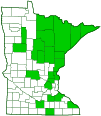
Bennett’s laceweaver is a common, small to medium-sized, hackledmesh weaver spider. It occurs in the United States from Maine to Maryland, west to Minnesota and Iowa, and south along the Appalachian Mountains to North Carolina. It occurs in southern Canada from Nova Scotia west to Manitoba.
Adults are active in the wild from March through October in northern climates like Minnesota, though they are active year-round within human structures. They are a ground-dwelling species and are typically found under stones, logs, sticks, and leaf litter. They are also frequently found in crawl spaces and damp unfinished basements.
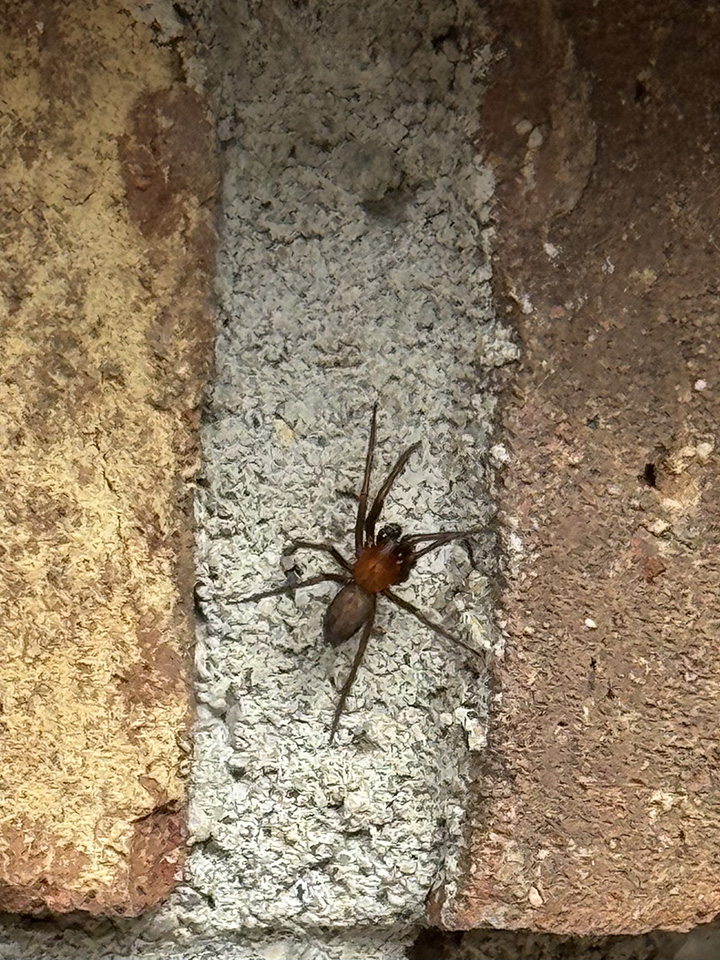
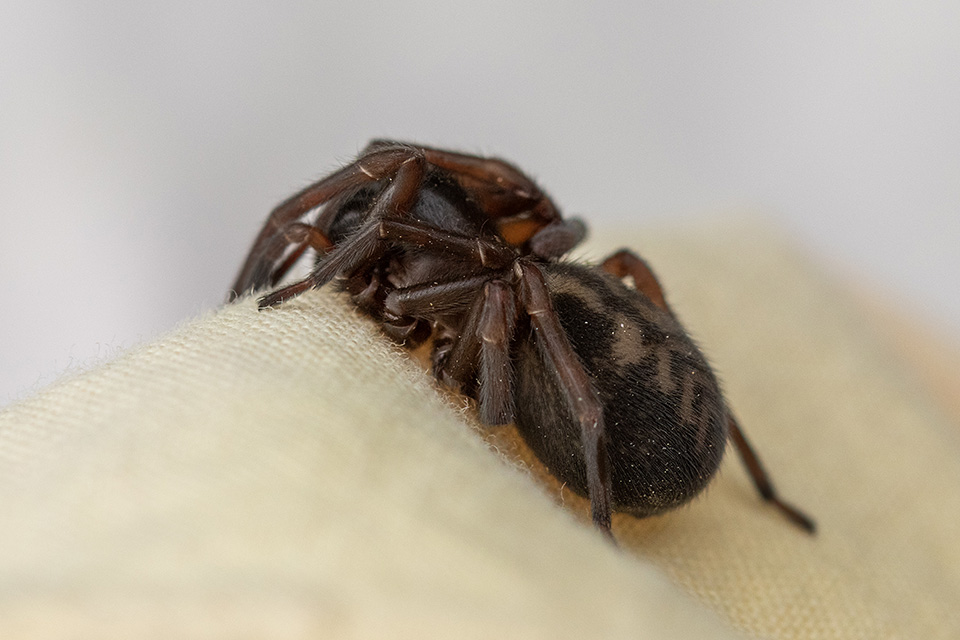
Females are 3⁄16″ to ½″ (5 to 12 mm) in length and have a ½″ to 11⁄16″ (12 to 18 mm) legspan. The body is robust. The color varies from light orangish brown to dark blackish brown (brown) with whitish (pale) markings of the same color.
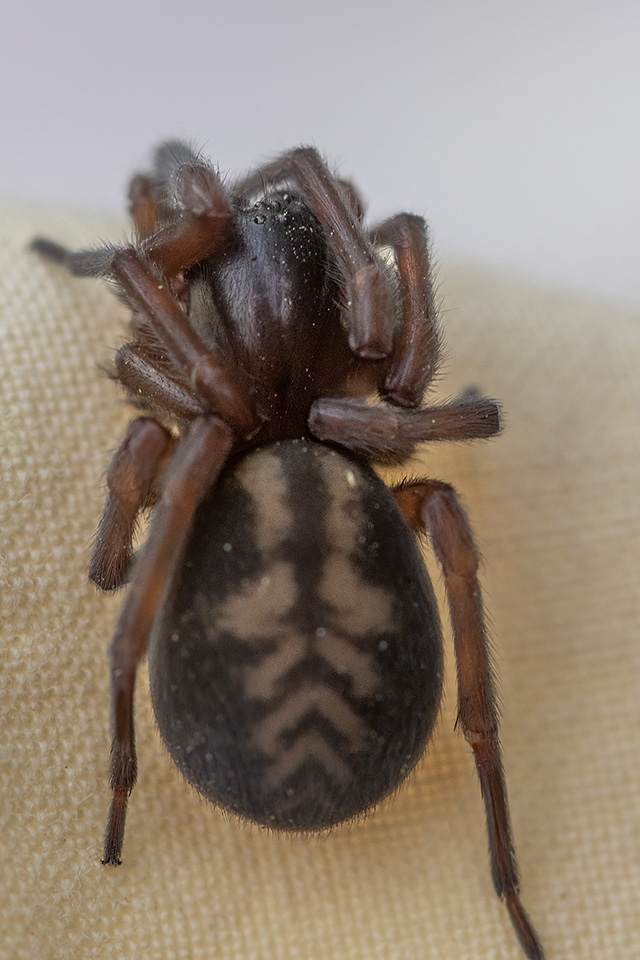
The front part of the body (cephalothorax) is brown and lacking in dark markings. The hardened plate (carapace) covering the thorax is 1.4 times longer than wide, almost as long as the abdomen. The head region is slightly narrowed and straight sided, and the thoracic region is broadly rounded, giving the carapace a distinct pear-shaped appearance. The longitudinal depression in the middle (dorsal groove) is short but distinct. The head region is low in front and highest halfway to the dorsal groove. The jaws (chelicerae) are dark reddish brown.
There are eight eyes in two rows of four. The front (anterior) row is straight and the rear (posterior) row is curved backwards, so that the anterior lateral eyes (ALE) and the posterior lateral eyes (PLE) nearly touch. The anterior median eyes (AME) are slightly larger than the posterior median eyes (PME). The ALE are larger than the AME.
The abdomen is oval and is rounded in the rear. It is brown with a pair of pale, submedian, longitudinal stripes on the front half, and a series of pale chevrons on the rear half.
The legs are brown, slightly paler than the carapace, and lacking in dark markings.
Males are smaller, 3⁄16″ to ⅜″ (5 to 9 mm) in length. The carapace is often covered in faint, smoky, net-like patterns or shadowy mottling. This pigmentation is frequently so dense that it makes the entire front half of the body appear almost uniformly dark. The AME and PME are about equal in size. The chelicerae are about the same color as the carapace. The abdomen is darker and the pale markings are distinct. The legs are significantly longer and have alternating light and dark rings.
Size
Female total length: 3⁄16″ to ½″ (5 to 12 mm)
Male total length: 3⁄16″ to ⅜″ (5 to 9 mm)
Legspan: ½″ to 11⁄16″ (12 to 18 mm)
Web
The web is a loose, irregular sheet or messy tangle of non-sticky silk built in the gaps and crevices under stones and sticks. This coarsely hackled silk has a fuzzy, woolly texture. On a molecular level, these extremely thin strands act like Velcro, snagging the hairs and appendages of prey.
Similar Species
Habitat
February to October
Ecology
Foraging
Web builder (Passive Hunter)
Prey
Small insects
Behavior
Life Cycle
Season
March through October
Distribution
Sources
Callobius bennetti (Blackwall, 1846) in GBIF Secretariat (2023). GBIF Backbone Taxonomy. Checklist dataset https://doi.org/10.15468/39omei accessed via GBIF.org. Accessed 5/14/2026.
Leech, R. (1972). A revision of the Nearctic Amaurobiidae (Arachnida: Araneida). Memoirs of the Entomological Society of Canada, 104(S84), 1–182. https://doi.org/10.4039/entm10484fv
Occurrence
Common
Taxonomy
Class
Order
Suborder
Araneomorphae (Typical Spiders)
Infraorder
Entelegynae
Zoosection
Rta clade (RTA Clade Spiders)
Zoosubsection
Marronoid (Meshweavers and Allies)
Family
Amaurobiidae (Hackledmesh Weavers)
Subfamily
Amaurobiinae
Genus
Callobius
Subordinate Taxa
Synonyms
Amaurobius bennetti
Amaurobius sylvestris
Common Names
Bennett’s hacklemesh weaver
Bennett’s laceweaver
hacklemesh weaver
hacklemesh weaver spider
night spider
tangled nest spider