cat-faced orbweaver - Species Profile
Conservation • Description • Habitat • Ecology • Distribution • Taxonomy

Conservation Status
IUCN Red List
not listed
NatureServe
NNR - Unranked
Minnesota
not listed
Description
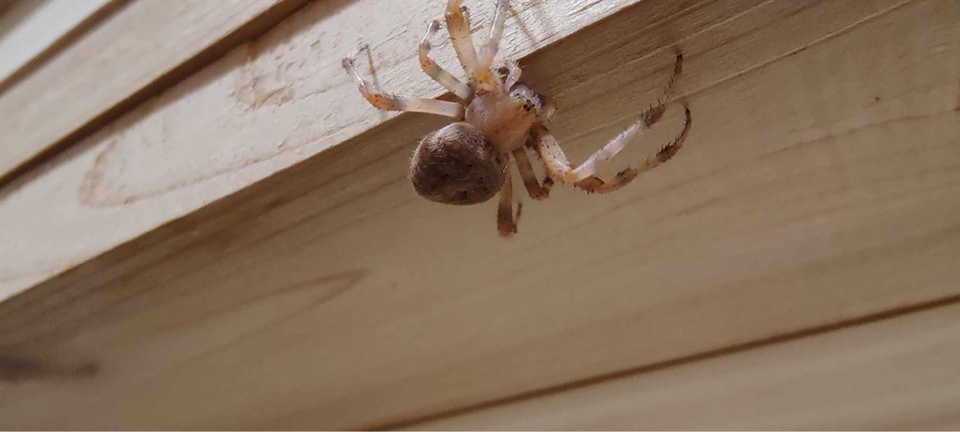
Cat-faced orbweaver is a common, medium-sized, sedentary spider. It occurs in the United States from Washington State to southern California, east to Wisconsin, Missouri, and New Mexico, and in southern Canada from British Columbia east to Manitoba. It is found in summer and fall under ledges, in barns and outbuildings, and on the eaves of houses. In the west it is also found in pine woodlands.
The female is ½″ to 1″ (13 to 25 mm) in length and has a ⅜″ to ¾″ (10 to 20 mm) legspan.
The front part of the body (cephalothorax) is much smaller than the abdomen. The upper side (carapace) is uniformly light brown and is covered with light brown or white hairs. There is a brown or dark brown longitudinal furrow in the middle, but this is often obscured by the lighter hairs. The underside is brown with a pale, longitudinal streak in the middle.
There are eight eyes arranged in two parallel rows of four eyes each. The rear row is curved forward, the front row is straight or slightly curved backward. All of the eyes are small, but the median eyes are larger than the lateral eyes.
The abdomen is large, oval, rounded, and highest in front. There is a low rounded hump on each side in the shoulder (humeral) area. The upper side is light gray to brown. On the front of the abdomen there is a white longitudinal stripe crossed by two V-shaped marks. This is said to resemble the face of a cat and is the feature that gives the spider its common name. These markings vary in intensity and are sometimes difficult to discern but are rarely completely absent. Apart from the “cat face”, the abdomen is unmarked. The base color varies from light grayish-brown to orangish brown and, in the far west, dark brown. Dark individuals have a leaf-shaped marking (folium) on the abdomen.
The legs are long, spiny, and yellowish-brown, with indistinct dark brown rings. The front two pairs project forward, the hind two pairs project backward. The last segment (tarsus) on each leg has three claws at the tip, though these are not visible to the naked eye.
The male is much smaller, 3⁄16″ to 5⁄16″ (5.4 to 7.9 mm) in length. The abdomen is elongated and much smaller.
Size
Female Body Length: ½″ to 1″ (13 to 25 mm)
Male Body Length: 3⁄16″ to 5⁄16″ (5.4 to 7.9 mm)
Legspan: ⅜″ to ¾″ (10 to 20 mm)
Web
The web is large and oval. It is called an “orb”, which gives this family of spiders its common name. It has about 20 radii, hangs vertically, and is usually oblong, much taller than wide. A retreat is constructed at one side of the web.
Similar Species
Habitat
Under ledges, in barns and outbuildings, on the eaves of houses, and in pine woodlands.
Ecology
Foraging
Web builder (Passive Hunter)
Prey
Behavior
Life Cycle
Eggs are laid in the fall, overwinter, and hatch in the spring. Hatchlings survive by eating their siblings. Mature adults are active in summer and fall.
Season
Summer and fall
Distribution

Sources
Biodiversity occurrence data published by: Minnesota Biodiversity Atlas (accessed through the Minnesota Biodiversity Atlas Portal, bellatlas.umn.edu. Accessed 8/22/2024).
Araneus gemmoides Chamberlin & Ivie, 1935 in GBIF Secretariat (2023). GBIF Backbone Taxonomy. Checklist dataset https://doi.org/10.15468/39omei accessed via GBIF.org. Accessed 8/22/2024.
Occurrence
Common
Taxonomy
Class
Order
Suborder
Araneomorphae (Typical Spiders)
Infraorder
Entelegynae
Superfamily
Araneoidea (Orbweavers and Allies)
Family
Subfamily
Araneinae (Typical Orbweavers)
Genus
Araneus (Angulate and Roundshouldered Orbweavers)
Species
This spider was originally classified as Araneus gemma. In 1888 McCook separated that species into three distinct species, A. gemma, A. gemmoides, and A. pirus. A. gemma is the western species and does not occur in Minnesota. A. gemmoides range overlaps the entire range of A. gemma and extends further east into Wisconsin. A. pirus is now considered a synonym of A. gemma. Where A. gemma and A. gemmoides both occur, interbreeding takes place freely and there is a complete intergradation of characteristics. Some females cannot be assigned to either species.
Subordinate Taxa
Synonyms
Araneus canmorus
Common Names
cat-faced orbweaver
catfaced spider
cat-faced spider
jewel spider
plains orbweaver