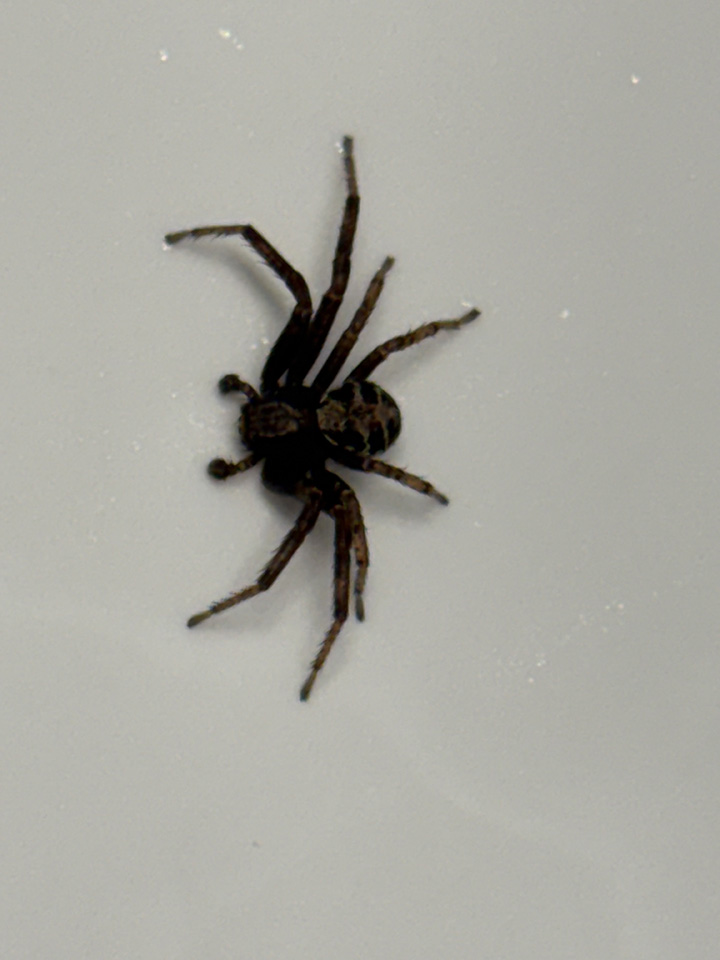
elegant crab spider - Species Profile
Conservation • Description • Habitat • Ecology • Distribution • Taxonomy

Conservation Status
IUCN Red List
not listed
NatureServe
NNR - Unranked
Minnesota
not listed
Description
Elegant crab spider is a common and widespread ground crab spider. It is medium sized for a spider, but it is one of the largest and most common spiders in the genus Xysticus. It occurs in the United States and southern Canada east of the Great Plains, with scattered records in the west.
Adults are active from April to September, peaking from May to July. They are found in leaf litter, under logs and stones, in cavities in dung, and occasionally on foliage near the ground.
Adult females are 5⁄16″ to ⅜″ (7.5 to 10 mm) in length. Males are much smaller, 3⁄16″ to ¼″ (5.5 to 7.0 mm) in length. The legspan is ½″ to 11⁄16″ (12 to 18 mm). The body is hard and crab-like in appearance. The coloration is variable. The background color is light brown or orangish brown (pale). The markings are mostly medium brown, orangish brown, or dark brown (dark).
The plate (carapace) covering the front part of the body (cephalothorax) is slightly longer than wide. When viewed from above, it is smoothly rounded on the sides. When viewed from the side it is highest near the front and drops down toward the back near the base of the third pair of legs. The rear of the carapace is overhung by the abdomen. On the male, the carapace is mostly dark, somewhat lighter and mottled in the middle. There is a narrow, whitish border on each side of the central pale area that join together in a point at the rear. On the female, the carapace is similar but mostly pale with a dark longitudinal stripe on each side. The central area is pale, not mottled. There is an indistinct, dark, narrow, longitudinal stripe in the middle. The whitish borders are broken and less distinct than on the male.
There are eight eyes arranged in two curved rows of four. The front (anterior) row is curved forward and the rear (posterior) row is curved backward. The lateral eyes are larger than the median eyes and are on low raised projections (tubercles). The anterior median eyes (AME) are closer to the anterior lateral eyes (ALE) than to each other. The posterior median eyes (PME) are closer to each other than to the posterior lateral eyes (PLE). The median ocular area (MOA), the area defined by the middle four eyes, is broader than long and slightly narrowed in front. The plate on the face above the mouth (clypeus) is armed with several long spines. The jaws (chelicerae) are small and have no teeth.
The abdomen is large, broadly oval, widest toward the rear, and flattened above. There are three pairs of large dark spots. They are separated in the middle by a broad pale stripe, and separated from each other by narrow, rearward-curved bands.
The legs are long, stout, and mostly pale with numerous dark dots and slightly larger spots. The first and second pairs of legs are the longest. They are strong, spiny, and nearly equal in length. They are normally held out and forward, crab-like. This is the feature that gives the family Thomisidae its common name. The third and fourth pairs are shorter and nearly equal in length. On the female, the legs are entirely pale, matching the carapace. On the male, the third segment (femur) is dark, matching the carapace. The last part of each leg (tarsus) has two claws at the end but these are not visible without magnification. The tarsi on all legs do not have a brush of hairs (scopula) on the underside, and there is no tuft of hairs (claw tuft) at the end on any leg.
Size
Female Body Length: 5⁄16″ to ⅜″ (7.5 to 10 mm)
Male Body Length: 3⁄16″ to ¼″ (5.5 to 7.0 mm)
Legspan: ½″ to 11⁄16″ (12 to 18 mm)
Web
Ground crab spiders do not produce webs.
Similar Species
Habitat
In leaf litter, under and logs and stones, in cavities in in dung, and occasionally on foliage near the ground
Ecology
Foraging
Ambush hunter (Sit-and-Wait)
Prey
Insects and other spiders
Behavior
Adults are slow moving, and they rely on ambush to capture their prey.
When the legs are held out to the side the spider is able to walk forward, backward, or sideways (laterigrade).
The female does not build webs, snares, or retreats. To protect its egg sac it will fold over the edge of a leaf and secure it with silk.
Life Cycle
Spiderlings in the next to last stage of development or younger overwinter.
Season
Peaking May to July
Distribution

Occurrence
Taxonomy
Class
Order
Suborder
Araneomorphae (Typical Spiders)
Infraorder
Entelegynae
Superfamily
Thomisoidea
Family
Thomisidae (Crab Spiders)
Subfamily
Thomisinae
Tribe
Coriarachnini
Genus
Subordinate Taxa
Synonyms
Common Names
elegant crab spider