forest wolf spider - Species Profile
Conservation • Description • Habitat • Ecology • Distribution • Taxonomy
Conservation Status
IUCN Red List
not listed
NatureServe
NNR - Unranked
Minnesota
not listed
Description
Forest wolf spider is a common, medium-sized, wolf spider. It occurs in the Unites States east of the Rocky Mountains. It is mostly absent from the deep south but there are a handful of records from Florida west to Texas. It occurs across southern Canada.
Adults are active from April through October. They are found in forests and meadows and at woodland edges, on the ground on fallen leaves and sticks.
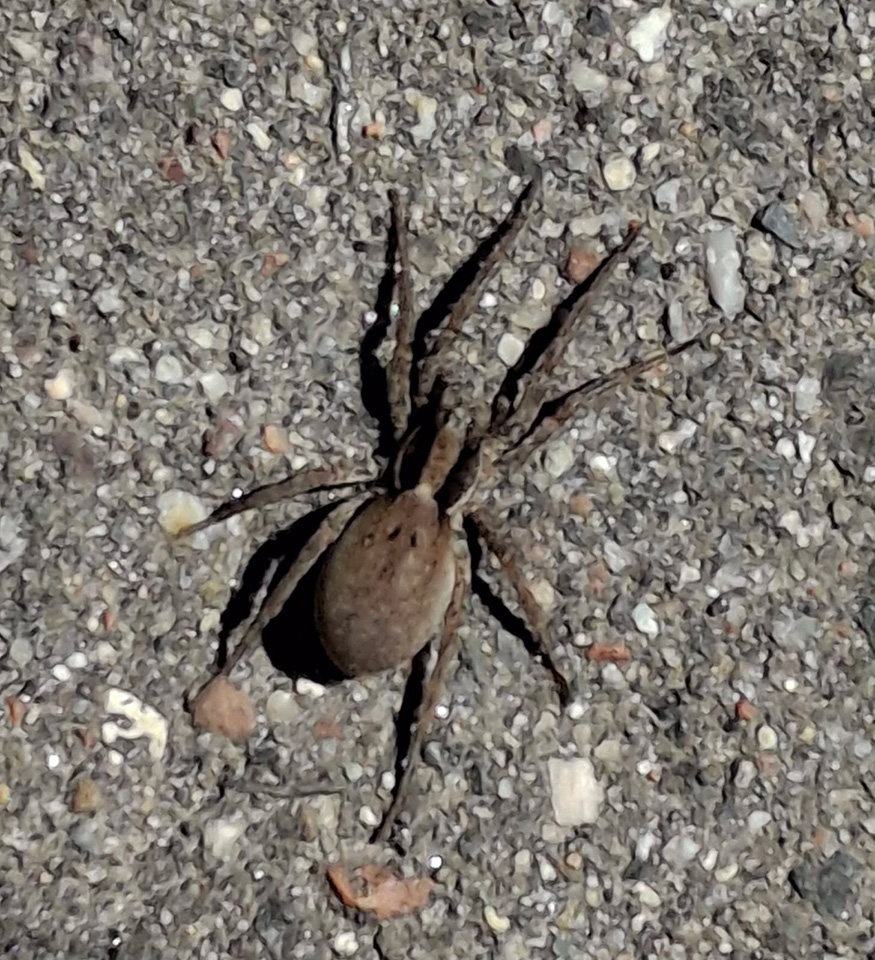
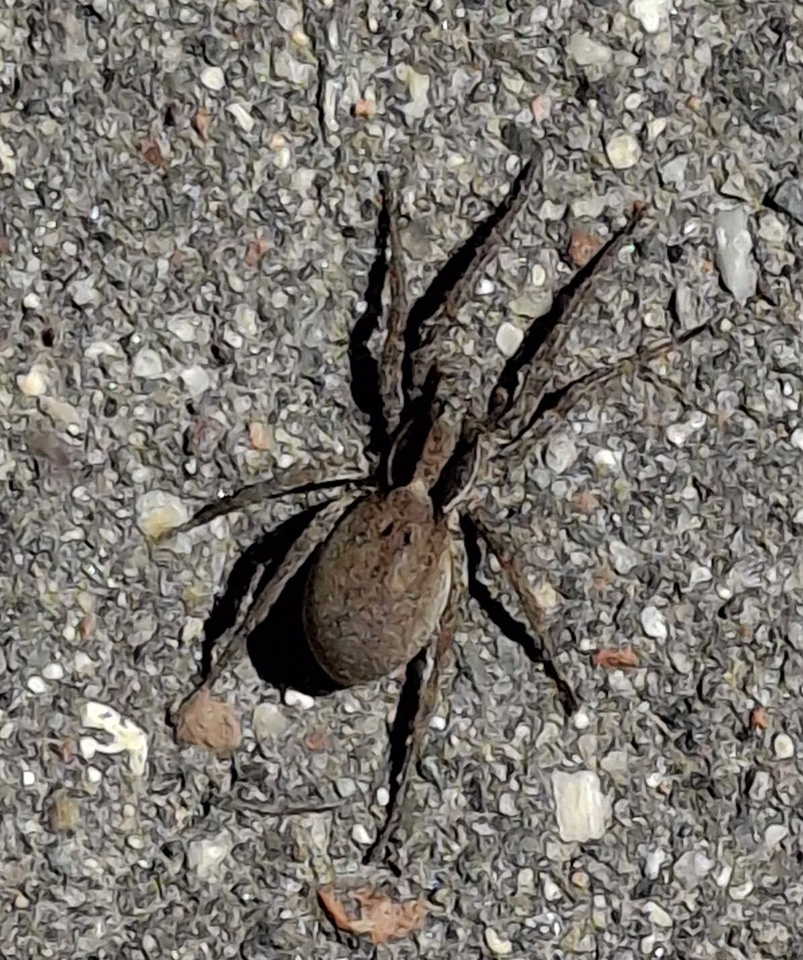
Females are 7⁄16″ to 9⁄16″ (11 to 14 mm) in length with a 1″ to 1⅜″ (25 to 35 mm) legspan. The body is light gray to light brown (pale) with dark brown or black (dark) markings, and it is densely covered with short pale hairs. The underside (sternum) is entirely dark reddish brown to black.
The front part of the body (cephalothorax) is longer than wide. The upper side (carapace) of the cephalothorax is concave in the rear and smoothly convex on the sides. There is a broad, pale, longitudinal stripe in the middle bordered by a broad dark stripe on each side, and there is a very narrow but distinct pale stripe on each lateral margin.
The eye region and the face are pale. There are eight eyes in two rows of four. The front (anterior) row has four small, equally spaced eyes, and it is slightly curved forward. The median eyes (AME) are larger than the lateral eyes (ALE). The rear (posterior) row has two very large posterior median eyes (PME) and two large posterior lateral eyes (PLE). The PLE are set well behind the PME, and some authors describe this arrangement as three rows of eyes. The rear row is about equal in width to the middle row. The PME are closer to the PLE than to each other. The PME and PLE have a layer of reflective tissue internally. This allows the spider to see in relative darkness. It also causes their eyes to shine when hit by the beam of a flashlight. The basal segments of the jaws (chelicerae) are large and powerful. They are black but they are densely covered with pale hairs, especially near the base, with more black hairs toward the tip. The front and rear margins each have three teeth.
The abdomen is egg-shaped. It is pale at the base with a pair of dark patches or short longitudinal stripes on each side, a continuation of the dark stripes on the carapace. There are a pair of small but distinct dark spots toward the front, and there is usually a series of dark chevrons at the rear.
The legs are long, stout, pale, and hairy. They are not ringed.
Males are smaller, ⅜″ to ½″ (9 to 12 mm) in length. The dark patches at the front corners of the abdomen continue as distinct stripes along each side of the abdomen. The stripes frequently break up into oblique lines and spots.
Size
Female total length: 7⁄16″ to 9⁄16″ (11 to 14 mm)
Male total length: ⅜″ to ½″ (9 to 12 mm)
Legspan: 1″ to 1⅜″ (25 to 35 mm)
Web
No web and no retreat
Similar Species
Habitat
Forests, meadows, and woodland edges
Ecology
Foraging
Active hunter (Cursorial Hunter)
Ambush hunter (Sit-and-Wait)
Foraging behavior within the Lycosidae family functions as an energetic trade-off determined largely by body mass and microhabitat choice. Smaller, lighter species are typically active hunters, employing a “stop-and-go” cursorial style to continuously search leaf litter for prey. Larger, heavy-bodied species primarily operate as ambush hunters from fixed burrows or retreats. For these larger spiders, continuous roaming consumes prohibitive amounts of energy and increases exposure to predators like birds and pompilid wasps.
As a medium-to-large species, Hogna frondicola demonstrates behavioral plasticity. It does not construct a permanent burrow or silk retreat; instead, it operates as an ambush hunter, tucking into leaf litter or under bark and remaining perfectly motionless to surprise passing prey. However, it readily transitions to an active hunter style when wandering to track scarce prey or to locate mates.
Prey
Behavior
Unlike most wolf spiders, forest wolf spiders hunt during the day.
Life Cycle
Adults overwinter. They may live up to two years.
Season
April through October
Distribution
Sources
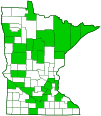
Biodiversity occurrence data published by: Minnesota Biodiversity Atlas (accessed through the Minnesota Biodiversity Atlas Portal, bellatlas.umn.edu. Accessed 5/20/2026).
Hogna frondicola (Emerton, 1885) in GBIF Secretariat (2023). GBIF Backbone Taxonomy. Checklist dataset https://doi.org/10.15468/39omei accessed via GBIF.org. Accessed 5/20/2026.
Occurrence
Common and widespread
Taxonomy
Class
Order
Suborder
Araneomorphae (Typical Spiders)
Infraorder
Entelegynae
Zoosection
Rta clade (RTA Clade Spiders)
Zoosubsection
Oval calamistrum clade (Oval Calamistrum Clade Spiders)
Superfamily
Lycosoidea (Wolf Spiders and Allies)
Family
Subfamily
Lycosinae
Genus
Hogna
Genus
This species was formerly placed in the genus Lycosa, which contained more than 50 North American species along with many European, Asian, and South American species. All New World species have recently been moved to new genera. The genus Hogna was re-evaluated and established for many New World species based on distinct features of the copulatory organs, its significantly large body size, and characteristic dark dorsal patterning, including a prominent median pale stripe on the carapace.
Subordinate Taxa
Synonyms
Lycosa frondicola
Common Names
broad-banded wolf spider
forest wolf spider