furrow orbweaver - Species Profile
Conservation • Description • Habitat • Ecology • Distribution • Taxonomy
Conservation Status
IUCN Red List
not listed
LC - Least Concern
NatureServe
NNR - Unranked
Minnesota
not listed
Description
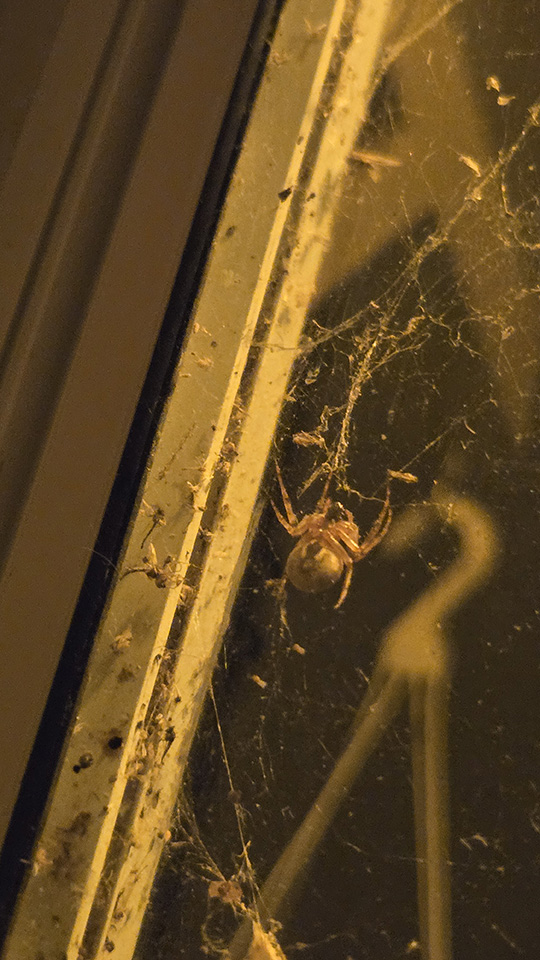
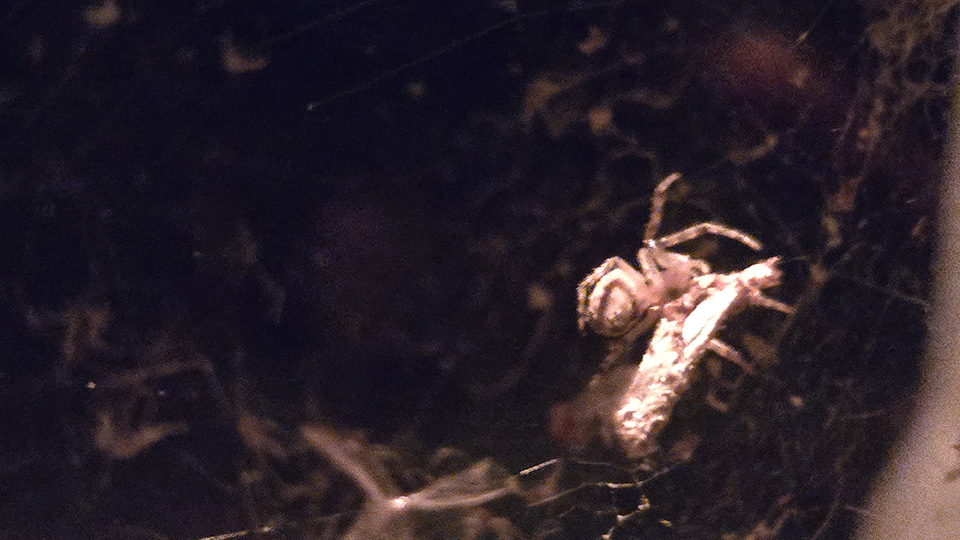
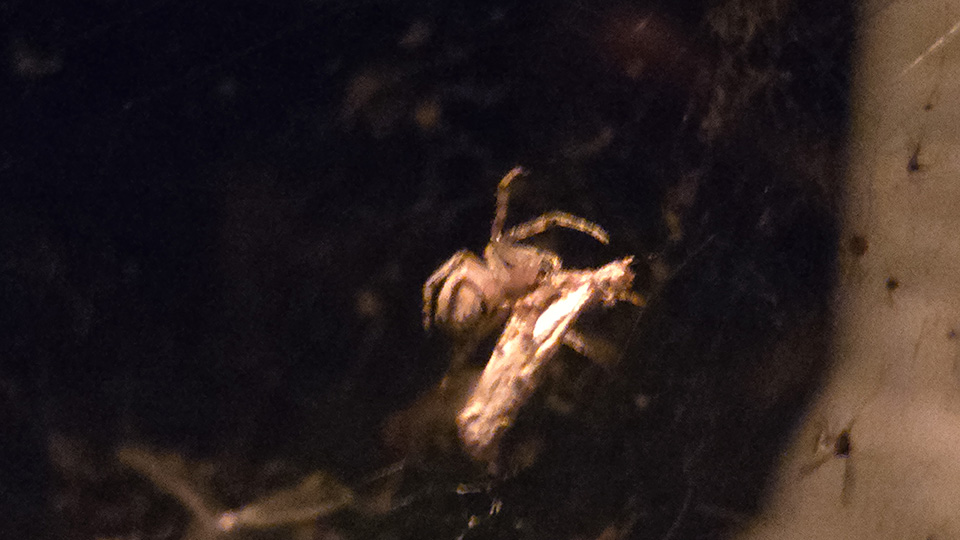
Furrow orbweaver is a small to medium-sized, drably colored, nocturnal orbweaver. It occurs in Europe, Asia, and North America. It occurs throughout the United States and Canada. It is very common across the eastern half of the U.S., but in the West, its distribution is largely restricted to cities and towns. While accidental human transport likely aids their arrival, human land use creates the necessary microclimates—irrigated vegetation, artificial water bodies, and outdoor lighting—that allow this moisture-dependent species to thrive in otherwise arid landscapes.
Furrow orbweaver is found on bushes in forests, on lake shores, and in other damp places. It is also found around human-built structures, including bridges, barns, boat houses and docks, fences, and windows of houses.
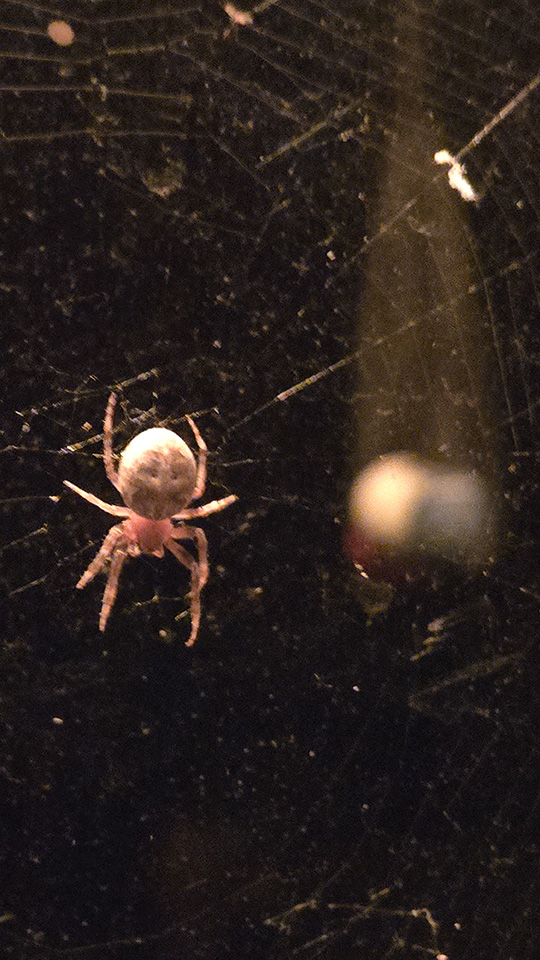
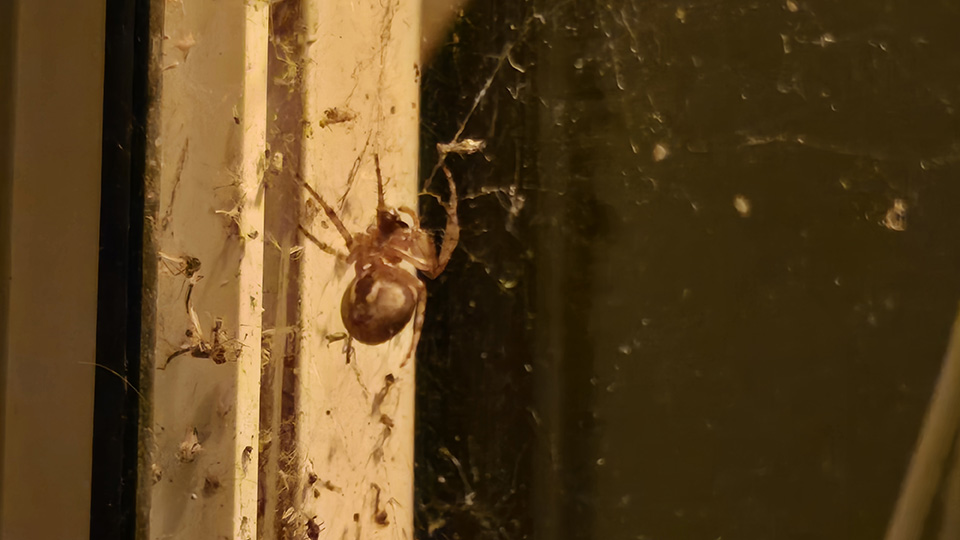
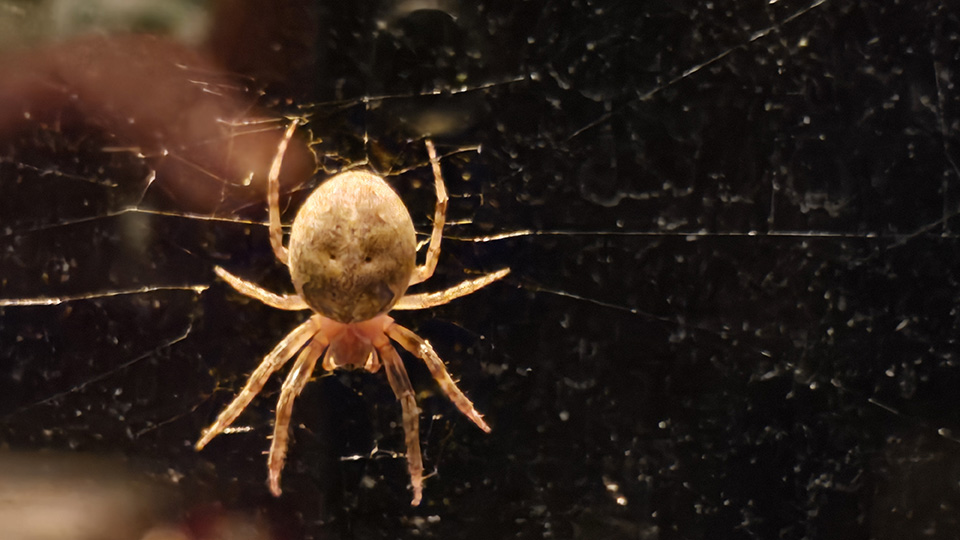
The female is ⅜″ to ½″ (9 to 12 mm) in length. The male is much smaller, ¼″ to ⅜″ (7 to 9 mm) in length. The legspan is 11⁄16″ to 1⅜″ (18 to 35 mm). The overall color is brown or grayish brown (dark) and whitish or light brown (pale).
The front part of the body (cephalothorax) is longer than wide and is flattened. The upper side (carapace) is dark with a narrow pale band on each lateral margin. A furrow (cervical groove) extends forward and toward each side from about the center of the carapace. It defines the boundary between the head and the thorax. Another furrow (dorsal groove) extends in the middle from behind the cervical groove toward the rear of the carapace.
There are eight eyes arranged in two parallel rows of four. On each side the lateral eyes are widely separated from the middle (median) eyes and are almost touching each other. The back (posterior) row is curved backward, the front (anterior) row is nearly straight. All the eyes are small, but the median eyes are somewhat larger than the lateral eyes.
The abdomen is round or broadly elliptical, it is somewhat flattened above, and there are no humps. It is light with a dark, usually unbroken, leaf-shaped mark (folium). The underside of the abdomen is black with a pair of conspicuous, white, comma-shaped marks.
Coloration ranges from pale tan to dark brownish black. On dark individuals, the carapace is deep brown and the folium is broadly darkened along the margins with a paler central field. On lighter individuals, the carapace is yellowish-brown to light brown, and the folium is predominantly pale with its dark border reduced to a thin, unbroken scalloped line. Intermediate specimens showing varying degrees of shading between these two extremes are common.
Size
Female total length: ⅜″ to ½″ (9 to 12 mm)
Male total length: ¼″ to ⅜″ (7 to 9 mm)
Legspan: 11⁄16″ to 1⅜″ (18 to 35 mm)
Web
The web is circular, vertical or nearly so, and up to in 24″ (61 cm) diameter, with 12 to 20 radii, widely-spaced spirals, and a carelessly finished hub.
Similar Species
Habitat
Forests, lake shores, and in other damp places, and around human-built structures
Ecology
Foraging
Web builder (Passive Hunter)
Prey
Behavior
Diurnal hiding behavior is highly opportunistic. In natural vegetation, it rarely constructs an elaborate standalone silk retreat, instead taking cover in nearby seed heads, folded leaves, or lower stem foliage—often at a noticeable distance from the web hub. On artificial structures or smooth surfaces that lack natural crevices, it adapts by lining a crack or spinning a compact silken shelter adjacent to the frame.
Life Cycle
Unlike other orbweavers, adults survive harsh Minnesota winters and live for up to two years. Subadults and mated females produce cryoprotectants in fall to lower their freezing point, allowing them to withstand temperatures down to extreme negatives. To shield themselves from desiccating winds and ice formation, they seek out dry, sheltered microhabitats in tight structural cavities or in the hidden, insulated space that forms between the surface of the ground and the bottom of a snowpack.
Season
May through October
Distribution
Sources
Larinioides cornutus (Clerck, 1757) in Bánki, O., Roskov, Y., Döring, M., Ower, G., Hernández Robles, D. R., Plata Corredor, C. A., Stjernegaard Jeppesen, T., Örn, A., Pape, T., Hobern, D., Garnett, S., Little, H., DeWalt, R. E., Miller, J., Orrell, T., Aalbu, R., Abbott, J., Abreu, C., Acero P, A., et al. (2026). Catalogue of Life (2026-07-17 XR). Catalogue of Life Foundation, Amsterdam, Netherlands. https://doi.org/10.48580/dgykv
Occurrence
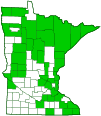
Common and widespread
Taxonomy
Class
Order
Suborder
Araneomorphae (Typical Spiders)
Infraorder
Entelegynae
Superfamily
Araneoidea (Orbweavers and Allies)
Family
Subfamily
Araneinae (Typical Orbweavers)
Genus
Larinioides (Furrow Spiders)
Subordinate Taxa
Synonyms
Aranea apoclisa
Aranea cornuta
Aranea foliata
Aranea frondosa
Aranea leuwenhoekii
Araneus cornutus
Araneus folium
Araneus ixobolatus
Cyphepeira cornuta
Epeira affinis
Epeira apoclisa
Epeira apoclisa americana
Epeira apoclysa
Epeira arundinacea
Epeira cornuta
Epeira cornuta inermis
Epeira foliata
Epeira foliosa
Epeira lyrata
Epeira marmorata
Epeira sericata
Epeira strix
Epeira tectorum
Epeira tricolor
Epeira vicaria
Larinioides apoclisa
Larinioides cornuta
Larinioides foliata
Larinioides suspicax
Nuctenea cornuta
Common Names
furrow orbweaver