horned parasitic cobweaver - Species Profile
Conservation • Description • Habitat • Ecology • Distribution • Taxonomy
Conservation Status
IUCN Red List
not listed
NatureServe
NNR - Unranked
Minnesota
not listed
Description
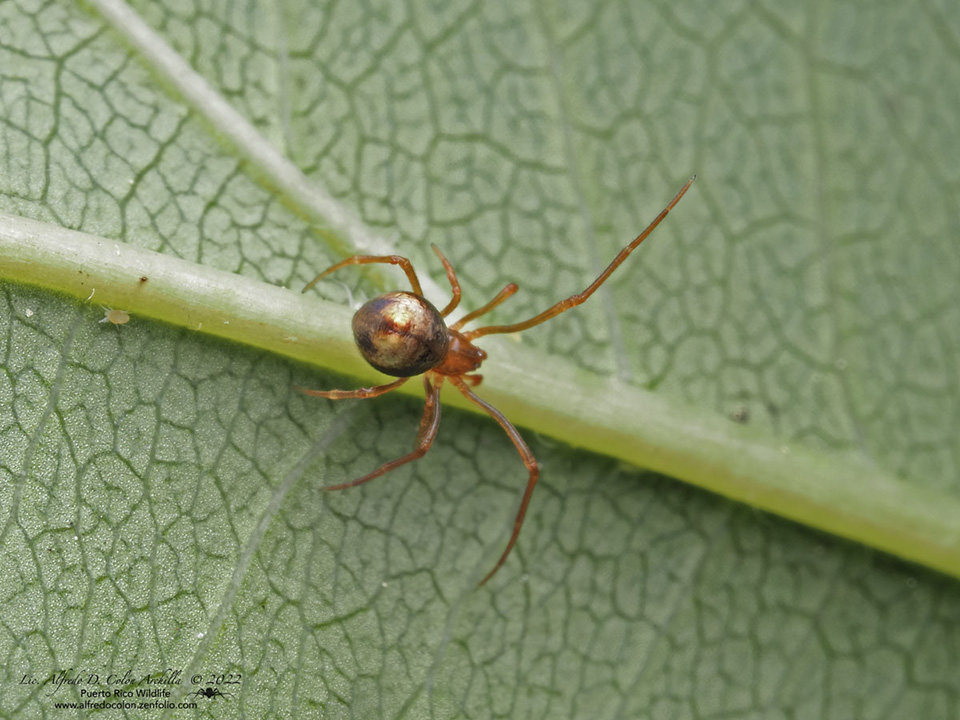
Horned parasitic cobweaver is a very small, kleptoparasitic spider. It occurs in the United States and southern Canada east of the Great Plains. It is found in a wide range of natural habitats, including forests, woodlands, shrubby areas, edges of ponds and wetlands, field margins, trails, and roads bordered by low vegetation. It is also found in human-altered (anthropogenic) environments, including gardens, old fields, sheds, house walls, and other built structures.
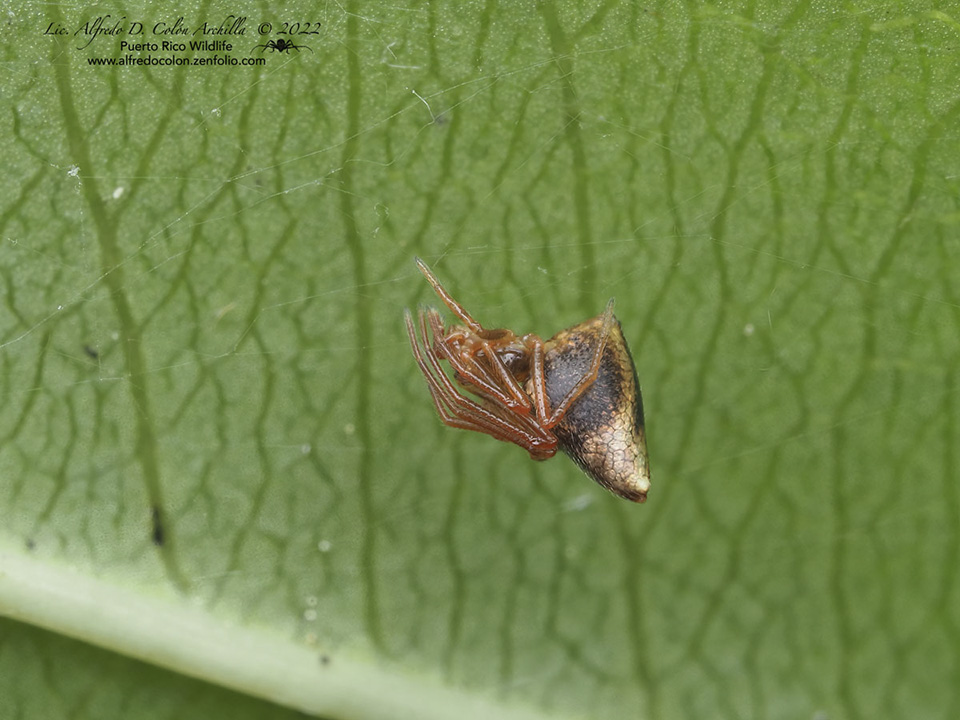
Females are ⅛″ (3.5 mm to 4.0 mm) in length. The legspan is ¼″ to ⅜″ (7 to 10 mm). The color can vary from light brownish yellow to dark yellowish brown. The overall body shape is roughly triangular and can be mistaken for a pine bud or other debris.
The front part of the body (cephalothorax) is long and rectangular. The upper side (carapace) is high and is somewhat rounded below the central groove. The head region is slightly elevated and the eyes are small. The anterior median eyes (AME) are very close to the anterior lateral eyes (ALE). There is a narrow groove below the eyes. The area below the eyes (clypeus) is quite high and it is somewhat rounded below the groove.
The abdomen is high and steeply triangular. This feature is the origin of the species epithet trigonum, which translates to “three-cornered.” As the female matures it develops two small, humped projections at the tip of the abdomen.
The male is smaller, ⅛″ (2.7 mm to 3.3 mm) in length. Upon reaching maturity, the male develops two long, blunt, horn-like extensions with hairs (setae) at the tip: one at the front of the carapace (the “forehead”) and another on the clypeus. This is the feature that gives the species its common name. The abdomen is nearly triangular.
Size
Female total length: ⅛″ (3.5 mm to 4.0 mm)
Male total length: ⅛″ (2.7 mm to 3.3 mm)
Legspan: ¼″ to ⅜″ (7 to 10 mm)
Web
Horned parasitic cobweaver usually lives in the web of another spider. It typically adds silk to a portion of the existing web, increasing its stability and its ability to capture prey.
Similar Species
Habitat
A wide variety of both natural and human-altered environments.
Ecology
Foraging
Kleptoparasite (Wait-and-steal)
Prey
Captured prey in the webs of other spiders, and sometimes the host spider itself.
Behavior
In the web of a small spider, horned parasitic cobweaver is a kleptoparasite. When it detects the vibration of a newly captured prey, it quickly moves to the prey, often challenging the host, which may back away and sometimes abandon the web. When the web is no longer profitable, it scouts for another host.
In the web of a larger spider, like a grass spider, it is an opportunistic scavenger. It often weaves supplemental strands to intercept tiny insects (like gnats or midges) that are too small for the larger spider to bother with.
Life Cycle
Eggs are laid in distinct, stalked, papery brown egg sacs often hung in or near the host web. The egg sacs are vase-shaped or bottle-shaped, about ¼″ (6 mm) long, and white at first, eventually turning brownish. Each egg sac contains about 42 eggs.
Season
Adults are most conspicuous in late summer and fall.
Distribution
Sources
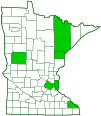
Biodiversity occurrence data published by: Minnesota Biodiversity Atlas (accessed through the Minnesota Biodiversity Atlas Portal, bellatlas.umn.edu. Accessed 3/5/2026).
Neospintharus trigonum (Hentz, 1850) in GBIF Secretariat (2023). GBIF Backbone Taxonomy. Checklist dataset https://doi.org/10.15468/39omei accessed via GBIF.org. Accessed 3/5/2026.
Occurrence
Taxonomy
Class
Order
Suborder
Araneomorphae (Typical Spiders)
Infraorder
Entelegynae
Superfamily
Araneoidea (Orbweavers and Allies)
Family
Subfamily
Argyrodinae (Kleptoparasitic Spiders)
Genus
Neospintharus
Genus
This species was originally described as Theridion trigonum in 1850. It was moved to the genus Argyrodes in 1882 and to the genus Neospintharus in 2004.
Subordinate Taxa
Synonyms
Argyrodes trigonum
Theridion trigonum
Common Names
horned parasitic cobweaver