humpbacked orbweaver - Species Profile
Conservation • Description • Habitat • Ecology • Distribution • Taxonomy

Conservation Status
IUCN Red List
not listed
NatureServe
NNR - Unranked
Minnesota
not listed
Description
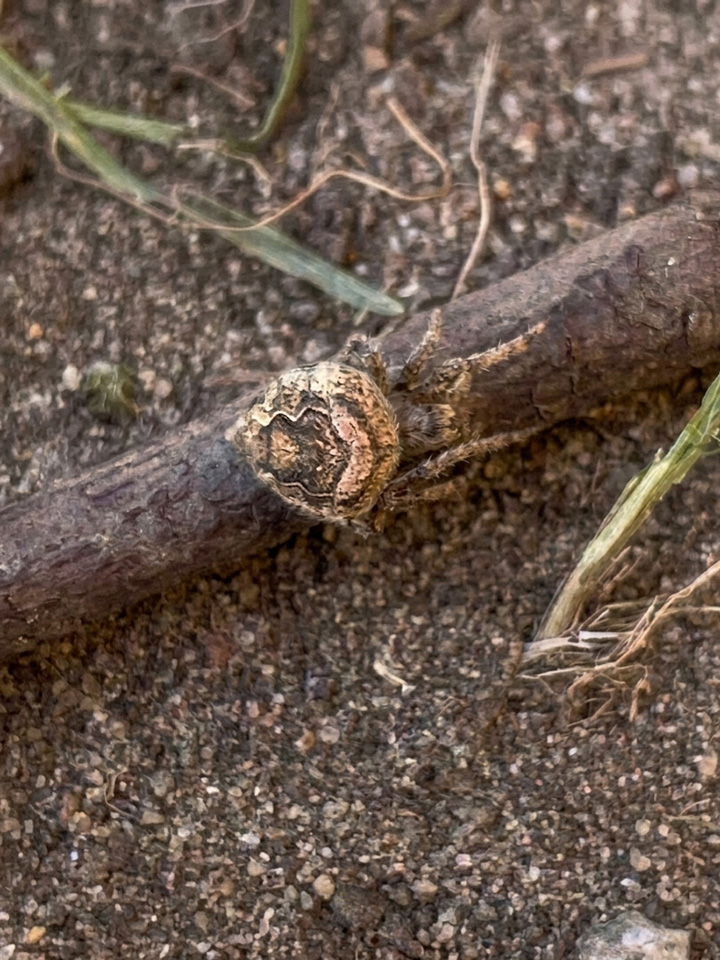
Humpbacked orbweaver is a small typical orbweaver. It occurs in the United States from Maine to North Dakota south to Florida and California, in southern Quebec and Ontario Canada, and in Central America. It is very common in the east, less common in Minnesota. It is found in open woodlands and woodland edges on trees and shrubs. During the day it rests on a dead twig or branch, where its color and markings camouflage it well, making it difficult to see.
The female is 3⁄16″ to ⅜″ (5.4 to 10 mm) in length and has a ⅜″ to ¾″ (10 to 20 mm) legspan. The male is slightly smaller, ⅛″ to ⅜″ (3.9 to 9.5 mm) in length.
The front part of the body (cephalothorax) is much smaller than the abdomen. The upper side (carapace) is mostly brown but dark on the sides. The thoracic region has a deep longitudinal furrow in the middle and is covered with long white hairs and with shorter downy hairs.
There are eight eyes arranged in two parallel rows of four eyes each. The eyes are not on raised projections (tubercles). The rear row is slightly curved forward, the front row is straight or slightly curved backward. All of the eyes are small, but the median eyes are larger than the lateral eyes, and the posterior median eyes (PME) are slightly smaller than the anterior median eyes (AME). On each side the lateral eyes are widely separated from the middle (median) eyes and are almost touching each other. The median ocular area (MOA), the area defined by the middle four eyes, is longer than wide and narrower in front than behind. There is a often a dark band on the face between the anterior lateral eyes (ALE) and the AME, and this band is sometimes continuous across the face. There is sometimes also a dark band between the PME.
The abdomen is large, longer than wide, and triangular when viewed from above, widest in front and pointed at the rear. When viewed from the side it appears squarely cut off (truncate) with a distinct hump at the end above the spinnerets. This is the feature that gives the species the first part of its common name. Some females have two or three humps in a line. There are no humps in the shoulder area (humeral tubercles). The color and markings on the upper side is variable but follows one of three basic patterns. It is most often gray or light brown with a dark, scalloped, triangular mark (folium) stretching from the front to the rear. The folium is sometimes faint. Some individuals have a bold dark stripe in the middle of the abdomen with the folium faint or missing. Some individuals have a white abdomen and a black folium with either three large black spots on the front margin or a continuous irregular black band on the front margin. The underside of the abdomen has a large black patch surrounding a white spot.
The legs are spiny and mostly gray or light brown with irregular dark bands. The first pair of legs is the longest, the third pair is the shortest. On the male, the first segment (coxa) on the front pair of legs has a hook-like spur on the underside. This spur fits into a groove on the upper side of the third segment (femur) on the second pair of legs.
Size
Female Body Length: 3⁄16″ to ⅜″ (5.4 to 10 mm)
Male Body Length: ⅛″ to ⅜″ (3.9 to 9.5 mm)
Legspan: ⅜″ to ¾″ (10 to 20 mm)
Web
A loose web with few threads is often constructed on a dead branch away from leaves or on a tree trunk. It is called an “orb”, which gives this family of spiders its common name. The orb is (19 to 30 cm) in diameter and has 18 to 21 radii and 58 to 64 sticky (viscid) threads. Webs of juveniles are smaller and have more threads. The web hangs more or less vertically and is somewhat asymmetrical, largest on the lower half. It is an open web with a medium-sized hole in the center. There is no retreat.
Similar Species
Habitat
Open woodlands and woodland edges
Ecology
Foraging
Web builder (Passive Hunter)
Prey
Behavior
Adults are active at night and rest on a dead branch during the day. The web is constructed in the evening after dark and is torn down in the morning, usually before daylight. When resting it usually keeps its legs slightly spread.
Life Cycle
The eggs are hung on a radius of the web.
Spiderlings in the final development stage (instar) overwinter.
Season
Distribution

Sources
Eustala anastera (Walckenaer, 1841) in Bánki, O., Roskov, Y., Döring, M., Ower, G., Hernández Robles, D. R., Plata Corredor, C. A., Stjernegaard Jeppesen, T., Örn, A., Pape, T., Hobern, D., Garnett, S., Little, H., DeWalt, R. E., Miller, J., Orrell, T., Aalbu, R., Abbott, J., Abreu, C., Acero P, A., et al. (2026). Catalogue of Life (2026-06-19 XR). Catalogue of Life Foundation, Amsterdam, Netherlands. https://doi.org/10.48580/dgy8b
Occurrence
Taxonomy
Class
Order
Suborder
Araneomorphae (Typical Spiders)
Infraorder
Entelegynae
Superfamily
Araneoidea (Orbweavers and Allies)
Family
Subfamily
Araneinae (Typical Orbweavers)
Genus
Eustala
Subordinate Taxa
Synonyms
Epeira anastera
Eustala anestera
Eustala prompta
Common Names
humpbacked orbweaver