house centipede - Species Profile
Conservation • Description • Habitat • Ecology • Distribution • Taxonomy
Conservation Status
IUCN Red List
not listed
NatureServe
not listed
Minnesota
not listed
Description
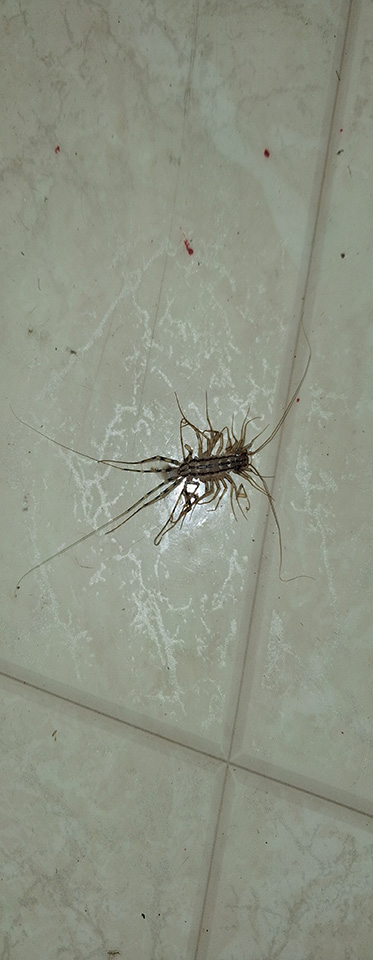
House centipede is a medium-sized, non-native, long-legged centipede. Originally native to Europe and North Africa, it has spread widely through global commerce and is now a cosmopolitan species found on every continent except Antarctica. It is a frequent inhabitant of homes and museums; while often considered an unsightly nuisance in these spaces, it is a beneficial predator that preys on other indoor pests without posing a threat to collections or property. Though commonly seen darting across basement floors or bathroom walls, most house centipedes actually live outdoors, sheltering in damp crevices, wood piles, and leaf litter.
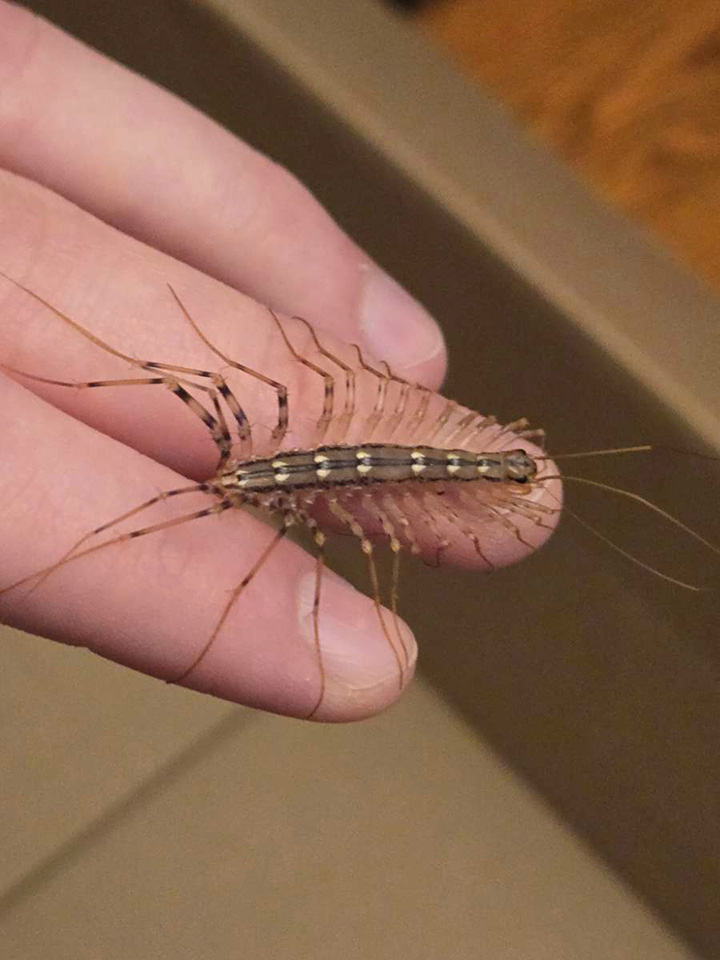
Adults are medium-sized though their exceptionally long legs make them seem much larger. The body alone typically ranges from 1″ to 1 3⁄16″ (25 to 30 mm) in length, though large individuals can be up to 2″ (50 mm) in length. Including the legs and large antennae, they can appear to be up to 4″ (10 cm) in length.
The body has fifteen segments and one pair of legs on each segment. It is light brownish yellow to medium yellowish brown with three narrow, longitudinal, dark brown or black stripes. A single row of cream-colored breathing pores (spiracles) in the middle of each segment is divided by the central dark stripe, making it appear like two light spots on each segment. On pale individuals the spots may not be apparent, but on close examination, they are always present.
The antennae are thread-like and extremely long, often longer than the body.
The legs are very long and have alternating light and dark bands. The last pair of legs is significantly longer than the others. In females, they can be twice as long as the body, mimicking the antennae and giving the centipede a symmetrical appearance that makes it difficult to distinguish the head from the rear.
Size
Body length: 1″ to 2″ (25 to 50 mm)
Similar Species
Stone centipedes (Order Lithobiomorpha) have a eddish-brown, flattened body with much shorter, solid-colored legs. They lack the three dark longitudinal stripes and the long antennae-like hind legs.
Habitat
Indoors in damp areas of human dwellings, including basements, bathrooms, and museums; outdoors in damp crevices under rocks, wood piles, and leaf litter
Ecology
Season
Year-round indoors; late spring through early autumn outdoors in Minnesota.
Behavior
House centipedes are usually nocturnal and remain hidden during the day. Daytime sightings may signal a large infestation. When disturbed, they move suddenly and rapidly.
Life Cycle
Females lay eggs in the soil (outdoors) or in damp crevices (indoors). Larvae hatch with only 4 pairs of legs, adding more with each molt.
House centipedes can live between three to seven years. They hatch from eggs with only four body segments and four pairs of legs. They pass through six larval and four post-larval stages, adding segments and legs at each molt. This development can take up to three years before they reach adulthood with fifteen segments and fifteen pairs of legs. They continue to grow and molt throughout their adult life.
Food
Small arthropods, including bedbugs, cockroach nymphs, earwigs, flies, moths, silverfish, and small spiders.
Toxicity
House centipedes are venomous and can deliver a painful “bite” if handled roughly. The venom is injected through a pair of modified front legs (forcipules) located just behind the head. For most people, the sensation is comparable to the sting of a honey bee, typically resulting in localized redness and swelling.
Distribution
Sources
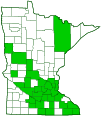
Biodiversity occurrence data published by: Minnesota Biodiversity Atlas (accessed through the Minnesota Biodiversity Atlas Portal, bellatlas.umn.edu. Accessed 4/2/2026).
Scutigera coleoptrata Linnaeus, 1758 in GBIF Secretariat (2023). GBIF Backbone Taxonomy. Checklist dataset https://doi.org/10.15468/39omei accessed via GBIF.org. Accessed 4/2/2026.
Occurrence
Common
Taxonomy
Subphylum
Myriapoda (Myriapods)
Class
Chilopoda (Centipedes)
Order
Scutigeromorpha (Long-legged Centipedes)
Family
Scutigeridae (Typical House Centipedes)
Genus
Scutigera
Subordinate Taxa
Synonyms
Cermatia floridana
Cermatia floridensis
Cermatia livida
Cermatia variegata
Cryptomera nemura
Julus araneoides
Scolopendra coleoptrata
Scolopendra lineata
Scolopendra nigricans
Scutigera aranea
Scutigera araneoides
Scutigera asiaeminoris
Scutigera capensis
Scutigera coleoptrata ssp. crinita
Scutigera coleoptrata ssp. genuina
Scutigera coleoptrata ssp. graeca
Scutigera coleoptrata ssp. insularum
Scutigera coleoptrata ssp. natalensis
Scutigera crinita
Scutigera floridana
Scutigera forceps
Scutigera graeca
Scutigera insularum
Scutigera lineata
Scutigera livida
Scutigera longipes
Scutigera mohamedanica
Scutigera muscivora
Scutigera natalensis
Scutigera nemura
Scutigera nigricans
Scutigera nigrifrons
Scutigera pretzmanni
Scutigera rubrovittata
Scutigera variegata
Scutigera vesuviana
Selista forceps