brickwork woodlouse - Species Profile
Conservation • Description • Habitat • Ecology • Distribution • Taxonomy

Conservation Status
IUCN Red List
not listed
NatureServe
not listed
Minnesota
not listed
Description
Brickwork woodlouse is a large, exotic woodlouse. It is native to Europe, where it is widespread and common. It was introduced into North America, where it is now naturalized. It occurs across southern Canada. In the United States it occurs from Maine to New Jersey, west to North Dakota and South Dakota, with a few scattered occurrences in the west. It is not uncommon in Minnesota. It favors dry areas with limey (calcareous) surfaces. It is found in limestone quarries, on limestone pavement, and in loosely mortared walls. It is very often found in human houses. It is sometimes found on the bark of apple, lime, and basswood trees, all of which have calcareous bark. It is active at night, when it can be found on the surface. During the day it remains concealed, often under a rock or log.
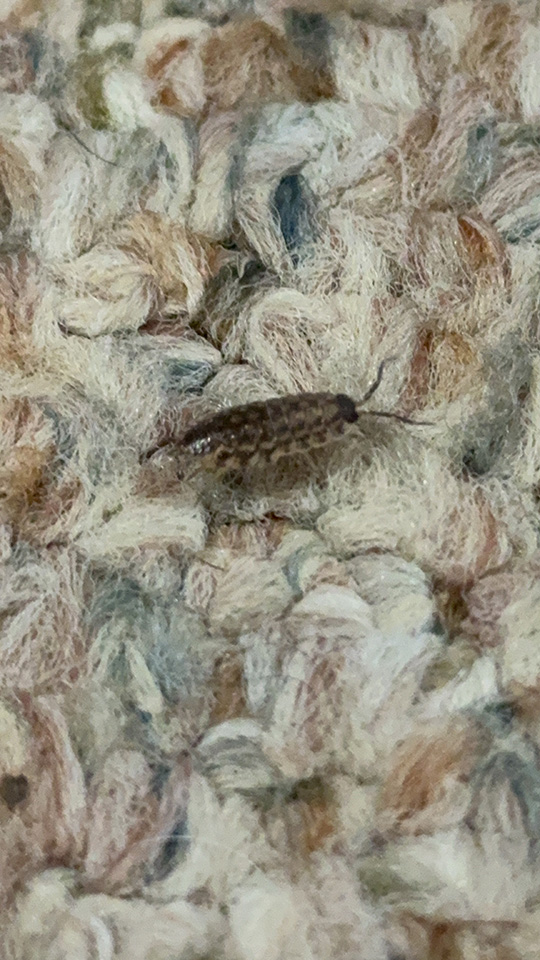
Adults are ⅜″ to ⅝″ (10 to 15 mm) in length. The body is oval in outline and more or less compressed above. It is rough or granular due to the presence of numerous rounded bumps (tubercles). It is yellowish with dark brown to almost black mottling, and a dark brown to almost black stripe in the middle (middorsal) bordered on each side by bright yellow markings. One imaginative describer likened the pattern to brickwork, and this is the source of this species’ common name.
The head is about twice as wide as long. It is fused to but not hidden under the first segment of the thorax. It has three lobes in front: a broadly rounded lobe in the center, and a longer, narrower, rounded lobe on each side. There are two widely spaced eyes. Each eye is a tight grouping of up to 30 dark-colored simple eyes (ocelli). The antennae are long. The end section of each antenna has two distinct segments. The first segment is a little longer than the second.
The thorax (pereon) is large and has seven segments of slightly unequal length. There is a single jointed leg on each side of each segment. The upper exoskeletal plate (tergite) on each thoracic segment and the first five abdominal segments is expanded on each side into a thin, flat, lateral extension (epimeron). The rear angle on each epimeron extends rearward. On the first thoracic tergite, the front angle on each side extends forward.
The abdomen (pleon) is much smaller and has six segments, all of which are distinct. The junction between the pereon and the pleon is smooth, not stepped. The lateral portions of the first two abdominal segment are concealed beneath the seventh thoracic segment. The third, fourth, and fifth segments have prominent, well developed, epimera. The last segment, the sixth, is called the telson. The telson is triangular and does not extend beyond the epimera of the fifth segment. On each side of the telson there is an elongated appendage, called a uropod. The uropods are lance-shaped and project well beyond the end of the body. On the under side of the abdomen there are just 2 pairs of pleopodial lungs. They appear as white dots on the first and second abdominal segments.
The legs are long relative to other families of woodlice.
Size
Total length: ⅜″ to ⅝″ (10 to 15 mm)
Similar Species
Habitat
Dry areas with limey (calcareous) surfaces; limestone quarries, limestone pavement, mortared walls, human houses, and the bark of apple, lime, and basswood trees.
Ecology
Season
Behavior
Unlike pill woodlice (Family Armadillidae), brickwork woodlouse cannot roll into a ball.
Lifespan
Life Cycle
Food
Mostly decaying leaf litter and rotting wood, but also fungal mycelium and algae
Distribution

Sources
Sargent, J. E. (1972). Terrestrial Isopods of Minnesota. Journal of the Minnesota Academy of Science, Vol. 38 No.2, 88-92.
Porcellio spinicornis Say, 1818 in GBIF Secretariat (2023). GBIF Backbone Taxonomy. Checklist dataset https://doi.org/10.15468/39omei accessed via GBIF.org. Accessed 4/19/2026.
Occurrence
Native to Europe
Taxonomy
Subphylum
Crustacea (Crustaceans)
Superclass
Multicrustacea (Typical Crustaceans)
Class
Malacostraca (Malacostracans)
Subclass
Eumalacostraca (Decapods, Isopods, and Allies)
Superorder
Peracarida (Amphipods, Isopods, and Allies)
Order
Isopoda (Isopods)
Suborder
Oniscidea (Woodlice, Pillbugs, and Rock Slaters)
Infraorder
Holoverticata (Woodlice and Pillbugs)
Parvorder
Orthogonopoda
Zoosection
Crinocheta
Family
Porcellionidae
Genus
Porcellio
Subordinate Taxa
Synonyms
Porcellio germanicus
Porcellio melanocephalus
Porcellio mixtus
Porcellio pictus
Common Names
brickwork woodlouse
painted woodlouse