Cinder Lichen - Species Profile
Conservation • Description • Ecology • Distribution • Taxonomy
Conservation Status
IUCN Red List
not listed
NatureServe
NNR - Unranked
SNR - Unranked
Minnesota
not listed
Description
Cinder Lichen is a common sunken disk lichen. It occurs worldwide on every continent including Antarctica. It is most common in North America and Europe. It occurs throughout the United States, but it is mostly absent from the Great Plains and the Great Basin. It is common in Minnesota.
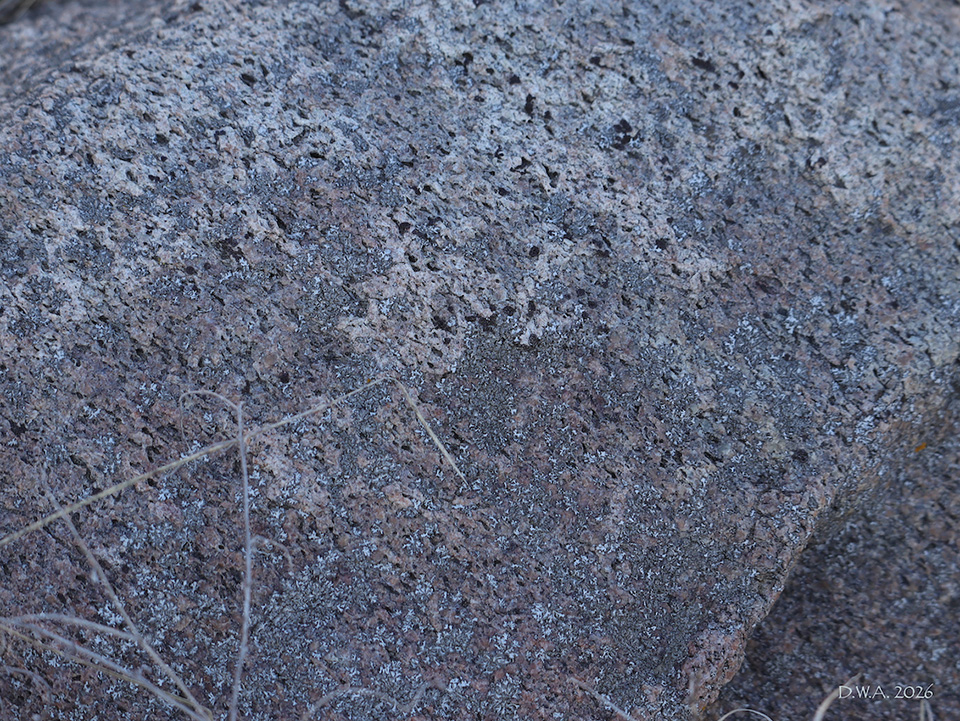
Cinder Lichen grows in open areas on rock that has silica (SiO2) as its principal constituent (siliceous), including granite, slate, sandstone, quartzite, brownstone, bluestone, and volcanic rock.
The vegetative body (thallus) is thin to thick and ⅝″ to 6″ (1.5 to 15 cm) in diameter. It is separated by cracks into distinct, island-like areas (areolate). The islands (areoles) are usually angular, sometimes irregular, flat or slightly convex, and 1⁄128″ to 1⁄16″ (0.2 to 2.0 mm) wide and more or less round. They are closely spaced, almost touching, but separated by distinct cracks. The upper surface is gray, whitish gray, or almost white, sometimes slightly tinged with yellow.
Spore-bearing reproductive structures (apothecia) are usually numerous. They are 1⁄256″ to 1⁄16″ (0.1 to 1.6 mm) in diameter. The disk is usually black, rarely brownish black, and it is usually concave, sometimes flat, rarely convex. It is flat with the surface of the thallus. This is the feature that gives the genus its common name. It sometimes has thin white dust (pruinescence) on the surface, but it usually does not. A single areole may have 1 to 3, rarely up to 10 apothecia, and these blend together.
Similar Species
Ecology
Substrate
Rock
Growth Form
Crustose
Habitat
Open areas
Hosts
Siliceous rock, including granite, slate, sandstone, quartzite, brownstone, and bluestone
Distribution

Sources
Biodiversity occurrence data published by: Minnesota Biodiversity Atlas (accessed through the Minnesota Biodiversity Atlas Portal, bellatlas.umn.edu. Accessed 4/19/2025).
The Consortium of North American Lichen Herbaria (CNALH) https://lichenportal.org/cnalh/index.php. Accessed 4/19/2025.
Mycology Collections Portal (MyCoPortal) https://www.mycoportal.org/portal/collections/index.php). Accessed 4/19/2025.
Aspicilia cinerea (L.) Körb. in GBIF Secretariat (2023). GBIF Backbone Taxonomy. Checklist dataset https://doi.org/10.15468/39omei accessed via GBIF.org. Accessed 4/19/2025.
Fink, B. (1910). The Lichens of Minnesota. United States: U.S. Government Printing Office.
Fink, Bruce. (1899). Contributions to a Knowledge of the Lichens of Minnesota. Retrieved from the University Digital Conservancy, https://hdl.handle.net/11299/177988.
Occurrence
Common
Taxonomy
Kingdom
Fungi (Fungi)
Subkingdom
Dikarya
Phylum
Ascomycota (Sac Fungi)
Subphylum
Pezizomycotina
Class
Lecanoromycetes (Common Lichens)
Subclass
Ostropomycetidae (Wart Lichens, Script Lichens, and Allies)
Order
Pertusariales (Wart Lichens, Water Lichens, and Allies)
Family
Megasporaceae
Genus
Aspicilia (Sunken Disk Lichens)
Mycobiont
Aspicilia cinerea
Photobiont
green algae other than Trentepohlia
Subordinate Taxa
Synonyms
Aspicilia cinerea var. alba
Aspicilia cinerea var. insignis
Aspicilia depressa
Aspicilia excipularis
Aspicilia polygonia
Aspicilia protrudens
Aspicilia pruinosa
Diploschistes actinostomus ssp. apertus
Diploschistes apertus
Gussonea cinerea
Lecanora cinerea
Lecanora excipularis
Lecanora illimata
Lecanora protrudens
Lichen cinereus
Parmelia cinerea
Psora cinerea
Sagedia depressa
Urceolaria cinerea
Urceolaria tessulata ssp. cinereus
Verrucaria cinerea
Zeora cinerea
Common Names
Cinder Lichen
Grey Sunken Disk Lichen



