Common Stinkhorn
(Phallus impudicus)
Conservation • Description • Habitat • Ecology • Distribution • Taxonomy

Conservation Status
IUCN Red List
not listed
NatureServe
not listed
Minnesota
not listed
Description
Common Stinkhorn occurs across the United states but is most common west of the Mississippi River. It is found in the summer and fall in deciduous woods, parks, lawns, and gardens. It grows on the ground, singly or in clusters. It is saprobic, obtaining its nutrients from decaying wood.
The fruiting body at first is whitish to yellowish, egg-shaped, 1½″ to 2⅜″ tall, and 1¼″ to 2″ wide. It resembles a puffball at least partially submerged in the ground. It is attached to the ground or other substrate by thread-like, branching, similarly colored strands (mycelium). Inside the “egg” there is a gelatinous layer, an olive-green spore mass (gleba), and all of the fully-formed parts of the mature stinkhorn. When conditions are right the “egg” ruptures and expands rapidly. In one or two days it produces a distinctly phallic structure with a stalk and thimble-like head. The rapid expansion is possible because all of the parts are fully formed and compressed inside the “egg”, and because the individual cells elongate, rather than new cells being produced. As the stinkhorn expands the gelatinous layer mixes with the spore mass producing a shiny, putrid slime that covers the cap. The foul-smelling slime is irresistible to flies, which feed on it, lay their eggs in it, and transfer spores when they fly to other stinkhorns. It is a smelly nuisance to homeowners who find the mushroom under their wood deck.
The stalk is white to yellowish-white, spike-like, hollow, spongy, fragile, 4″ to 11¾″ tall, and 1½″ to 2″ in diameter. At the base of the stalk the remnants of the ruptured “egg” (volva) is white.
The cap is thimble-like, ¾″ to 1½″ in height, and ⅝″ to 1½″ in diameter. There is a white, circular opening at the top where it attaches to the stalk. There are sometimes remnants of a membranous veil attached to the bottom of the cap. At first, the cap is covered with a thick, slimy or gluey, shiny, olive-green to olive-brown, spore-bearing mass (gleba). The gleba has a strong, putrid odor, repulsive to humans but irresistible to flies. When it is carried off by flies and/or washed off by rain it reveals a whitish, pitted and ridged (reticulate) surface.
Similar Species
Habitat and Hosts
Deciduous and coniferous woodlands, parks, lawns, gardens
Ecology
Season
Summer and fall
Distribution

Sources
Biodiversity occurrence data published by: Minnesota Biodiversity Atlas (accessed through the Minnesota Biodiversity Atlas Portal, bellatlas.umn.edu. Accessed 9/27/2026).
Phallus impudicus L. in Bánki, O., Roskov, Y., Döring, M., Ower, G., Hernández Robles, D. R., Plata Corredor, C. A., Stjernegaard Jeppesen, T., Örn, A., Pape, T., Hobern, D., Garnett, S., Little, H., DeWalt, R. E., Miller, J., Orrell, T., Aalbu, R., Abbott, J., Abreu, C., Acero P, A., et al. (2026). Catalogue of Life (2026-08-26 XR). Catalogue of Life Foundation, Amsterdam, Netherlands. https://doi.org/10.48580/dgyy9
Mycology Collections Portal (MyCoPortal) https://www.mycoportal.org/portal/collections/index.php). Accessed 9/27/2026.
Occurrence
Taxonomy
Kingdom
Fungi (Fungi)
Subkingdom
Dikarya
Phylum
Basidiomycota (Basidiomycete Fungi)
Subphylum
Agaricomycotina (Higher Basidiomycetes)
Class
Agaricomycetes (Mushrooms, Bracket Fungi, Puffballs, and Allies)
Subclass
Phallomycetidae
Order
Phallales (Stinkhorns and Allies)
Family
Phallaceae (Stinkhorns)
Genus
Phallus
Subordinate Taxa
Phallus impudicus var. impudicus 

Phallus impudicus var. togatus
Synonyms
Dictyophora duplicata var. obliterata
Hymenophallus togatus
Ithyphallus impudicus
Ithyphallus impudicus var. carneus
Ithyphallus mauritianus
Kirchbaumia imperialis
Morellus impudicus
Phallus foetidus
Phallus impudicus f. alveolatus
Phallus impudicus f. flavidus
Phallus impudicus f. reticulatus
Phallus impudicus f. subindusiatus
Phallus impudicus f. togatus
Phallus impudicus var. americanus
Phallus impudicus var. imperialis
Phallus impudicus var. obliteratus
Phallus impudicus var. pseudoduplicatus
Phallus impudicus var. subindusiatus
Phallus impudicus var. stream togatus
Phallus impudicus var. vulgaris
Phallus mauritianus
Phallus volvatus
Phallus vulgaris
Common Names
Common Stinkhorn
Stinkhorn
Visitor Photos
Share your photo of this fungus.
This button not working for you?
Simply email us at info@MinnesotaSeasons.com.
Attach one or more photos and, if you like, a caption.
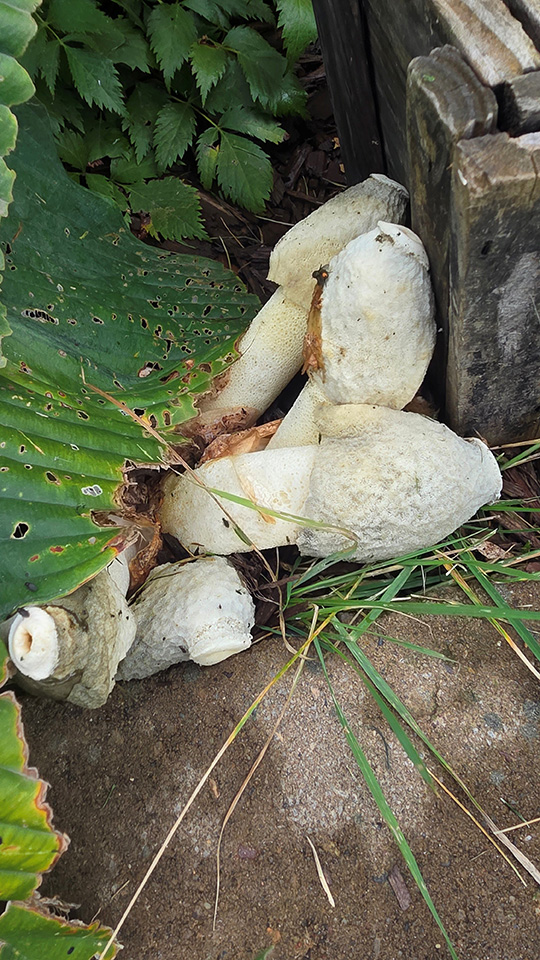


Not sure if these were the same kind or just different stages. Found in same location.


Minnesota Seasons Photos
Slideshows
Visitor Videos
Share your video of this fungus.
This button not working for you?
Simply email us at info@MinnesotaSeasons.com.
Attach a video, a YouTube link, or a cloud storage link.
Other Videos
Phallus impudicus timelapse HD
LS A
Phallus Impudicus
Nature Check
The Common Stinkhorn, Phallus impudicus
Wild Food UK
Flies on a Stinkhorn (Phallus impudicus)
Phil Champion
Common Stinkhorn
Mike's Nature Journal
Visitor Sightings
Report a sighting of this fungus.
This button not working for you?
Simply email us at info@MinnesotaSeasons.com.
Be sure to include a location.
Ellen Dyer
9/25/2026

Location: Duluth, MN
Amanda Ladd
6/19/2023

Location: Aitkin Co. Near Big Sandy Lake
Luciearl
10/9/2021
Location: Fairview Twp, Cass County
At first finding this egg like fungus. I truly thought it was an egg. After tearing away a portion of the outer skin, I still thought the gelatinous substance inside seemed like an egg. Then my son showed me it had a stem underneath. Puzzling. Hope we can find out what this interesting fungus might be.
Angie
10/4//2019
Location: Stewartville, MN
Found at park in the wood chips.
Anonymous2
9/18//2019
Location: Wadena County
Found in yard. Popped up randomly 16hrs after mowing & heavy rain
Luciearl
8/26/2018
Location: Cass County
Not sure if these were the same kind or just different stages. Found in same location.
Lucy Morrissey
8/24/2018
Location: Hennepin County
Minnesota Seasons Sightings