Hooded Rosette Lichen - Species Profile
Conservation • Description • Ecology • Distribution • Taxonomy
Conservation Status
IUCN Red List
not listed
NatureServe
NNR - Unranked
SNR - Unranked
Minnesota
not listed
Description
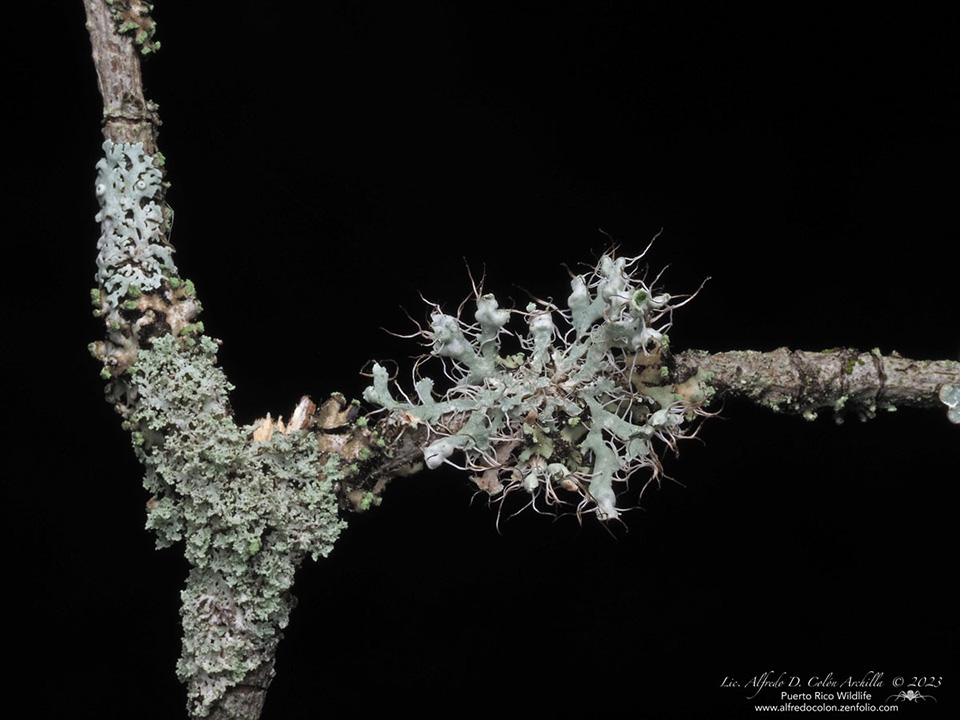
Hooded Rosette Lichen is a common, easily recognized species. It occurs worldwide on all continents except Antarctica, but it is much more common in the Northern Hemisphere. It occurs throughout the United States and Canada. It grows mostly on trees, especially on the trunk but also on twigs. Its abundance decreases toward the upper part of the tree, unlike Hoary Rosette Lichen (Physcia aipolia), whose abundance increases toward the upper part. It also grows on walls and occasionally on rock, including sandstone cemetery headstones.
The vegetative body (thallus) is leaf-like (foliose), lobed, and small, ¼″ to 1⅛″ (6 to 28 mm) in diameter, but it usually grows in dense clusters over large areas. It curves upward and away from the point of attachment to the surface (ascendant). This is the feature that gives the lichen the species epithet adscendens.
The lobes are elongated, up to 1⁄16″ (2 mm) wide, branched, and overlapping. They are swollen toward the end and open, creating a large air space separating the upper cortex and inner fungal layer (medulla) from the lower cortex. The lobe tips are rounded. The upper surface is gray, grayish green, or sea green. The margins have hair-like fibrils (cilia) that are pale at the base and darkened at the tip, sometimes almost entirely dark. The cilia can be short, 1⁄32″ to 1⁄16″ (1 to 2 mm) long, as long as the lobe, or much longer. The lobe tips expand into hollow, hood-like structures over cortex-free areas (soralia) where powdery reproductive granules (soredia) are produced. This feature gives the lichen its common name.
The lower thallus surface is white to grayish with long root-like structures (rhizines). The rhizines are pale at the base and darkened at the tip. The lower ones anchor the thallus to the substrate, but where the thallus curves upward the rhizines reach outward.
Cup-shaped reproductive structures (apothecia) are rare. When present, they are small, 1⁄32″ to 3⁄32″ (1 to 2.5 mm) in diameter, and stalkless or on short stalks. The disks are flat or slightly concave, black, and sometimes have a whitish, dusty deposit (pruina) on the surface.
Similar Species
Ecology
Substrate
Tree bark
Growth Form
Foliose
Habitat
Hosts
Distribution

Sources
Biodiversity occurrence data published by: Minnesota Biodiversity Atlas (accessed through the Minnesota Biodiversity Atlas Portal, bellatlas.umn.edu. Accessed 9/13/2026).
The Consortium of North American Lichen Herbaria (CNALH) https://lichenportal.org/cnalh/index.php. Accessed 9/13/2026.
Mycology Collections Portal (MyCoPortal) https://www.mycoportal.org/portal/collections/index.php). Accessed 9/13/2026.
Physcia adscendens H. Olivier in Bánki, O., Roskov, Y., Döring, M., Ower, G., Hernández Robles, D. R., Plata Corredor, C. A., Stjernegaard Jeppesen, T., Örn, A., Pape, T., Hobern, D., Garnett, S., Little, H., DeWalt, R. E., Miller, J., Orrell, T., Aalbu, R., Abbott, J., Abreu, C., Acero P, A., et al. (2026). Catalogue of Life (2026-08-26 XR). Catalogue of Life Foundation, Amsterdam, Netherlands. https://doi.org/10.48580/dgyy9
Fink, B. (1910). The Lichens of Minnesota. United States: U.S. Government Printing Office.
Fink, Bruce. (1899). Contributions to a Knowledge of the Lichens of Minnesota. Retrieved from the University Digital Conservancy, https://hdl.handle.net/11299/177988.
Occurrence
Common
Taxonomy
Kingdom
Fungi (Fungi)
Subkingdom
Dikarya
Phylum
Ascomycota (Sac Fungi)
Subphylum
Pezizomycotina
Class
Lecanoromycetes (Common Lichens)
Subclass
Lecanoromycetidae (Shield Lichens, Sunburst Lichens, Rosette Lichens, and Allies)
Order
Caliciales (Button Lichens, Rosette Lichens, and Allies)
Family
Physciaceae (Rosette Lichens, Frost Lichens, and Allies)
Genus
Physcia (Rosette Lichens)
Mycobiont
Physcia adscendens
Photobiont
green algae other than Trentepohlia
Subordinate Taxa
Synonyms
Dimelaena stellaris f. anthelina
Dimelaena stellaris var. adscendens
Lichen aipolius anthelina
Lichen anthelinus
Parmelia aipolia f. anthelina
Parmelia aipolia var. anthelina
Parmelia anthelina
Parmelia stellaris f. anthelina
Physcia adscendens
Physcia aipolia f. anthelina
Physcia aipolia var. anthelina
Physcia hispida
Physcia hispida f. adscendens
Physcia stellaris f. anthelina
Physcia stellaris var. adscendens
Physcia stellaris var. anthelina
Xanthoria aipolia var. anthelina
Common Names
Hooded Rosette Lichen
