Mossy Maze Polypore
(Cerrena unicolor)
Conservation • Description • Habitat • Ecology • Distribution • Taxonomy
Conservation Status
IUCN Red List
not listed
NatureServe
NNR - Unranked
Minnesota
not listed
Description
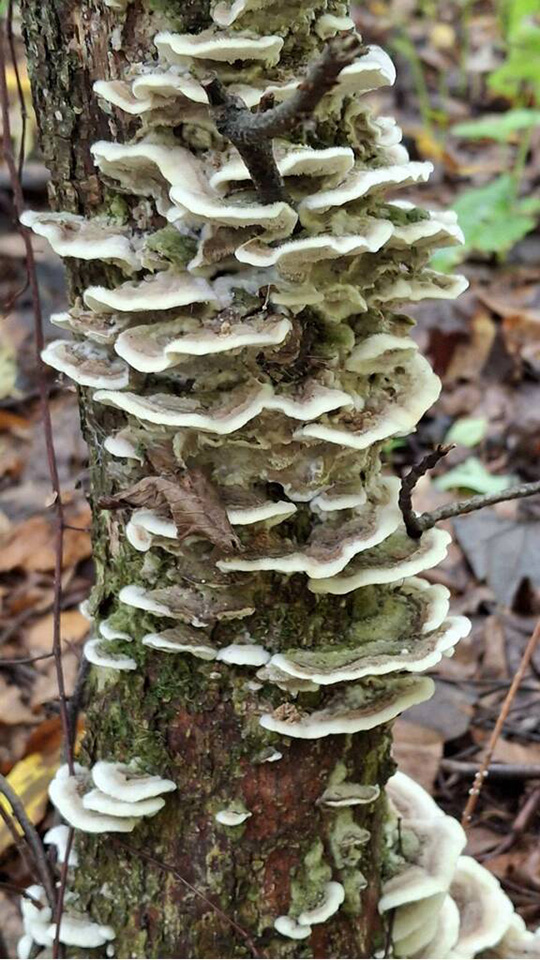
Mossy Maze Polypore is a widespread and very common bracket fungi (polypore). It occurs in Europe and Asia, and throughout North and Central America. In the United States it is common east of the Great Plains, uncommon in the Pacific northwest, and absent elsewhere. In Minnesota it is very common in the eastern half of the state, uncommon to absent in the western half. It is found year round in deciduous and mixed forests. It grows in overlapping clusters on dead hardwood stumps and logs. It is saprobic, obtaining its nutrients from rotting wood. It causes white rot in wood.
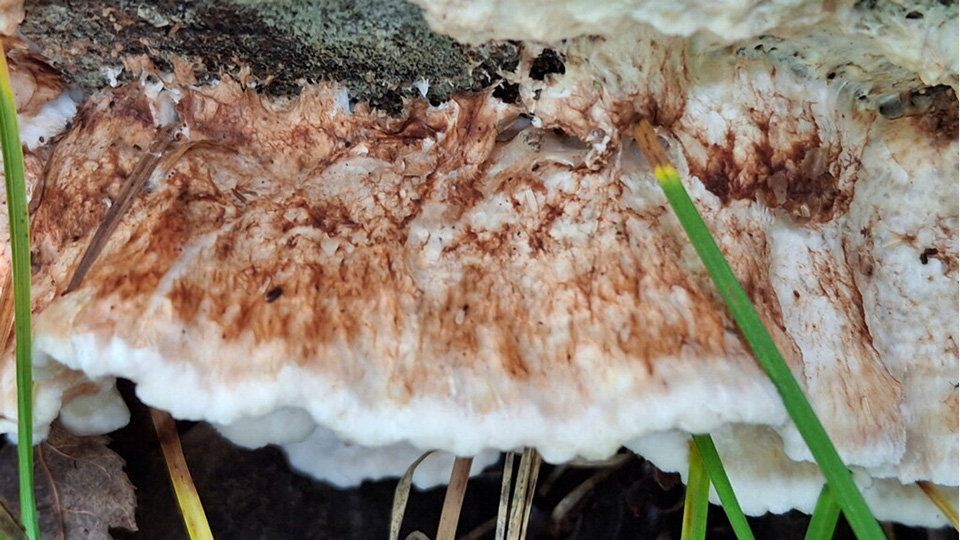
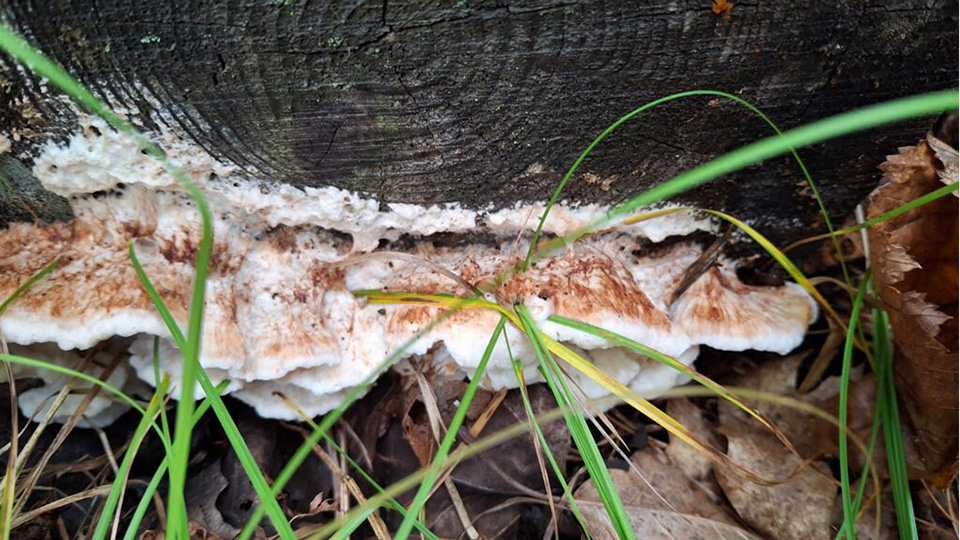
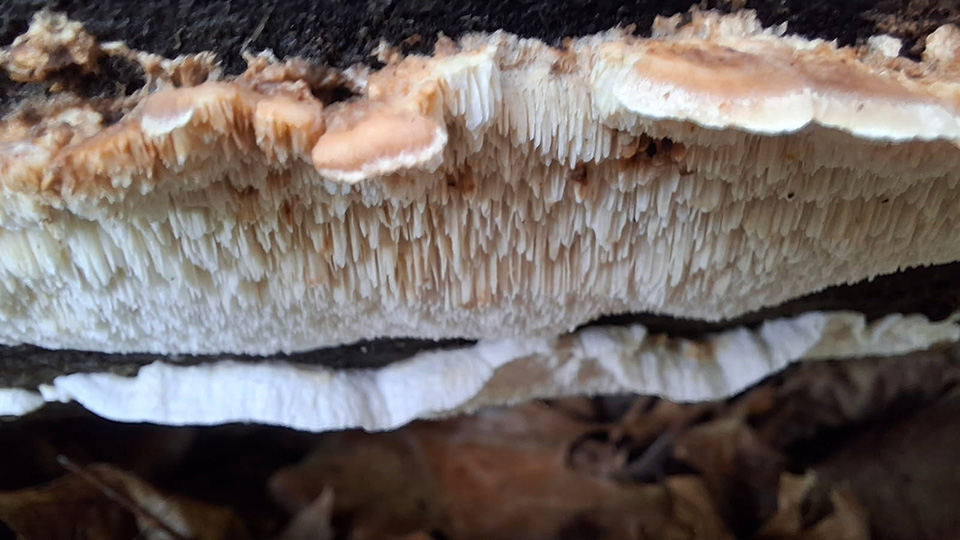
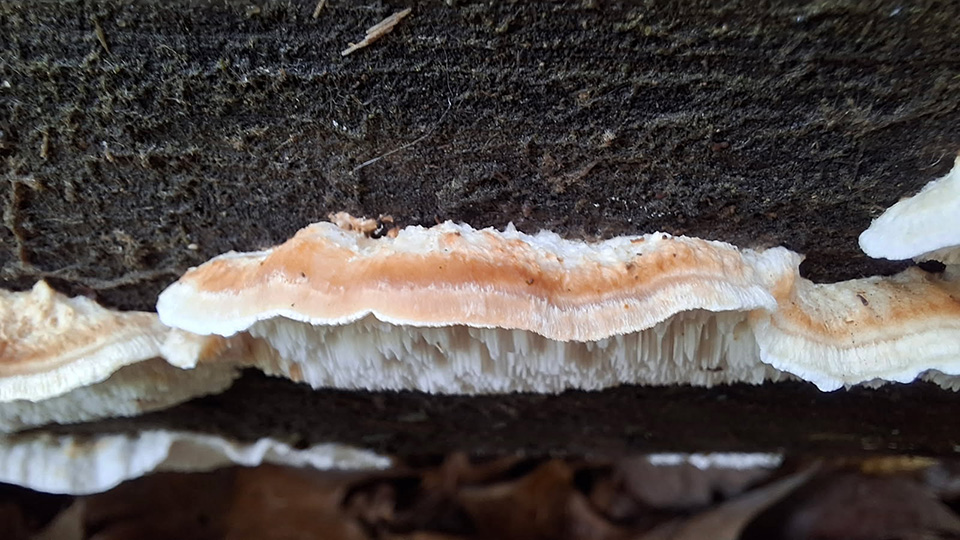
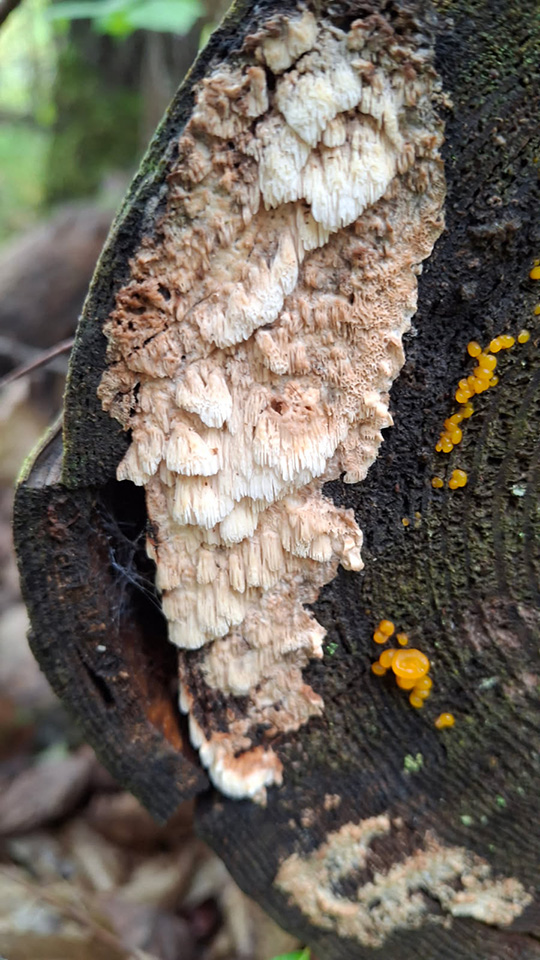
When growing on the underside of a log it looks like a pore surface that has lost its cap. When on the top or side of a log or stump it produces a semi-circular, kidney-shaped to fan-shaped, shelf-like or bracket-like cap. The cap is 1¼″ to 4″ (3 to 10 cm) wide. It is attached to the substrate without a stalk. The upper surface is whitish to brownish or dark brown, but is often green due to a covering of algae. It is concentrically zoned and has a broad pale margin. It is densely covered with fine hairs, sometimes velvety. It is smooth at first, becoming wrinkled or bumpy with age.
The pore surface is whitish when young, becoming smoky gray at maturity. The pores are slotted, maze-like. The tubes are up to ⅛″ (4 mm) deep. They often break into teeth as they age.
When sliced, there is a thin dark line just beneath the upper surface. The flesh is whitish, leathery, and tough. It is inedible.
The spore print is white.
Similar Species
Thin-Walled Maze Polypore (Daedaleopsis confragosa) upper surface is hairless or slightly hairy. The pore walls are relatively thin and white to tan or brown.
Habitat and Hosts
Dead hardwood stumps and logs in deciduous and mixed forests
Ecology
Season
Year round
Distribution

Sources
Biodiversity occurrence data published by: Minnesota Biodiversity Atlas (accessed through the Minnesota Biodiversity Atlas Portal, bellatlas.umn.edu. Accessed 9/30/2026).
Cerrena unicolor (Bull.) Murrill in Bánki, O., Roskov, Y., Döring, M., Ower, G., Hernández Robles, D. R., Plata Corredor, C. A., Stjernegaard Jeppesen, T., Örn, A., Pape, T., Hobern, D., Garnett, S., Little, H., DeWalt, R. E., Miller, J., Orrell, T., Aalbu, R., Abbott, J., Abreu, C., Acero P, A., et al. (2026). Catalogue of Life (2026-08-26 XR). Catalogue of Life Foundation, Amsterdam, Netherlands. https://doi.org/10.48580/dgyy9
Mycology Collections Portal (MyCoPortal) https://www.mycoportal.org/portal/collections/index.php). Accessed 9/30/2026.
Occurrence
Widespread and very common
Taxonomy
Kingdom
Fungi (Fungi)
Subkingdom
Dikarya
Phylum
Basidiomycota (Basidiomycete Fungi)
Subphylum
Agaricomycotina (Higher Basidiomycetes)
Class
Agaricomycetes (Mushrooms, Bracket Fungi, Puffballs, and Allies)
Subclass
Incertae sedis
Order
Polyporales (Shelf Fungi)
Family
Cerrenaceae
Genus
Cerrena
Subordinate Taxa
Synonyms
Agaricus cinereus
Antrodia incana
Boletus unicolor
Bulliardia grisea
Bulliardia nigro-zonata
Bulliardia nigrozonata
Bulliardia unicolor
Cerrena cinerea
Cerrena unicolor f. poroides
Cerrena unicolor f. resupinata
Cerrena unicolor var. irpicoides
Coriolus unicolor
Coriolus unicolor f. resupinatus
Coriolus unicolor var. irpicoides
Daedalea cinerea
Daedalea cinerea var. grisea
Daedalea grisea
Daedalea incana
Daedalea latissima
Daedalea lobata
Daedalea nigrozonata
Daedalea unicolor
Daedalea unicolor f. irpicoides
Daedalea unicolor var. deformata
Daedalea unicolor var. fumosa
Daedalea unicolor var. hydnoidea
Daedalea unicolor var. ochracea
Daedalea unicolor var. resupinata
Daedalea unicolor var. zonata
Daedaleopsis incana
Hydnum unicolor
Lenzites cinereus
Lenzites unicolor
Phyllodontia magnusii
Phyllodontia unicolor
Physisporus latissimus
Polyporus latissimus
Sistotrema cinereum
Sistotrema cinereum var. daedaleum
Sistotrema cinereum var. lutescens
Sistotrema unicolor
Striglia cinerea
Striglia unicolor
Trametes latissima
Trametes unicolor
Trametes unicolor f. latissima
Common Names
Mossy Maze Polypore
Visitor Photos
This button not working for you?
Simply email us at info@MinnesotaSeasons.com.
Attach one or more photos and, if you like, a caption.


Minnesota Seasons Photos
Slideshows
Cerrena unicolor
Mushrooms Fungi
Visitor Videos
This button not working for you?
Simply email us at info@MinnesotaSeasons.com.
Attach a video, a YouTube link, or a cloud storage link.
Other Videos
Visitor Sightings
This button not working for you?
Simply email us at info@MinnesotaSeasons.com.
Be sure to include a location.
Luciearl
9/28/2026

Location: Fairview Twp.
Luciearl
September 2026

Location: Fairview Twp.
Luciearl
9/27/2026

Location: Fairview Twp.
Luciearl
12/8/2018

Location: Cass County
Minnesota Seasons Sightings