Orange Mycena - Species Profile
Conservation • Description • Habitat • Ecology • Distribution • Taxonomy

Conservation Status
IUCN Red List
not listed
NatureServe
NNR - Unranked
Minnesota
not listed
Description
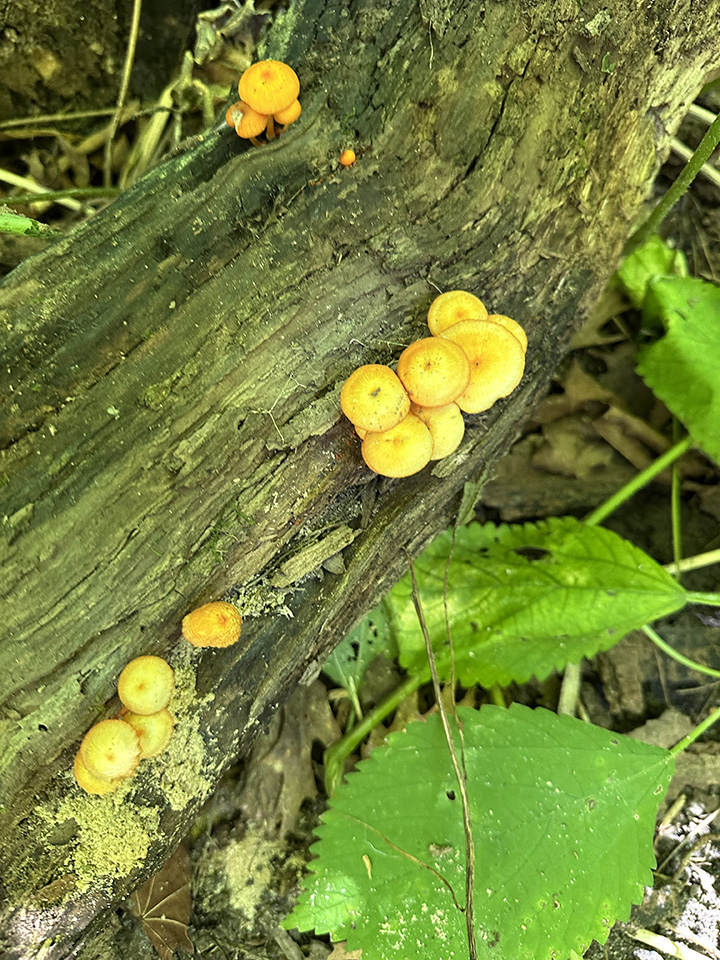
Orange Mycena is a common, colorful, bonnet mushroom. It occurs in North America east of the Great plains and in the Pacific Northwest, and in Mexico and Central America. A variety of this species occurs in eastern Australia and New Zealand. It is found from June through September in woodlands, growing on the dead wood of deciduous trees. It obtains its nutrients from decaying wood (saprobic). It almost always forms tight clusters, with several stems arising from the same point. It is rarely found alone. When handled, the orange pigment will stain the skin.
The cap on young specimens is oval or bell-shaped, bright reddish-orange, shiny, hairless, and sticky. The margin is curved inward. As it ages the cap flattens out, becoming broadly bell-shaped or convex to nearly flat, sometimes with a small depression in the middle. The color fades to bright orange, then paler and more yellowish. The margins sometimes become lined. The upper surface is dull and dry but becomes sticky when wet. Mature caps are ⅜″ to 1½″ (1 to 4 cm) in diameter. Older caps are sometimes almost white.
The stalk is slender, 1¼″ to 2¾″ (3 to 7 cm) long, and 1⁄16″ to ⅛″ (2 to 4 mm) thick. It is often curved or wavy and is sometimes flared at the top. It is tough, cartilaginous, hollow, and sticky when wet. The color is the same as the cap, but it is often paler near the top. It is smooth except rough to the touch just near the top when young. The base is covered with long, stiff, orange hairs. When squeezed, it exudes a watery orange juice.
The gills are closely spaced or crowded. They are broadly attached (adnate) or notched at the point of attachment. The surfaces are pale orange or salmon-colored, but the edges are brilliant reddish-orange. They stain orangish-yellow when bruised.
The flesh is thick, yellowish-white, and watery. Edibility is unknown, but all descriptions mention that the taste is “mealy”, “not distinctive”, or “lacking”.
The spore print is white.
Similar Species
Habitat and Hosts
Woodlands
Dead hardwood
Ecology
Season
June through September
Distribution

Sources
Biodiversity occurrence data published by: Minnesota Biodiversity Atlas (accessed through the Minnesota Biodiversity Atlas Portal, bellatlas.umn.edu. Accessed 8/23/2026).
Mycena leaiana (Berk.) Sacc. in Bánki, O., Roskov, Y., Döring, M., Ower, G., Hernández Robles, D. R., Plata Corredor, C. A., Stjernegaard Jeppesen, T., Örn, A., Pape, T., Hobern, D., Garnett, S., Little, H., DeWalt, R. E., Miller, J., Orrell, T., Aalbu, R., Abbott, J., Abreu, C., Acero P, A., et al. (2026). Catalogue of Life (2026-07-17 XR). Catalogue of Life Foundation, Amsterdam, Netherlands. https://doi.org/10.48580/dgykv
Mycology Collections Portal (MyCoPortal) https://www.mycoportal.org/portal/collections/index.php). Accessed 8/23/2026.
Occurrence
Common
Taxonomy
Kingdom
Fungi (Fungi)
Subkingdom
Dikarya
Phylum
Basidiomycota (Basidiomycete Fungi)
Subphylum
Agaricomycotina (Higher Basidiomycetes)
Class
Agaricomycetes (Mushrooms, Bracket Fungi, Puffballs, and Allies)
Subclass
Agaricomycetidae
Order
Agaricales (Common Gilled Mushrooms and Allies)
Suborder
Marasmiineae
Family
Mycenaceae
Genus
Mycena (Bonnets)
Subordinate Taxa
Synonyms
Agaricus leaianus
Collybia leaiana
Derminus leaianus
Mycena leaiana
Mycena leaiana var. australis
Prunulus leaianus
Common Names
Golden Fairy Helmet
Lea’s Mycena
Orange Mycena