Pear-shaped Puffball - Species Profile
Conservation • Description • Habitat • Ecology • Distribution • Taxonomy

Conservation Status
IUCN Red List
not listed
NatureServe
not listed
Minnesota
not listed
Description
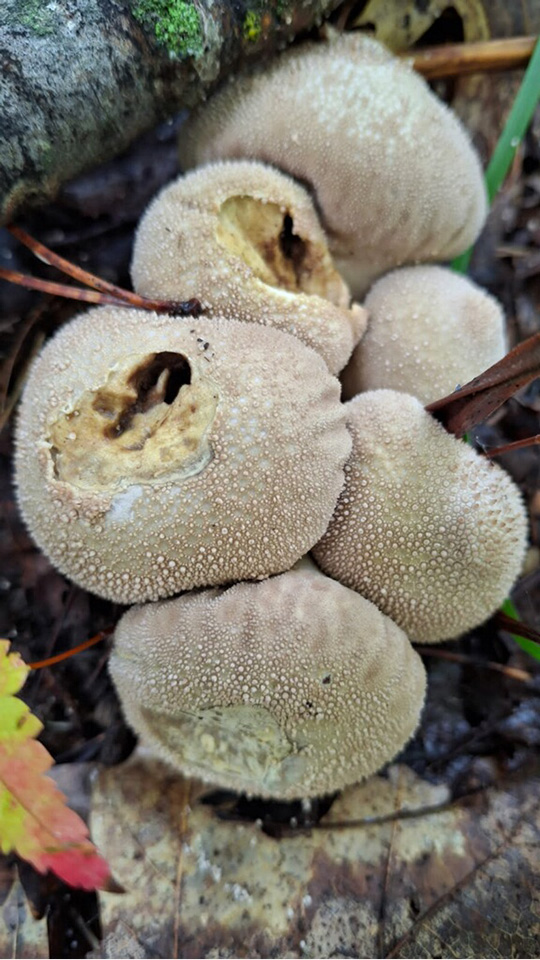
Pear-shaped Puffball, while not the best known puffball, is the most common one in northeast and midwest North America. It is common in Minnesota. Unlike most puffballs, it grows on and obtains its nutrients from rotting wood (saprobic). It is usually found in dense clusters, sometimes scattered, on rotting logs or stumps. The clusters have been described as sometimes “as large as a loaf of bread.”
The fruiting body is pear-shaped to nearly round, 1″ to 2″ in tall, and ⅝″ to 2″ in diameter. When they first appear they are white and smooth, sometimes with a few scattered white spines at the top. Later they become whitish to pale brown and covered with tiny white spines. As it continues to develop it becomes yellowish to brown, the spines disappear, the surface develops fine cracks forming small patches or granules, and it is rough to the touch. The patches or granules eventually fall off exposing a smooth surface. When mature a pore or tear develops at the top (apex) through which spores are released by raindrops or wind. Eventually they turn brown. The tough outer skin persists into winter and sometimes into the following spring.
The flesh is white and fleshy at first, becoming yellowish and granular as it ages, and brownish dust (spores) when mature. It is edible when young and firm inside but relatively tasteless, becoming bitter with age.
Conspicuous white mycelial threads (rhizomorphs) are usually radiating from the base, sometimes in the surrounding substrate.
Similar Species
Common Puffball (Lycoperdon perlatum) is similar in appearance, but it grows on the ground, not on wood.
Habitat and Hosts
Rotting wood
Ecology
Season
Summer to late fall
Distribution

Sources
Biodiversity occurrence data published by: Minnesota Biodiversity Atlas (accessed through the Minnesota Biodiversity Atlas Portal, bellatlas.umn.edu. Accessed 10/8/2024).
Apioperdon pyriforme (Schaeff.) Vizzini in GBIF Secretariat (2023). GBIF Backbone Taxonomy. Checklist dataset https://doi.org/10.15468/39omei accessed via GBIF.org. Accessed 10/8/2024.
Mycology Collections Portal (MyCoPortal) https://www.mycoportal.org/portal/collections/index.php). Accessed 10/8/2024.
Occurrence
Common and widespread
Taxonomy
Kingdom
Fungi (Fungi)
Subkingdom
Dikarya
Phylum
Basidiomycota (Basidiomycete Fungi)
Subphylum
Agaricomycotina (Higher Basidiomycetes)
Class
Agaricomycetes (Mushrooms, Bracket Fungi, Puffballs, and Allies)
Subclass
Agaricomycetidae
Order
Agaricales (Common Gilled Mushrooms and Allies)
Suborder
Agaricineae
Family
Lycoperdaceae (Puffballs)
Genus
Apioperdon
Order
The family Lycoperdaceae was formerly placed in the order Lycoperdales. Recent molecular phylogenetic studies resulted in a resturcturing of fungal taxonomy. Genera formerly in the families Tulostomataceae, Battarreaceae, Lycoperdaceae, and Mycenastraceae have been moved to Agaricaceae. The move has been universally accepted.
Family
This species was formerly classified as Lycoperdon pyriforme, and that genus was formerly placed in the family Lycoperdaceae. Recent phylogenetic analysis showed that family to be a subgroup within the family Agaricaceae. The move has not been universally accepted. Index Fungorum, MycoBank, Catalog of Life, and NCBI all include Lycoperdon in the family Lycoperdaceae.
Genus
This species was formerly classified as Lycoperdon pyriforme. Based on research published in 2003, it was separated from other Lycoperdon species due to its preferred habitat, mycelial strings, and other factors, and it was reclassified as Morganella pyriformis. In 2008, a more inclusive study placed it back in the genus Lycoperdon in the new subgenus Apioperdon. An analysis published in 2017 showed that L. pyriforme is phylogenetically distinct from Lycoperdon and has sufficient distinct morphological features to be placed outside of that genus. The subgenus was raised to the genus level, and the species was reclassified as Apioperdon pyriforme, the only species in the new genus.
Subordinate Taxa
Synonyms
Lycoperdon betulinum
Lycoperdon oviforme
Lycoperdon proteus var. ovoideum
Lycoperdon pyriforme
Lycoperdon pyriforme ssp. globosum
Lycoperdon pyriforme ssp. tessellatum
Lycoperdon pyriforme var. betulinum
Lycoperdon pyriforme var. echinosporum
Lycoperdon pyriforme var. flavum
Lycoperdon pyriforme var. globosum
Lycoperdon pyriforme var. globulosum
Lycoperdon pyriforme var. icterinum
Lycoperdon pyriforme var. intumescens
Lycoperdon pyriforme var. serotinum
Lycoperdon pyriforme var. tesselatum
Lycoperdon pyriforme var. usambarense
Lycoperdon saccatum
Lycoperdon serotinum
Morganella pyriformis
Utraria pyriformis
Utraria pyriformis var. tessellata
Common Names
Pear-shaped Puffball
Stump Puffball