Phomopsis gall - Species Profile
Overview • Description • Distribution • Taxonomy

Overview
Diaporthe (until recently widely known, and still commonly referred to, as Phomopsis) is a very large genus of ascomycetous (sac) fungi. It occurs worldwide on every continent, including Antarctica.
According to the Catalogue of Life, the genus contains over 730 recognized species, as well as a significant number of unranked or synonymized taxa. Within this group, a specialized subset of approximately 15 to 20 species is responsible for causing the highly recognizable swellings known as phomopsis galls on various hardwood hosts.
The lifecycle of these fungi begins with spores produced throughout the growing season, which are dispersed by wind and rain splashes. These spores typically infect a host by entering a wound in a young twig; once established, the fungus spreads through the branches and eventually to the trunk.
Although phomopsis galls are generally not fatal, they can significantly reduce a host’s vigor. Branches that become completely girdled by the fungal growth will eventually die, yet despite these localized impacts, a tree may persist for many decades even with a heavy gall burden. From a management perspective, infected branches can be pruned to improve the tree's appearance or health, though no chemical or systemic treatment currently exists for the fungus.
Beyond the species that produce woody galls, the genus Diaporthe is a diverse and economically significant plant pathogen. It is responsible for a variety of destructive conditions including seed decay, fruit rot, and stem blights. In the Midwest, it is a primary concern for soybean growers, where it causes Pod and Stem Blight, and for viticulturists, where it causes Phomopsis Cane and Leaf Spot in grapevines. Unlike the gall-forming species that stimulate tissue growth, these agricultural strains typically cause rapid necrosis and decay.
Description
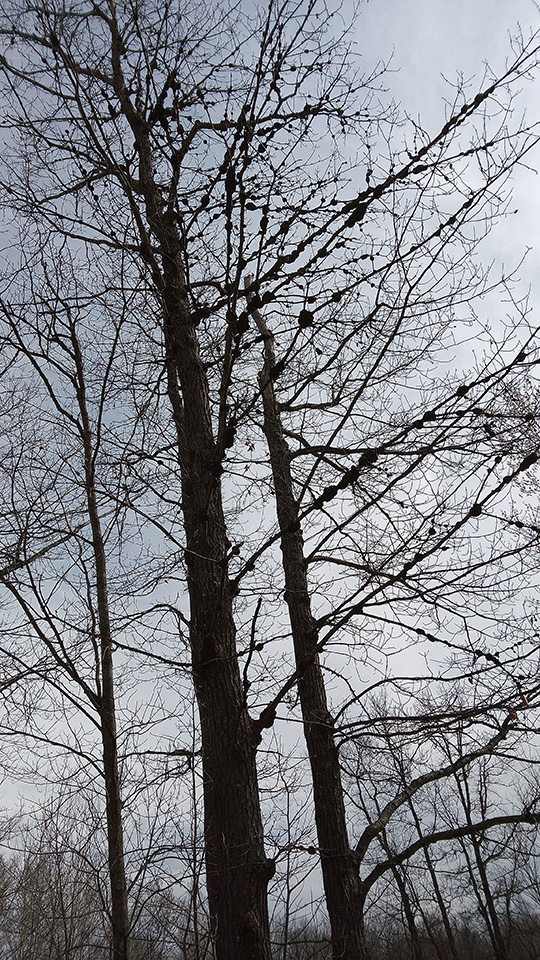
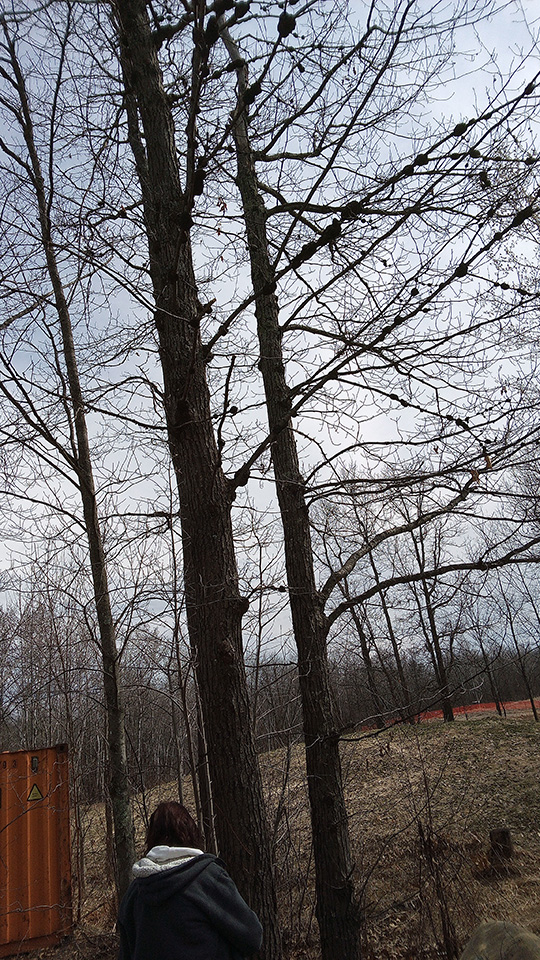
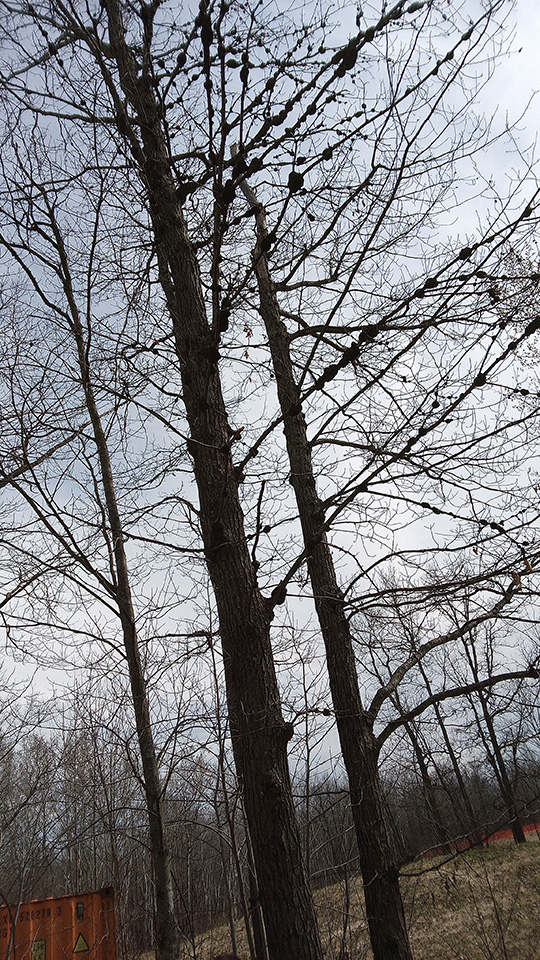
Phomopsis galls are distinctive, woody, “pillowy” swellings (galls) on various hardwoods caused by several species of fungi in the genus Diaporthe. While these perennial growths are most often associated with bitternut hickory, they also frequently appear on other species, including maples and oaks.
Galls may occur singly or in clusters on the trunk and branches. They are woody, rough, and roughly spherical in shape, ranging from less than an inch to over 10″ in diameter. They appear as tight clusters of nodules, with each nodule reaching up to 1″ or more in diameter. If sectioned, they reveal disorganized, hyperplastic, woody tissue with an absence of insect chambers or larval tunnels.
Distribution

Sources
Biodiversity occurrence data published by: Minnesota Biodiversity Atlas (accessed through the Minnesota Biodiversity Atlas Portal, bellatlas.umn.edu. Accessed 2/21/2026).
Mycology Collections Portal (MyCoPortal) https://www.mycoportal.org/portal/collections/index.php). Accessed 2/21/2026.
Taxonomy
Kingdom
Fungi (Fungi)
Subkingdom
Dikarya
Phylum
Ascomycota (Sac Fungi)
Subphylum
Pezizomycotina
Class
Sordariomycetes
Subclass
Diaporthomycetidae
Order
Diaporthales
Family
Diaporthaceae
Genus
Historically, this fungus was assigned two separate names based on its life stage: Phomopsis for its asexual form and Diaporthe for its sexual form. Following a 2011 shift in botanical nomenclature toward a “one fungus, one name” system, the two were unified under the older name, Diaporthe. While the common name "Phomopsis galls" persists due to its long-standing use in field guides and forest pathology, the scientific classification has been updated to reflect this collapse into a single genus.
Subordinate Taxa
Synonyms
Dialytes
Melanoporthe
Phomopsis
Common Names
phomopsis galls