Russell’s Bolete - Species Profile
Conservation • Description • Habitat • Ecology • Distribution • Taxonomy

Conservation Status
IUCN Red List
not listed
NatureServe
NNR - Unranked
Minnesota
not listed
Description
Russell’s Bolete is a fairly common, medium-sized to large, fleshy mushroom. It occurs in the United States east of the Great Plains. There is a disjunct population in southeastern Arizona, an area that hosts a number of eastern species. It also occurs in southern Mexico, northern Central America, and Japan. It is found in the summer and early fall, alone, scattered, or in small groups. It grows on the ground usually under oaks but also under other deciduous trees and sometimes under coniferous trees. It has a mutually beneficial relationship (mycorrhizal) with the tiny rootlets of trees, absorbing sugars and amino acids while helping the tree absorb water.
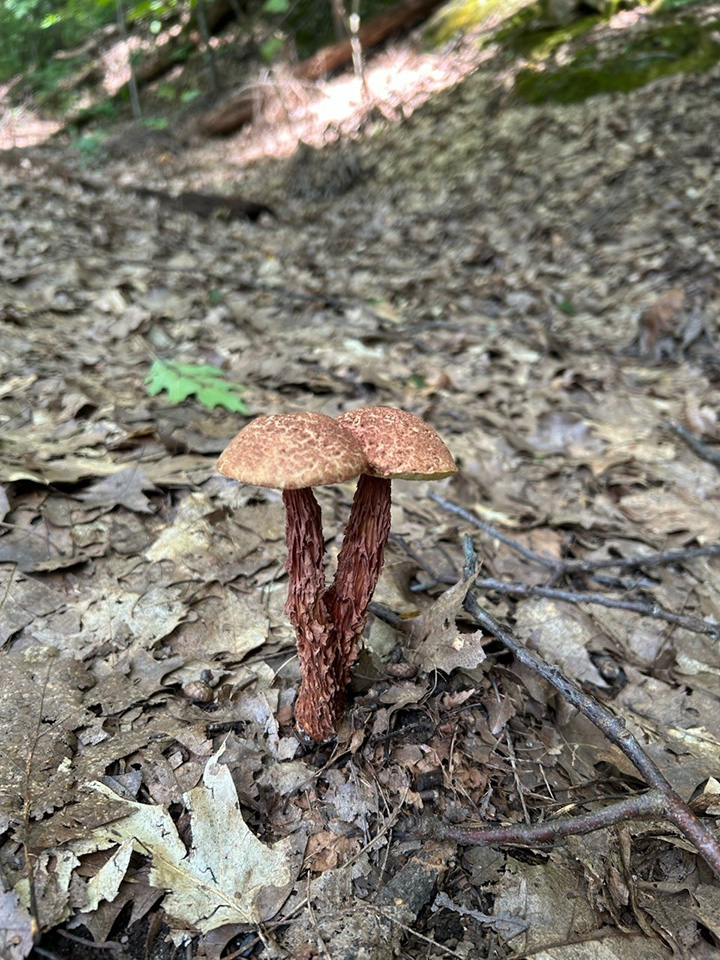
When it first appears the cap is convex, the margins are rolled inward, and the upper surface is densely covered with fine velvety hairs. It can be yellowish-brown, reddish-brown, buff, or olive-gray. As it ages the cap spreads out and becomes hairless (bald). Mature caps are broadly convex. They can be 1¼″ to 5″ (3 to 13 cm) in diameter but are usually no more than 3½″ (9 cm) in diameter. The upper surface breaks up into small scales exposing the pale flesh beneath.
The stalk is solid, tough, reddish-brown, slender, 4″ to 8″ (10 to 20 cm) long, and 5⁄16″ to ¾″ (8 to 20 mm) thick. It is dry but when young it is sticky just at the base. It is often curved, and it is usually the same size for its entire length, but sometimes it is slightly thickened at the base. The surface is deeply ridged and pocketed (lacerated) in a net-like pattern (reticulate).
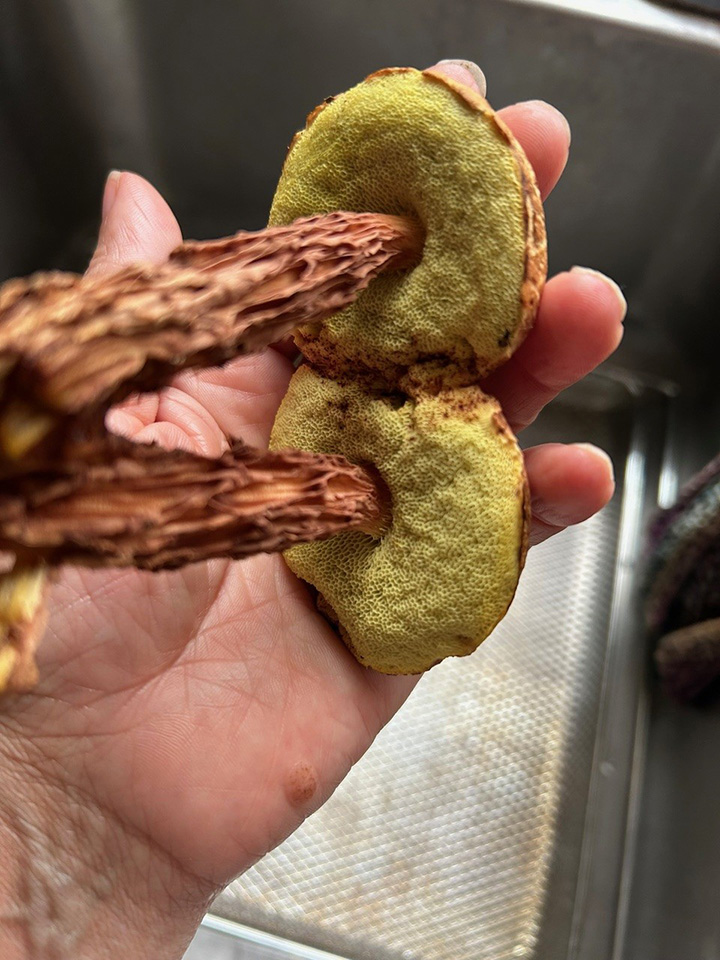
The pore surface is yellow when young, becoming greenish-yellow with age. It does not change color when bruised. The pores are angular and wide, 1⁄32″ (1 mm) broad or more. The pore tubes are up to ⅝″ (15 mm) deep.
The flesh is pale yellow throughout, including under the upper skin (cuticle). It does not change color when bruised or sliced. It is edible but the texture is soft and the taste is bland.
The spore print is dark olive to olive brown.
Similar Species
Habitat and Hosts
Oaks and other deciduous trees, sometimes coniferous trees
Ecology
Season
Summer and early fall
Distribution

Sources
Biodiversity occurrence data published by: Minnesota Biodiversity Atlas (accessed through the Minnesota Biodiversity Atlas Portal, bellatlas.umn.edu. Accessed 8/10/2026).
Aureoboletus russellii (Frost) G. Wu & Zhu L. Yang in Bánki, O., Roskov, Y., Döring, M., Ower, G., Hernández Robles, D. R., Plata Corredor, C. A., Stjernegaard Jeppesen, T., Örn, A., Pape, T., Hobern, D., Garnett, S., Little, H., DeWalt, R. E., Miller, J., Orrell, T., Aalbu, R., Abbott, J., Abreu, C., Acero P, A., et al. (2026). Catalogue of Life (2026-07-17 XR). Catalogue of Life Foundation, Amsterdam, Netherlands. https://doi.org/10.48580/dgykv
Mycology Collections Portal (MyCoPortal) https://www.mycoportal.org/portal/collections/index.php). Accessed 8/10/2026.
Occurrence
Fairly common
Taxonomy
Kingdom
Fungi (Fungi)
Subkingdom
Dikarya
Phylum
Basidiomycota (Basidiomycete Fungi)
Subphylum
Agaricomycotina (Higher Basidiomycetes)
Class
Agaricomycetes (Mushrooms, Bracket Fungi, Puffballs, and Allies)
Subclass
Agaricomycetidae
Order
Boletales (Boletes and Allies)
Suborder
Boletineae
Family
Subfamily
Xerocomoideae
Genus
Aureoboletus
Genus
This species was originally described in 1878 as Boletus russellii. In 1931 it was moved to the genus Boletellus and in 2016 it was moved to the genus Aureoboletus.
Subordinate Taxa
Synonyms
Boletus russellii
Boletellus russellii
Boletogaster russellii
Ceriomyces russellii
Frostiella russellii
Suillus russellii
Common Names
Jagged-stemmed Bolete
Pitted Bolete
Russell’s Bolete
Shagnet