Violet-toothed Polypore - Species Profile
Conservation • Description • Habitat • Ecology • Distribution • Taxonomy
Conservation Status
IUCN Red List
not listed
NatureServe
NNR - Unranked
Minnesota
not listed
Description
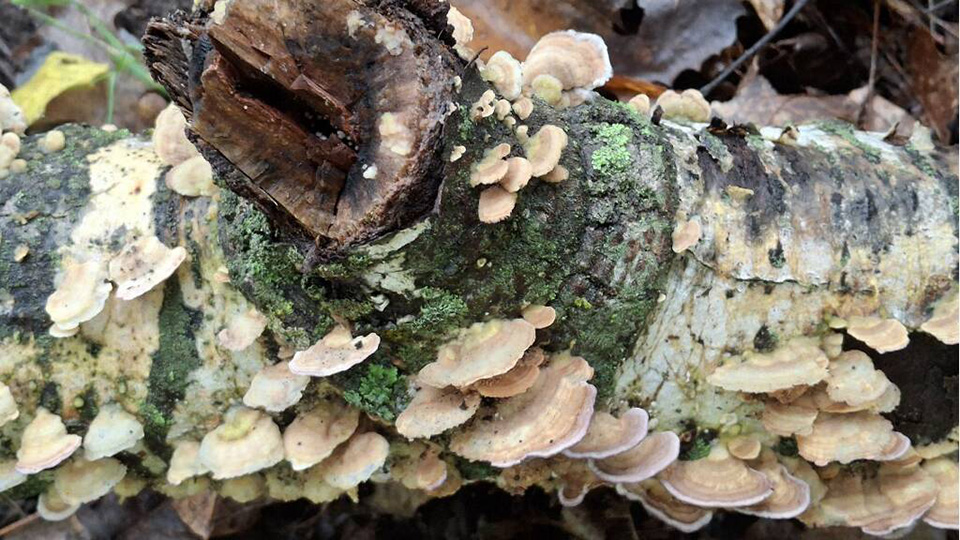
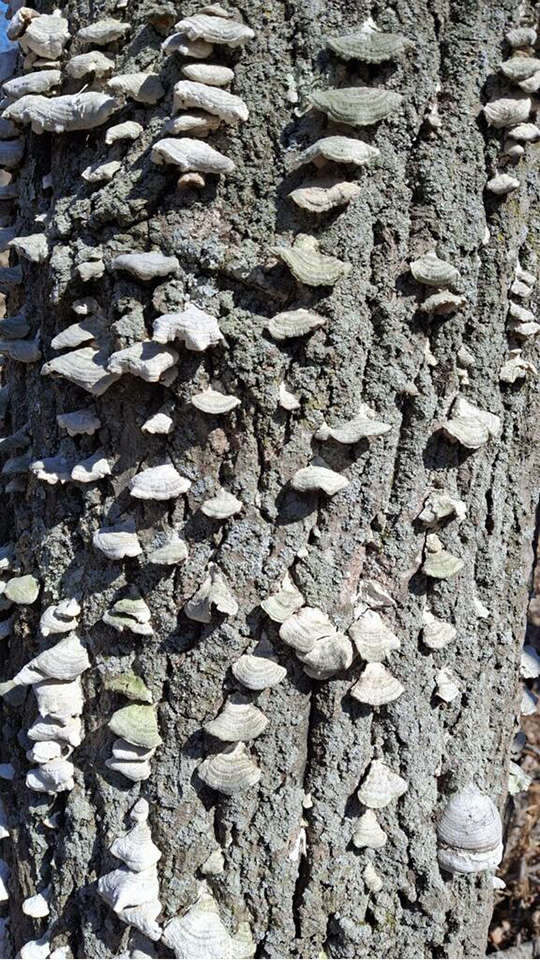
Violet-toothed Polypore is a common and widespread bracket fungus. It occurs in Europe, western Asia, Australia, South America, and North America. It is one of the most commonly encountered fungi in eastern North America, more common than the seemingly ubiquitous Turkey Tail. It is uncommon in the west and mostly absent from the Great Plains. In Minnesota it is common in the east, uncommon in the northwest, and absent from the southwest. It is found in late spring, summer, and fall, on hardwoods, in deciduous and mixed forests and woodlands. It grows on dead and fallen sticks, branches, and logs, and on stumps. It appears alone or in overlapping clusters, sometimes in a large mass completely covering a rotting log. It obtains its nutrients from dead wood (saprobic).
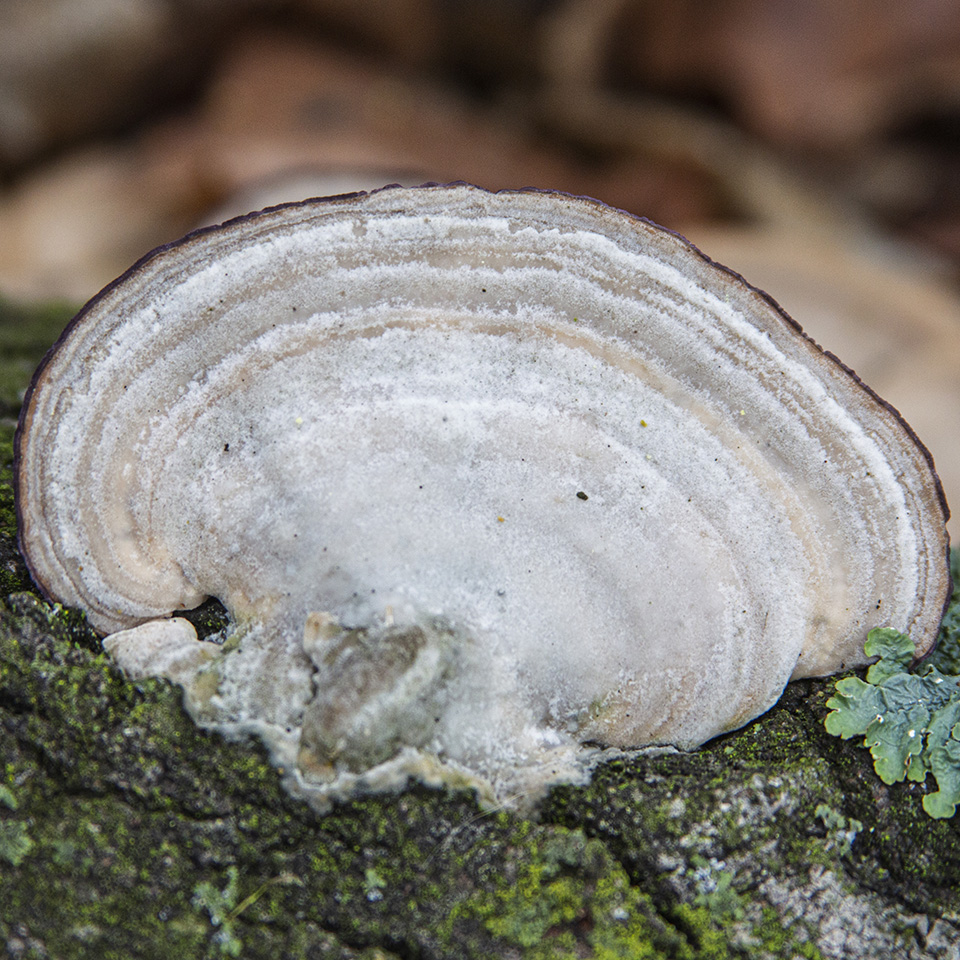
The fruiting body is a ⅜″ to 3″ (1.0 to 7.5 cm) wide, up to ⅛″ (3 mm) thick, shelf-like or bracket-like cap. It is flattened, only slightly convex, and may be fan-shaped, semi-circular, kidney-shaped, or irregular in outline. When it first appears the cap is shades of violet from dark to pale. The violet color soon fades. The mature cap is velvety hairy on the upper side and concentrically zoned with white, grayish-white, and brownish-white. The margin is sometimes pale violet. Older caps may be mostly hairless.
The pore surface is pore-like at first, with 2 to 5, violet-colored pores per milliimeter. As it ages it becomes tooth-like and the violet color fades to buff or brown. The violet color fades from the center outward. Mature specimens often retain some violet tints near the margin, or just a thin violet fringe. Older specimens don’t show any trace of violet.
The flesh is tough and inedible.
Similar Species
Fungus (Pallidohirschioporus subchartaceus) grows only on aspen and poplar.
Purplepore Bracket (Trichaptum abietinum) almost always grows on coniferous trees.
Habitat and Hosts
Deciduous and mixed forests and woodlands. Hardwoods.
Ecology
Season
Late spring, summer, and fall
Distribution

Sources
Biodiversity occurrence data published by: Minnesota Biodiversity Atlas (accessed through the Minnesota Biodiversity Atlas Portal, bellatlas.umn.edu. Accessed 9/29/2026).
Pallidohirschioporus biformis (Fr.) Y.C. Dai, Yuan Yuan & Meng Zhou in Bánki, O., Roskov, Y., Döring, M., Ower, G., Hernández Robles, D. R., Plata Corredor, C. A., Stjernegaard Jeppesen, T., Örn, A., Pape, T., Hobern, D., Garnett, S., Little, H., DeWalt, R. E., Miller, J., Orrell, T., Aalbu, R., Abbott, J., Abreu, C., Acero P, A., et al. (2026). Catalogue of Life (2026-08-26 XR). Catalogue of Life Foundation, Amsterdam, Netherlands. https://doi.org/10.48580/dgyy9
Mycology Collections Portal (MyCoPortal) https://www.mycoportal.org/portal/collections/index.php). Accessed 9/29/2026.
Occurrence
Very common in Minnesota forests
Taxonomy
Kingdom
Fungi (Fungi)
Subkingdom
Dikarya
Phylum
Basidiomycota (Basidiomycete Fungi)
Subphylum
Agaricomycotina (Higher Basidiomycetes)
Class
Agaricomycetes (Mushrooms, Bracket Fungi, Puffballs, and Allies)
Subclass
Agaricomycetidae
Order
Hymenochaetales
Family
Hirschioporaceae
Genus
Pallidohirschioporus
Genus
This species was first described as Polyporus biformis by Elias Magnus Fries in 1833. It was placed in the family Polyporaceae in the order Polyporales. In 1972 Miles Joseph Berkeley transferred it into the genus Trichaptum in the order Hymenochaetales, and it became Trichaptum biforme. Trichaptum and several other genera in the Hymenochaetales were Incertae sedis (“uncertain placement”), and they were not placed in a family.
The genus Trichaptum contained species that were derived from more than one common ancestor (polyphyletic), and it was therefore invalid. A very recent morphological and molecular study (Zhou M et al., 2023) proposed a revised systematics of Trichaptum s. l.. Two new families and five new genera were proposed. Ten species were transferred into the new genus Pallidohirschioporus and the new family Hirschioporaceae. Pallidohirschioporus biformis became the type species of the genus Pallidohirschioporus.
The proposed move has not been widely accepted – yet. This mat be in part to the newness of the study, which was published in August 2023. Index Fungorum, MycoBank, NatureServe, NCBI, and Catalogue of Life have adopted the new systematics. Mushroom Observer, Discover Life, and iNaturalist still use the name Trichaptum biforme.
Subordinate Taxa
Synonyms
Bjerkandera biformis
Coriolus biformis
Coriolus elongatus
Coriolus friesii
Coriolus laceratus
Coriolus pergamenus
Coriolus prolificans
Coriolus sartwellii
Coriolus sublimitatus
Heteroporus pergamenus
Hirschioporus elongatus
Hirschioporus friesii
Hirschioporus pergamenus
Irpex elongatus
Microporellus friesii
Microporus biformis
Microporus candicans
Microporus elongatus
Microporus evolvens
Microporus friesii
Microporus inquinatus
Microporus laceratus
Microporus pergamenus
Microporus prolificans
Microporus sartwellii
Polyporus biformis
Polyporus ehretiae
Polyporus elongatus
Polyporus elongatus var. stipitatus
Polyporus evolvens
Polyporus friesii
Polyporus hodgkinsoniae
Polyporus inquinatus
Polyporus laceratus
Polyporus menandianus
Polyporus pergamenus
Polyporus pergamenus var. elongatus
Polyporus prolificans
Polyporus pseudopargamenus
Polyporus pseudopergamenus
Polyporus sartwellii
Polystictus biformis
Polystictus candicans
Polystictus elongatus
Polystictus elongatus ssp. hodgkinsoniae
Polystictus elongatus var. hodgkinsoniae
Polystictus elongatus var. stipitatus
Polystictus evolvens
Polystictus friesii
Polystictus hodgkinsoniae
Polystictus hodgkinsoniae var. stipitatus
Polystictus inquinatus
Polystictus laceratus
Polystictus menandianus
Polystictus pergamenus
Polystictus pergamenus ssp. laceratus
Polystictus pergamenus ssp. pseudopergamenus
Polystictus prolificans
Polystictus prolificans var. apus
Polystictus sartwellii
Polystictus sublimitatus
Spongipellis lacerata
Trametes biformis
Trametes friesii
Trametes pergamena
Trichaptum biforme
Trichaptum biforme var. fuscatum
Trichaptum biforme var. microsporum
Trichaptum biforme var. pusillum
Trichaptum pergamenum
Common Names
Violet-toothed Polypore