Yellow Morel - Species Profile
Conservation • Description • Habitat • Ecology • Use • Distribution • Taxonomy

Conservation Status
IUCN Red List
not listed
NatureServe
not listed
Minnesota
not listed
Description
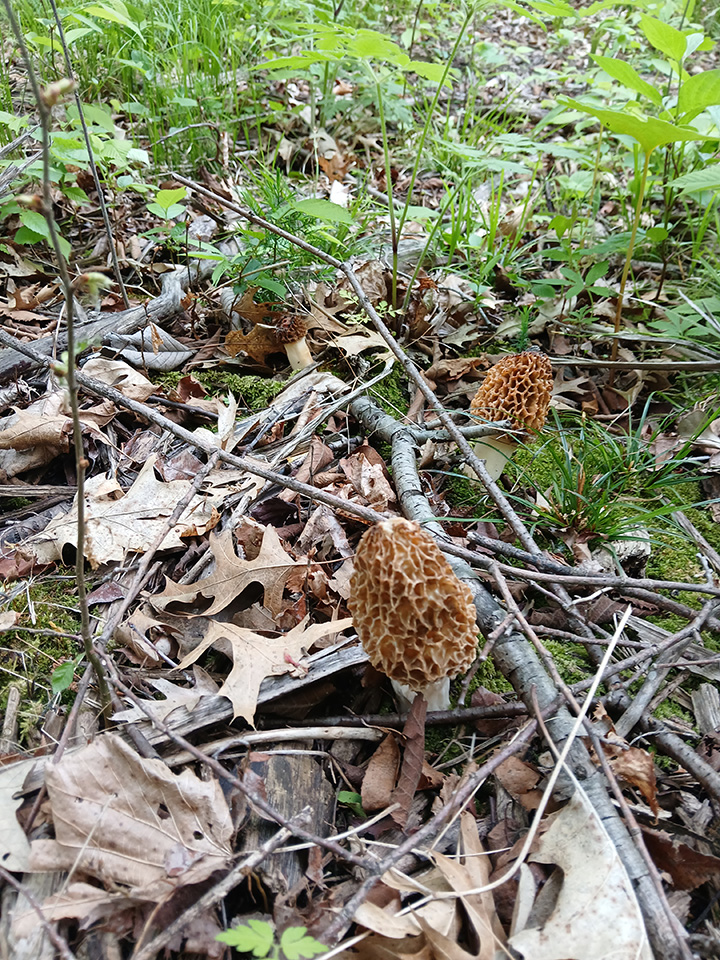
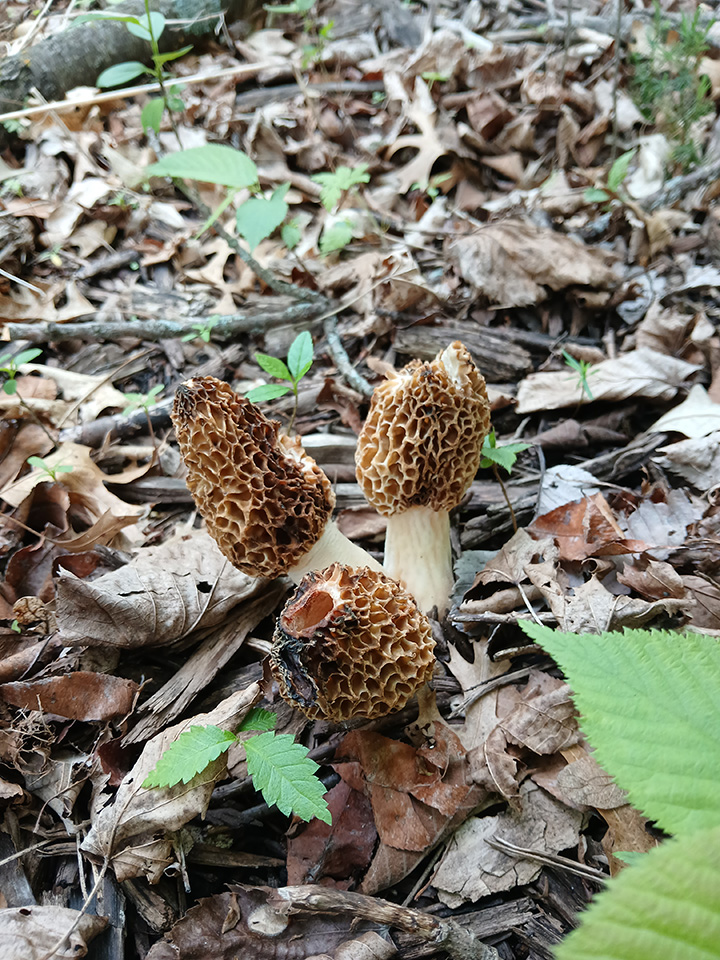
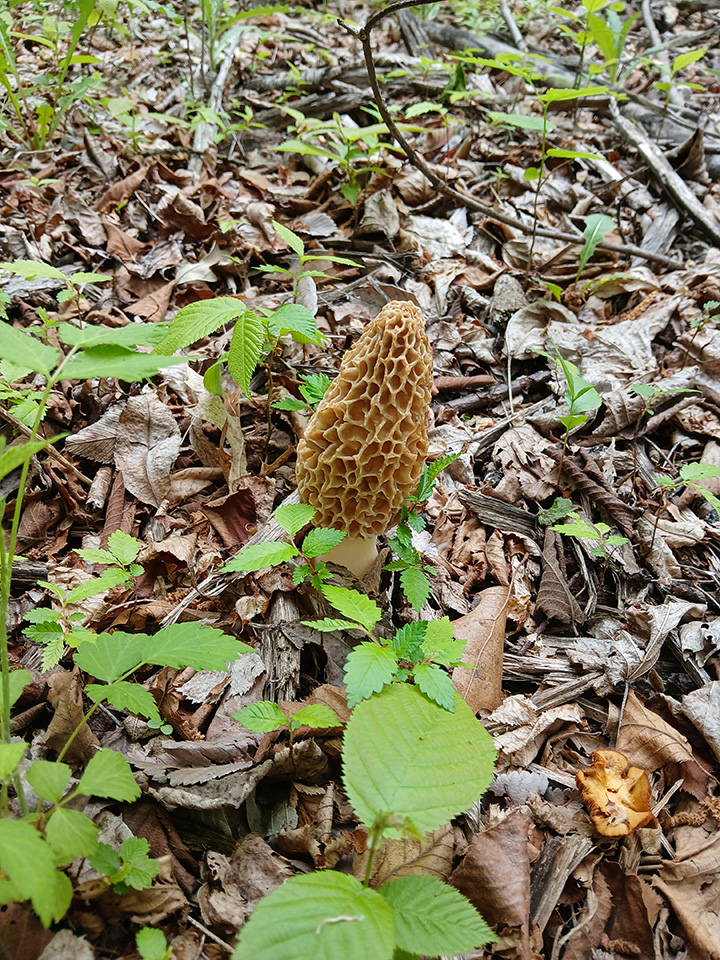
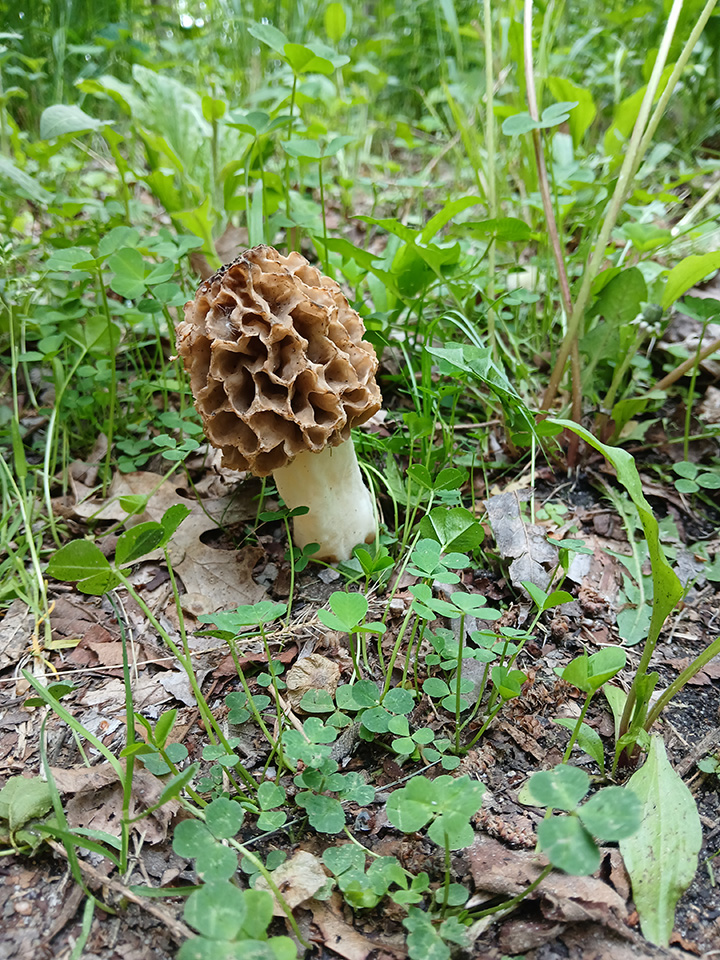
Yellow Morel, also called American Yellow Morel, White Morel, and Blond Morel, is a common, easily recognized mushroom. Morels are one of the “Foolproof Four”, the four most easily identified mushrooms. It is found growing alone, scattered, or clustered on the ground under hardwoods, often poking through leaf litter.
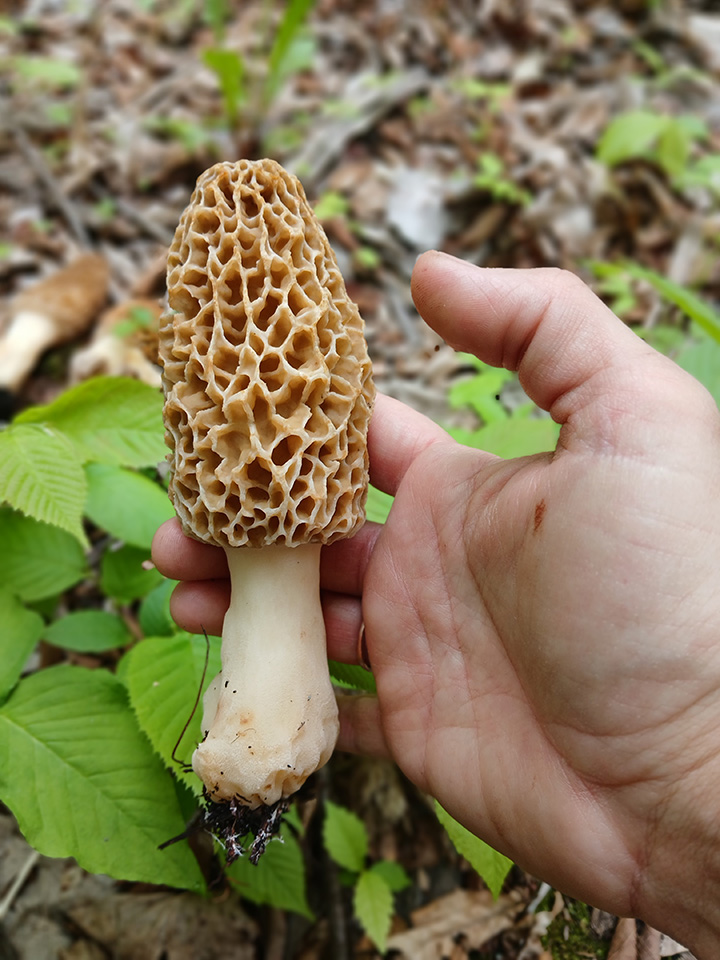
The cap is hollow; usually egg-shaped with a blunt, cone-shaped tip; 1¼″ to 4¼″ long; and ¾″ to 2⅜″ wide. Sometimes it is round, cone-shaped, or irregular in shape. It is deeply pitted with irregularly shaped and randomly oriented pits. The edges of the pits are broadly angled, not sharp. The overall color of the cap is yellowish-brown. When young the cap is shallowly pitted, the ridges are yellow or whitish, and the pits are grayish-brown or dark brown. When mature the cap is deeply pitted and the ridges are the same color or slightly paler than the pits. The ridges do not darken or turn black with age. The margin of the cap is attached directly to the stalk but it is often creased at that point and may appear unattached.
The stalk is usually ⅜″to 2″ long, and ⅜″to 1″thick, usually shorter than the cap. In favorable conditions it may get much longer with age. It is hollow; whitish, pale yellowish-brown, or tan; and usually granular.
Similar Species
False Morel (Gyromitra esculenta) surface is folded, not pitted. The cap is not completely fused to the stalk. The stalk is not hollow. It is poisonous.
Habitat and Hosts
A wide variety of habitats, but especially in deciduous forests under a hardwood tree.
Ecology
Season
May
Use
State mushroom
Yellow Morel is the state mushroom of Minnesota.
Distribution

Sources
Biodiversity occurrence data published by: Minnesota Biodiversity Atlas (accessed through the Minnesota Biodiversity Atlas Portal, bellatlas.umn.edu. Accessed 5/17/2024).
Morchella americana Clowez & Matherly in GBIF Secretariat (2023). GBIF Backbone Taxonomy. Checklist dataset https://doi.org/10.15468/39omei accessed via GBIF.org. Accessed 5/17/2024.
Mycology Collections Portal (MyCoPortal) https://www.mycoportal.org/portal/collections/index.php). Accessed 5/17/2024.
Occurrence
Common
Taxonomy
Kingdom
Fungi (Fungi)
Subkingdom
Dikarya
Phylum
Ascomycota (Sac Fungi)
Subphylum
Pezizomycotina
Class
Pezizomycetes
Subclass
Pezizomycetidae
Order
Pezizales
Family
Morchellaceae (Morels and Allies)
Genus
Morchella (True Morels)
Section
Morchella (Yellow Morels)
Species
Recent molecular phylogenetic analyses of the genus Morchella showed that with two exceptions, the species endemic to Europe are restricted to Europe, and the names applied to those species could not be applied to North American morels. The two exceptions occur in both in Europe and Asia, but not in North America.
This species was formerly knows as Morchella esculenta, a species common in both Europe and the United States. A recent taxonomic revision of Morchella in North America (Kuo et al., 2012) renamed the North American morels previously known as M. esculenta as M. esculentoides.
A later molecular phylogenetic analysis of the true morels of North America (Richard et al., 2015) showed Morchella esculentoides to be s synonym of Morchella americana. The most common Esculenta Clade
yellow morel in North America is now Morchella americana.
Subordinate Taxa
Synonyms
Morchella americana var. americana
Morchella americana var. elongata
Morchella californica
Morchella claviformis
Morchella esculentoides
Morchella populina
Common Names
American Blond Morel
American Yellow Morel
Blond Morel
Common Morel
Gray Morel
Morel
White Morel
Yellow Morel
Following the separation of the North American true morels from those of Europe, several new common names have been adopted for the most common North American yellow morel, including American Blond Morel and American Yellow Morel. The name White Morel was used by iNaturalist, but it has not been widely adopted. Most sources retained the common name Yellow Morel. The name White Morel was used by iNaturalist for a time, but it was not widely adopted. The name Gray Morel was misapplied to morels with gray caps and nearly black pits, but these are immature Yellow Morels.