American dagger moth - Species Profile
Conservation • Description • Habitat • Ecology • Distribution • Taxonomy

Hodges #
9200
Conservation Status
IUCN Red List
not listed
NatureServe
NNR - Unranked
Minnesota
not listed
Description
Dagger Moths (genus Acronicta) is a large genus with about 150 species worldwide, more than 73 species in North America north of Mexico. At least 28 species have been reported in Minnesota. The common name refers to a black, dagger-like dash on the forewings of many of the species. Most adults are gray with darker gray markings, and they are difficult to identify.
American dagger moth is the largest dagger moth in eastern United States. The adult is 1 1 ⁄16″ to 1½″ (27 to 38 mm) long and has a wingspan of 2″ to 2 9 ⁄16″ (50 to 65 mm). It is found in deciduous woodlands and forests across the United States and southern Canada. It is common and sometimes abundant east of the Great Plains, common in Minnesota.
The forewings are pale gray or brownish-gray. There is a circular spot in the upper median area (orbicular spot) and a kidney-shaped spot at the end of the discal cell (reniform spot). The orbicular spot is a thin dark circle. The reniform spot has a thin dark outline. It is dark in the center, pale toward the edges. There is no claviform spot. There are faint gray, basal, antemedial (AM), median, and postmedial (PM) lines. The basal, AM, and PM lines are doubled, two thin dark lines with a wider pale area between. The median line is usually complete between the reniform spot and the leading edge of the wing (costal margin). The PM line is strongly jagged and the pale middle is lighter than the background color of the wing. There is only a single thin, black, dagger-like dash. It passes through the PM line in the anal area. There is no subterminal line. The terminal line consists of a series of conspicuous black spots between the veins.
The hindwing on the male is light tannish gray. There is an indistinct gray discal spot, a gray PM line, gray shading in the submarginal area, and dark gray spots representing a terminal line. The fringe is white. On the female the hindwing is dark grayish-brown, the PM line is less distinct, and the fringe is tannish-white.
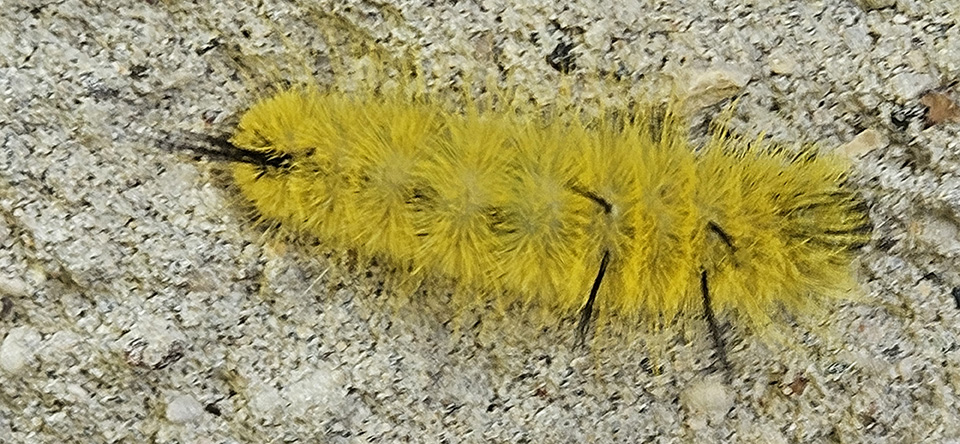
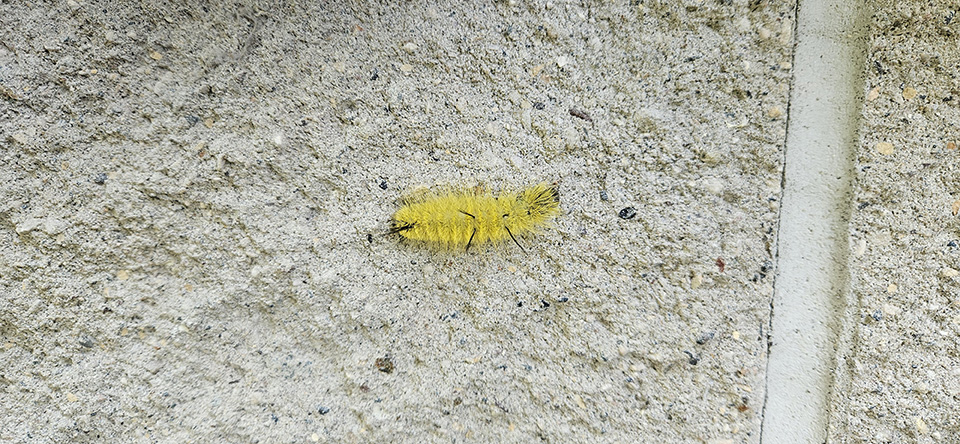
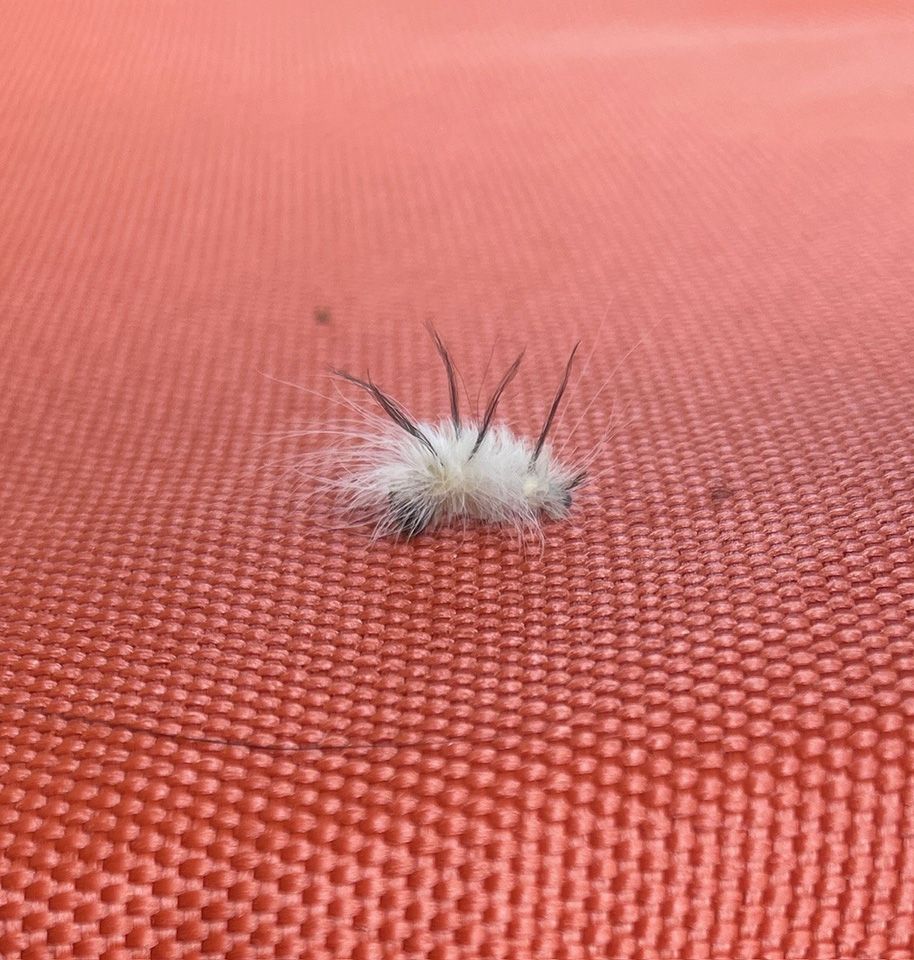
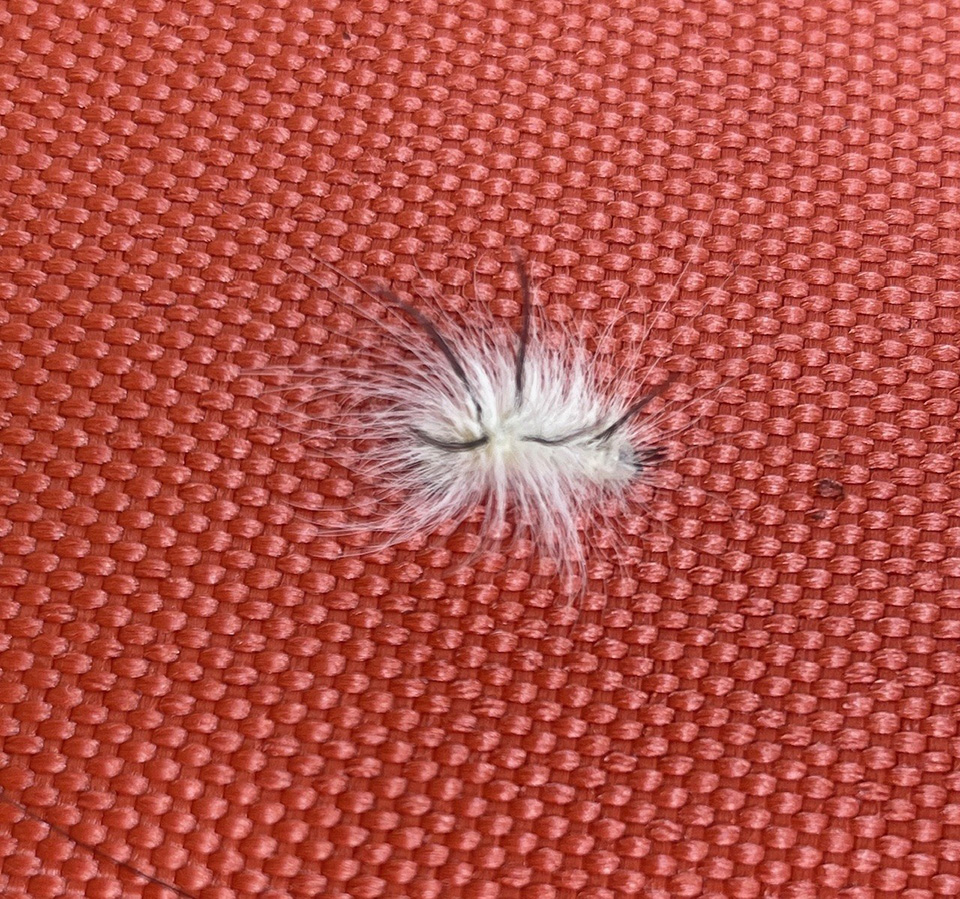
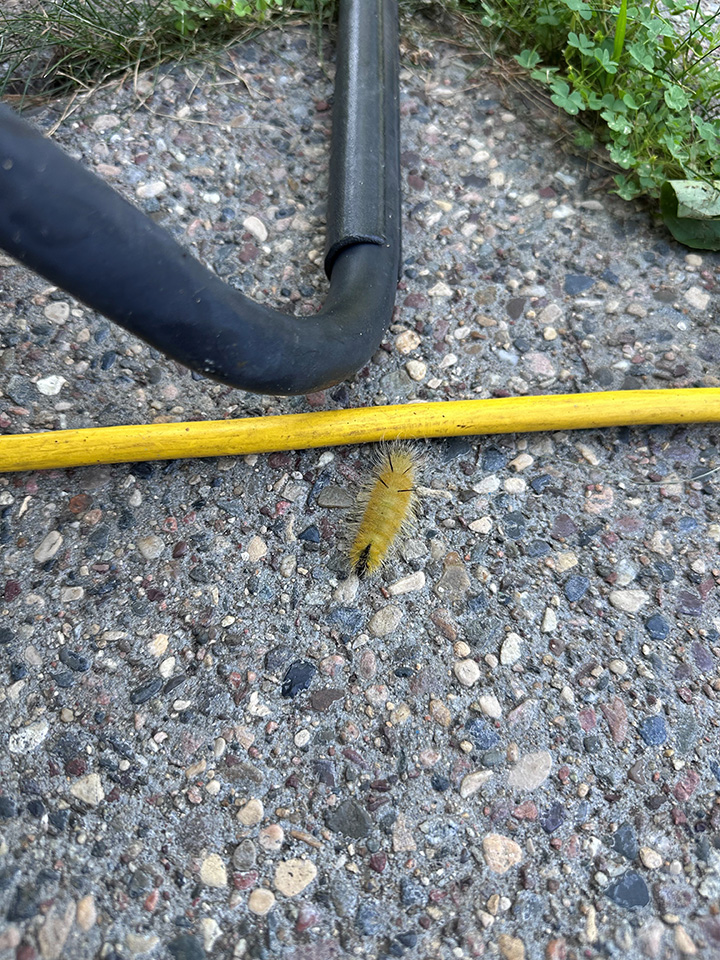
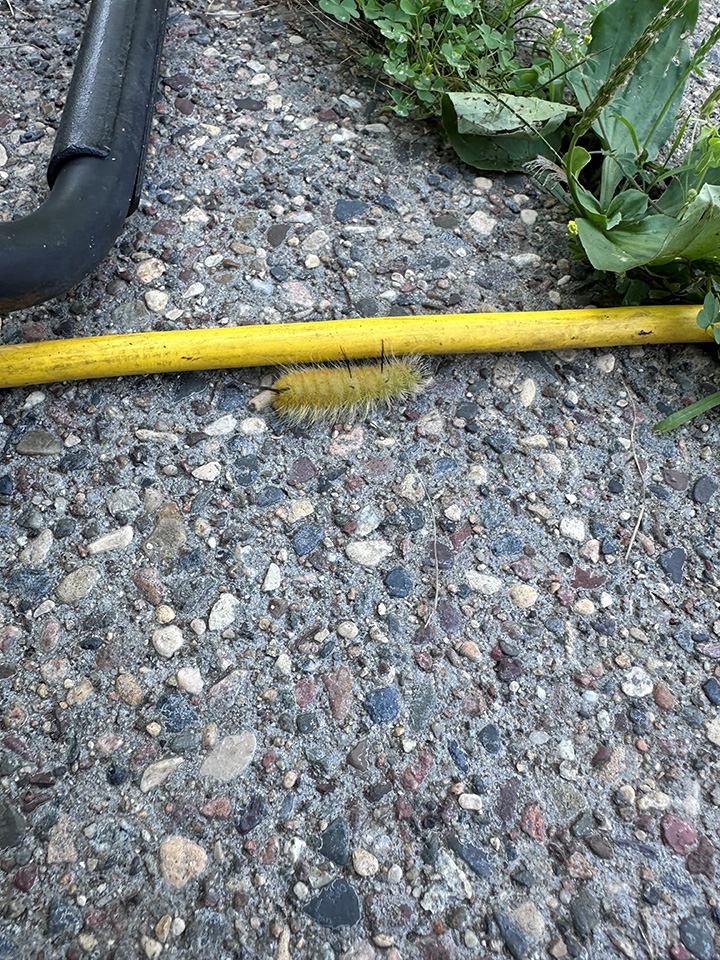
The late stage (instar) caterpillar is pale green and large, up to 2 3 ⁄16″ (55 mm) long. It is densely covered with long, white or pale yellow, hair-like outgrowths (setae). The earlier instar caterpillar is darker yellow. There is a pair of long, erect, black lashes in the subdorsal area of the first and third abdominal segment, and a single, thicker lash in the middle of the eighth segment. The lashes are tight groups of bristle-like setae. They will break off and embed in the skin of predators or of human handlers. They contain a toxin which causes stinging and burning and can develop into a rash. Mature caterpillars are found from July to October.
Size
Total length: 1 1 ⁄16″ to 1½″ (27 to 38 mm)
Wingspan: 2″ to 2 9 ⁄16″ (50 to 65 mm)
Similar Species
Habitat
Deciduous woodlands and forests
Ecology
Season
One generation per year in Minnesota: April to September
Behavior
Adults are active at night and will come to lights.
To avoid detection by predators, the larva will sometimes clip off a partially eaten leaf, letting it fall to the ground.
Life Cycle
Pupa overwinter.
Larva Food/Hosts
Many woody plants, including alder, ash, basswood, birch, blue beech, boxelder, elm, hazel, hickory, horse chestnut, maple, oak, poplar, walnut, and willow.
Adult Food
Distribution

Sources
Biodiversity occurrence data published by: Minnesota Biodiversity Atlas (accessed through the Minnesota Biodiversity Atlas Portal, bellatlas.umn.edu. Accessed 7/18/2026).
Acronicta americana Harris, 1841 in Bánki, O., Roskov, Y., Döring, M., Ower, G., Hernández Robles, D. R., Plata Corredor, C. A., Stjernegaard Jeppesen, T., Örn, A., Pape, T., Hobern, D., Garnett, S., Little, H., DeWalt, R. E., Miller, J., Orrell, T., Aalbu, R., Abbott, J., Abreu, C., Acero P, A., et al. (2026). Catalogue of Life (2026-06-19 XR). Catalogue of Life Foundation, Amsterdam, Netherlands. https://doi.org/10.48580/dgy8b
Quinn, Edward. M., and Ron Danielson. April 27, 2009. A Survey of Lepidoptera in Three Priority Areas of the Minnesota State Parks System. https://files.dnr.state.mn.us/eco/nongame/projects/consgrant_reports/2009
/2009_quinn_danielson.pdf.
Occurrence
Common
Taxonomy
Order
Lepidoptera (Butterflies and Moths)
Superfamily
Noctuoidea (Owlet Moths and Allies)
Family
Noctuidae (Cutworm Moths and Allies)
Subfamily
Acronictinae
Genus
Acronicta (Dagger Moths)
Subgenus
Acronicta
Section
Acronicta americana (American and Large Gray Daggers and Allies)
Subordinate Taxa
Synonyms
Acronicta acericola
Acronicta aceris
Acronicta eldora
Acronicta obscura
Common Names
American dagger
American dagger moth