Mexican grass-carrying wasp
(Isodontia mexicana)
Conservation • Description • Habitat • Ecology • Distribution • Taxonomy

Conservation Status
IUCN Red List
not listed
NatureServe
not listed
Minnesota
not listed
Description
Mexican grass-carrying wasp is a slender, solitary, thread-waisted wasp. It is common in the northern half of the eastern United States and adjacent Canadian provinces. It has also been recorded, but is not common, south to Florida and west to California. It is common in the southern half of Minnesota. It is found from May to October in fields and other grassy open areas.
Adults are ⅝″ to ¾″ (16 to 20 mm) in length. Females average ⅝″ (17 mm), slightly larger than males which average ⅝″ (16 mm).
The head, thorax, and abdomen are completely black. The thorax is covered with long, erect, white hairs. The shield on the first segment of the thorax (pronotum) is short. There is a small rounded lobe on each side of the pronotum that does not reach the small plate (tegula) at the base of the wing.
The abdomen is shiny. The first segment is contracted into a thin stalk (petiole), making the body appear “thread-waisted”. There is a small brown spot at the base of the first segment of the abdomen, where the abdomen meets the petiole. This feature is thought to be diagnostic for this species.
The legs are black. On the middle leg there are two spurs at the tip (apex) of the fourth leg segment (tibia). The tibiae on the hind leg sometimes has a reddish tint. The end part of the leg, corresponding to the foot, has five segments. The last (terminal) segment on the front legs have no teeth.
There are both apressed silver hairs on the face and head, and erect white and brown hairs on the face. The antennae are black. The first antenna segment is longer than the second.
The wings are clear and tinted smoky brown.
Size
Total length: ⅝″ to ¾″ (16 to 20 mm)
Male Average Length: ⅝″ (16 mm)
Female Average Length: ⅝″ (17 mm)
Similar Species
Habitat
Fields and other grassy open areas
Ecology
Season
Two generations per year: May to October
Behavior
When at rest, the wings are held spread out at an angle from the body.
Life Cycle
The female builds a nest in a pre-existing natural cavity, an abandoned nest of another speceis, or a track of a storm window, lining it with dry or drying grass. She then finds and paralyses a tree cricket, katydid, or grasshopper, and carries it back to the nest. She partitions the nest and lays a single egg in each section. When the eggs hatch, the larvae feed on the still living cricket. They pupate after 4 to 6 days and emerge as adults in 2 to 3 weeks.
Larva Food/Hosts
Adult Food
Distribution

Sources
Biodiversity occurrence data published by: Minnesota Biodiversity Atlas (accessed through the Minnesota Biodiversity Atlas Portal, bellatlas.umn.edu. Accessed 10/18/2026).
Isodontia mexicana (de Saussure, 1867) in Bánki, O., Roskov, Y., Döring, M., Ower, G., Hernández Robles, D. R., Plata Corredor, C. A., Stjernegaard Jeppesen, T., Örn, A., Pape, T., Hobern, D., Garnett, S., Little, H., DeWalt, R. E., Miller, J., Orrell, T., Aalbu, R., Abbott, J., Abreu, C., Acero P, A., et al. (2026). Catalogue of Life (2026-08-26 XR). Catalogue of Life Foundation, Amsterdam, Netherlands. https://doi.org/10.48580/dgyy9Occurrence
Common in southern Minnesota
Taxonomy
Order
Hymenoptera (Ants, Bees, Wasps, and Sawflies)
Suborder
Apocrita (Narrow-waisted Wasps, Ants, and Bees)
Infraorder
Aculeata (Ants, Bees, and Stinging Wasps)
Superfamily
Apoidea (Bees and Apoid Wasps)
Family
Sphecidae (Thread-waisted Wasps)
Subfamily
Sphecinae
Tribe
Sphecini
Genus
Isodontia (Grass-carrying Wasps)
Subordinate Taxa
Synonyms
Sphex apicalis
Sphex apicalis mexicana
Common Names
Mexican grass-carrying wasp
Visitor Photos
This button not working for you?
Simply email us at info@MinnesotaSeasons.com.
Attach one or more photos and, if you like, a caption.
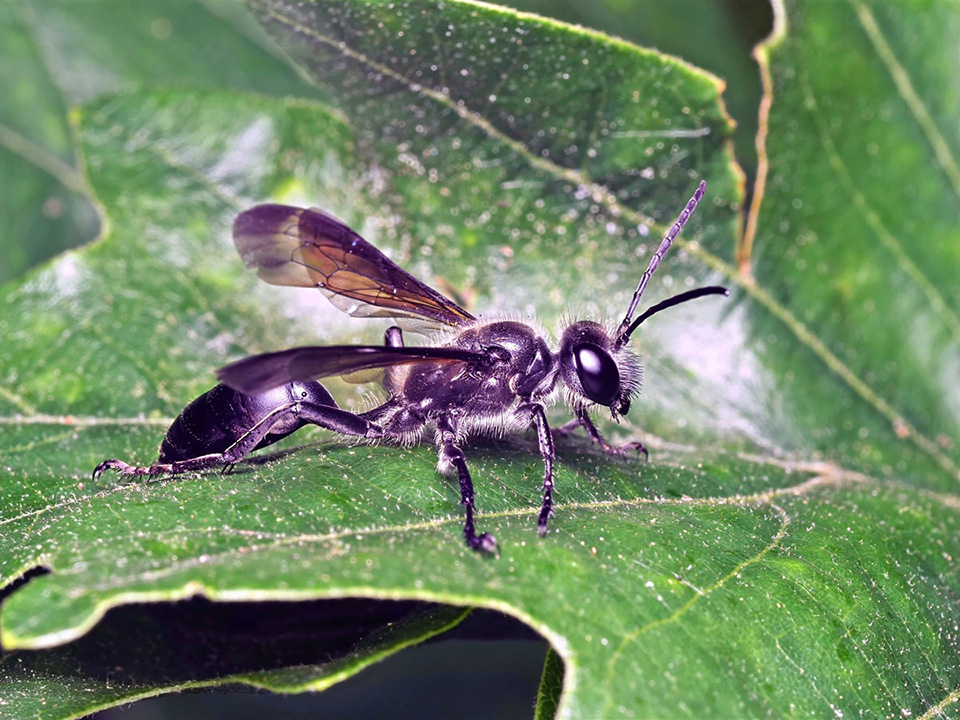
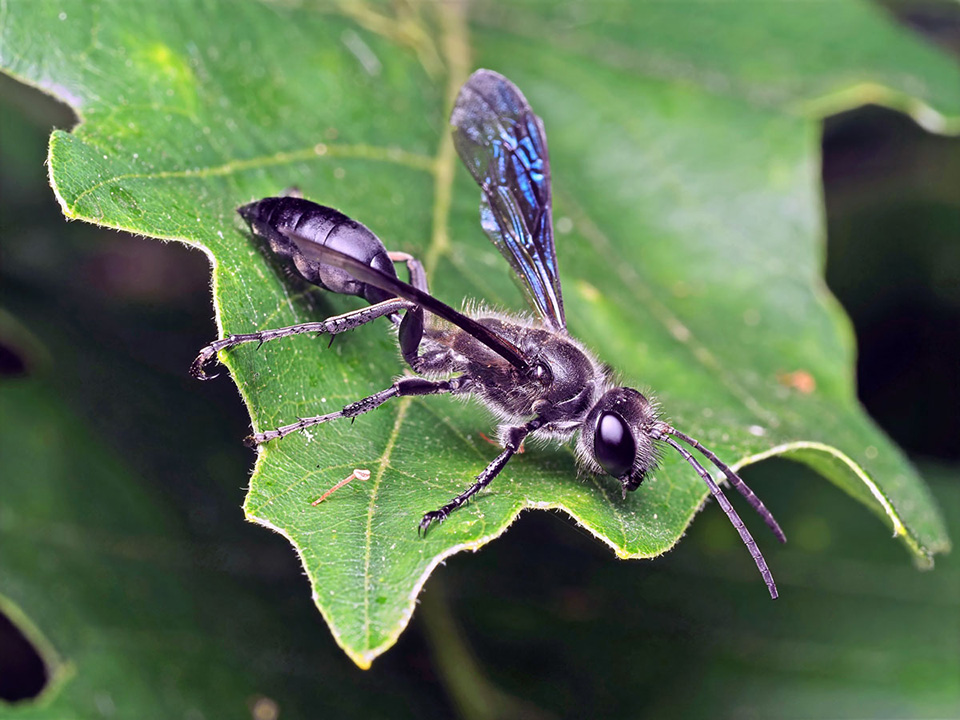


Isodontia mexicana
Isodontia mexicana, Mexican grass-carrying wasp, male. Photos taken at Barnes Prairie, Racine Co., WI. on June 18, 2024.


Mexican Grass-carrying Wasp Isodontia mexicana
Isodontia mexicana, Mexican Grass-carrying Wasp on gray dogwood leaf. Barnes Prairie, Racine Co., WI July 15, 2021.

Minnesota Seasons Photos
Slideshows
Digger Wasp (Isodontia mexicana)
Andree Reno Sanborn
Visitor Videos
This button not working for you?
Simply email us at info@MinnesotaSeasons.com.
Attach a video, a YouTube link, or a cloud storage link.
Other Videos
Isodontia mexicana
69Patchou
Guepe solitaire Isodontia mexicana:Ponte
Marc Germain
Visitor Sightings
This button not working for you?
Simply email us at info@MinnesotaSeasons.com.
Be sure to include a location.
Alfredo Colon
6/29/2026

Location: Albany, NY
Babette Kis
6/18/2024
Location: Barnes Prairie, Racine Co., WI
Isodontia mexicana, Mexican grass-carrying wasp, male. Photos taken at Barnes Prairie, Racine Co., WI. on June 18, 2024.
Judi Elliott
1/28/2024
Location: Flower Mound, Texas
In two days we have had four of these wasps in our bathroom area. The first two flew toward us and seemed aggressive. The next two seemed almost as if they were dying. We have had our house closed due to freezing temps. No pets, no open windows. Cannot find the source. We don’t have other bugs - only an occasional spider. Any info? Will they soon be gone?
Alfredo Colon
8/25/2022

Location: Albany, NY
Lexie
8/9/2023
Location: Louisville, KY
Sally Benjamin
8/8/2023
Location: 2515 Smith Valley Rd, La Crosse, WI
They are enjoying our red milkweed and elderberry flowers
Alfredo Colon
8/11/2022

Location: Albany, NY
Alfredo Colon
8/2/2022

Location: Albany, NY
Whitey Com
7/10/2022
Location: Excelsior, MN
Attempting to build a home in the support structure of a deck chair.
Babette Kis
7/15/2021
Location: Barnes Prairie, Racine Co., WI
Isodontia mexicana, Mexican Grass-carrying Wasp on gray dogwood leaf. Barnes Prairie, Racine Co., WI July 15, 2021.
Alfredo Colon
8/16 to 8/18/2019

Location: Slinger, Wisconsin
Christine Gerjets
6/14/2019
Location: Glenwood MN; Pope County
Building nest in window frame
Alfredo Colon
8/16/2018

Location: Woodbury, Minnesota
Alfredo Colon
6/8/2018

Location: Woodbury, Minnesota