Asteroid moth
(Cucullia asteroides)
Conservation • Description • Habitat • Ecology • Distribution • Taxonomy
Hodges #
10200
Conservation Status
IUCN Red List
not listed
NatureServe
NNR - Unranked
Minnesota
not listed
Description
Cucullia is a large genus of owlet moths with about 250 species worldwide, 36 species in North America north of Mexico. It is the only genus in the subfamily Cuculliinae. They are called hooded owlet moths due to a thick tuft of long hairs on the thorax that can be projected forward and curled over the head like a cowl or hood. Asteroid moth (Cucullia asteroides) is a common and widespread hooded owlet moth. It occurs east of the Rocky Mountains in the United States and southern Canada. It is common in Minnesota.
Adults are ⅞″ to 1⅛″ (23 to 29 mm) long and have a wingspan of 1¾″ to 2¼″(44 to 56 mm).
The forewing is long, narrow, pointed at the tip, pale gray, and sometimes tinged with blue or violet. There is a brown to blackish splotch on the leading edge (costal margin), and another one on the inner margin that widens as it approaches the anal angle on the outer margin. The postmedial (PM) line absent except for a small crescent near the inner margin. There is a circular spot in the median area (orbicular spot) and a kidney-shaped spot at the end of the discal cell (reniform spot). Both spots have brown centers ringed with dull white and thinly outlined with brown. On some individuals these spots are barely discernible. The hindwing is nearly white with a narrow brown border on males, a broad brown border on females.
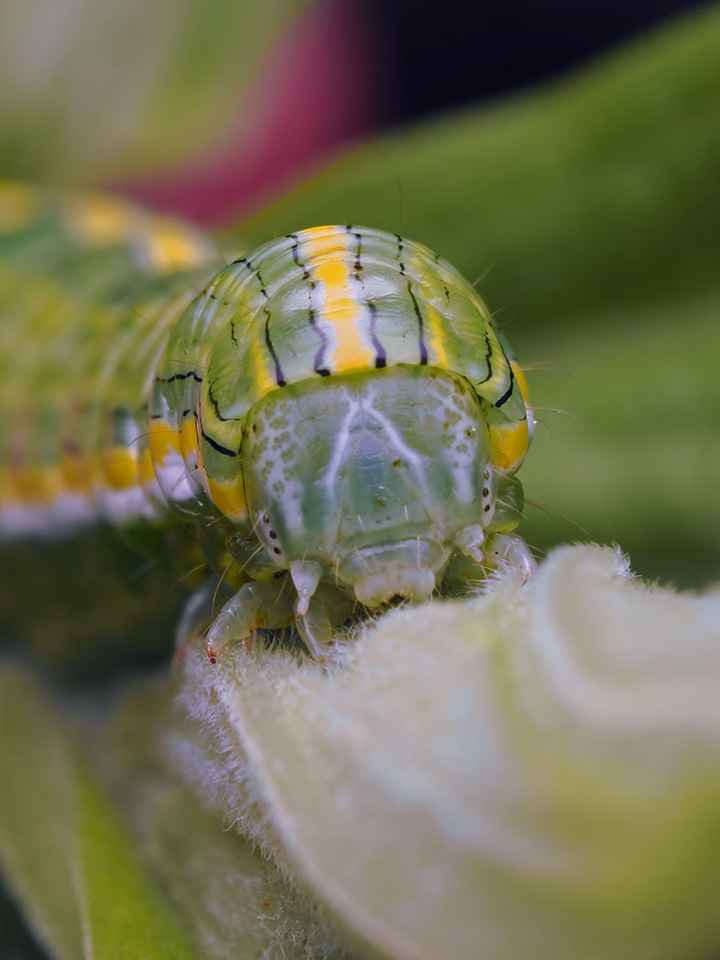
The caterpillar is stout, smooth, and up to 1¾″ (4.5 cm) long. It is usually green or yellowish-green, sometimes brown or purplish, with several thin, black or dark brown, longitudinal lines. There is a bright yellow stripe in the upper middle (middorsal stripe), often edged with white and bordered on each side with a thin black line. The breathing pores (spiracles) are white outlined with black. There are two thin lines in the subdorsal area, two in the supraspiracular area. In the spiracular area there is a broad line, yellow above and white below, bordered with thin black lines. Mature caterpillars are present from August to October.
Size
Total length: ⅞″ to 1⅛″ (23 to 29 mm)
Wingspan: 1¾″ to 2¼″ (44 to 56 mm)
Similar Species
Habitat
Fields and meadows, edges of forests and woodlands
Ecology
Season
One generation per year in Minnesota: Early July to mid-August
Behavior
When at rest the wings are folded over the body, the “hood” is curled over the head, and the front legs are stretched forward. It is well camouflaged, looking much like the twig on which it perches.
Life Cycle
Pupa overwinter in a cocoon underground
Larva Food/Hosts
Mostly flowers but also leaves of goldenrod and aster
Adult Food
Distribution

Sources
6, 7, 21, 22, 24, 27, 30, 75, 82, 83.
Biodiversity occurrence data published by: Minnesota Biodiversity Atlas (accessed through the Minnesota Biodiversity Atlas Portal, bellatlas.umn.edu. Accessed 10/15/2026).
Cucullia asteroides Guenée, 1852 in Bánki, O., Roskov, Y., Döring, M., Ower, G., Hernández Robles, D. R., Plata Corredor, C. A., Stjernegaard Jeppesen, T., Örn, A., Pape, T., Hobern, D., Garnett, S., Little, H., DeWalt, R. E., Miller, J., Orrell, T., Aalbu, R., Abbott, J., Abreu, C., Acero P, A., et al. (2026). Catalogue of Life (2026-08-26 XR). Catalogue of Life Foundation, Amsterdam, Netherlands. https://doi.org/10.48580/dgyy9
Quinn, Edward. M., and Ron Danielson. April 27, 2009. A Survey of Lepidoptera in Three Priority Areas of the Minnesota State Parks System. https://files.dnr.state.mn.us/eco/nongame/projects/consgrant_reports/2009
/2009_quinn_danielson.pdf.
Occurrence
Common
Taxonomy
Order
Lepidoptera (Butterflies and Moths)
Superfamily
Noctuoidea (Owlet Moths and Allies)
Family
Noctuidae (Cutworm Moths and Allies)
Subfamily
Cuculliinae
Genus
Cucullia (Hooded Owlets)
Subordinate Taxa
Synonyms
Common Names
asteroid moth
asteroid paint
goldenrod hooded owlet
the asteroid
Visitor Photos
This button not working for you?
Simply email us at info@MinnesotaSeasons.com.
Attach one or more photos and, if you like, a caption.
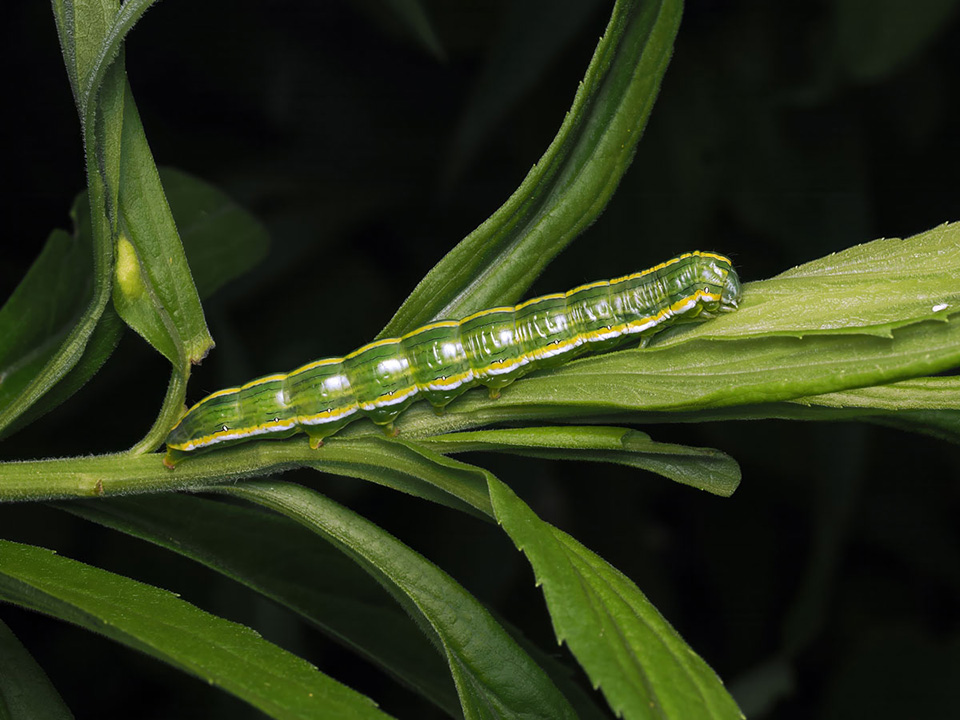
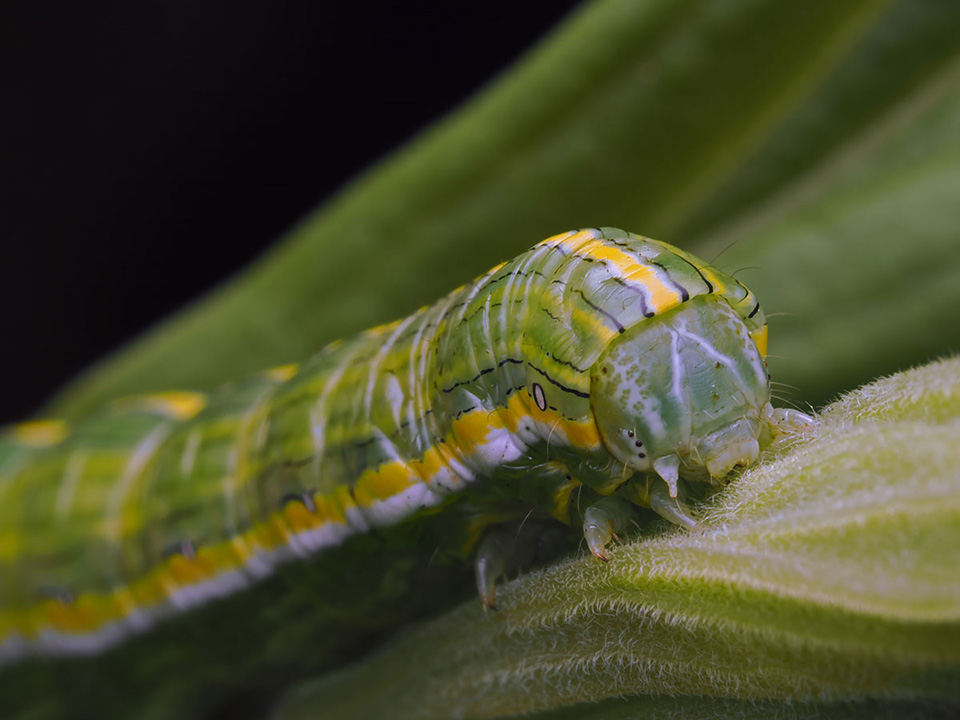
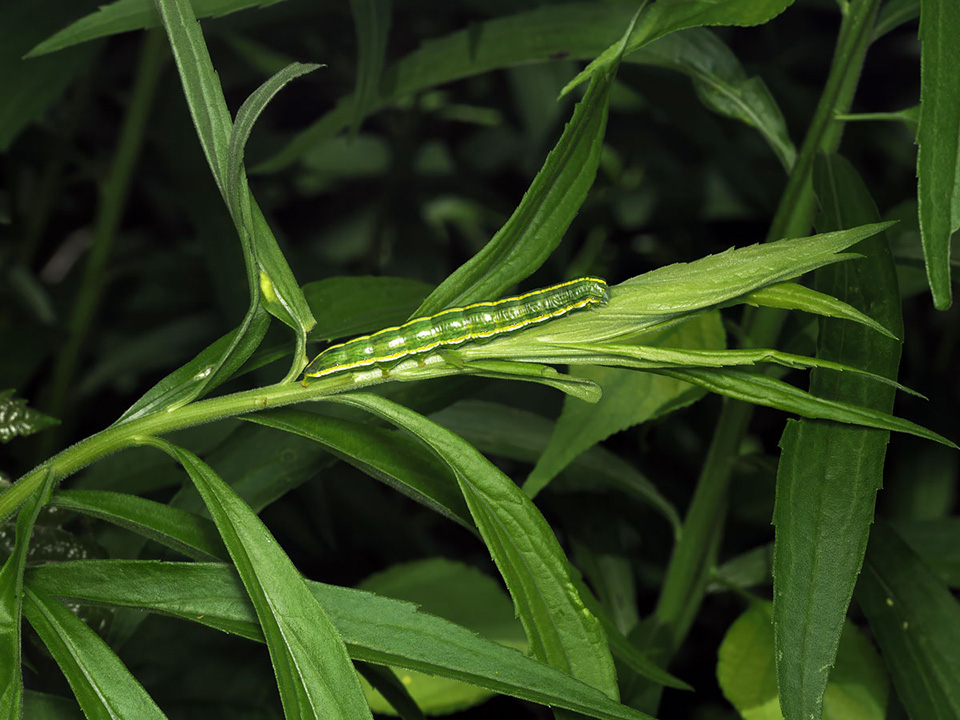

Cucullia asteroides the asteroid or goldenrod hooded owlet moth (caterpillar pictures)
… these caterpillars are found on goldenrod species. I've seen most of them on Solidago canadensis, Canada goldenrod, but have also found them on Solidago rigida, S. nemoralis and S. juncea.


Minnesota Seasons Photos
Slideshows
Goldenrod Hooded Owlet - Hodges#10200 (Cucullia asteroides)
Andree Reno Sanborn
Visitor Videos
This button not working for you?
Simply email us at info@MinnesotaSeasons.com.
Attach a video, a YouTube link, or a cloud storage link.
Other Videos
Cucullia asteroides
Carl Barrentine
GOLDENROD HOODED OWLET caterpillar feeding Cucullia asteroides
Rob Curtis
Visitor Sightings
This button not working for you?
Simply email us at info@MinnesotaSeasons.com.
Be sure to include a location.
Alfredo Colon
6/24/2026

Location: Albany, NY
Babette Kis
9/15/2020
Location: Barnes Prairie, Racine Co., WI
… these caterpillars are found on goldenrod species. I've seen most of them on Solidago canadensis, Canada goldenrod, but have also found them on Solidago rigida, S. nemoralis and S. juncea.
Babette Kis
9/23/2019
Location: Barnes Prairie, Racine Co., WI
Alfredo Colon
Summer 2018

Location: Woodbury, MN
Minnesota Seasons Sightings