blue-eyed darner - Species Profile
Conservation • Description • Habitat • Ecology • Distribution • Taxonomy
Conservation Status
IUCN Red List
not listedLC - Least Concern
NatureServe
not listed
N5 - Secure
SNR - Unranked
Minnesota
not listed
Description
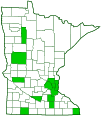
Blue-eyed darner is a common, relatively large dragonfly. It occurs in the western United States, throughout Mexico, and in southern British Columbia, Alberta, and Saskatchewan, Canada. In the U.S., it is common in the west, where it is the most common lowland darner. Until recently, it has been considered a rare stray in western Minnesota, but it appears to be extending its range to the east, and sightings in the state have increased in recent decades.
Blue-eyed darner is found in and around lakes, ponds, and slow streams with warm water and floating or emergent vegetation. Adults are crepuscular, feeding over open fields before sunrise and after sunset to avoid the hot midday sun. The young (naiads) are aquatic.
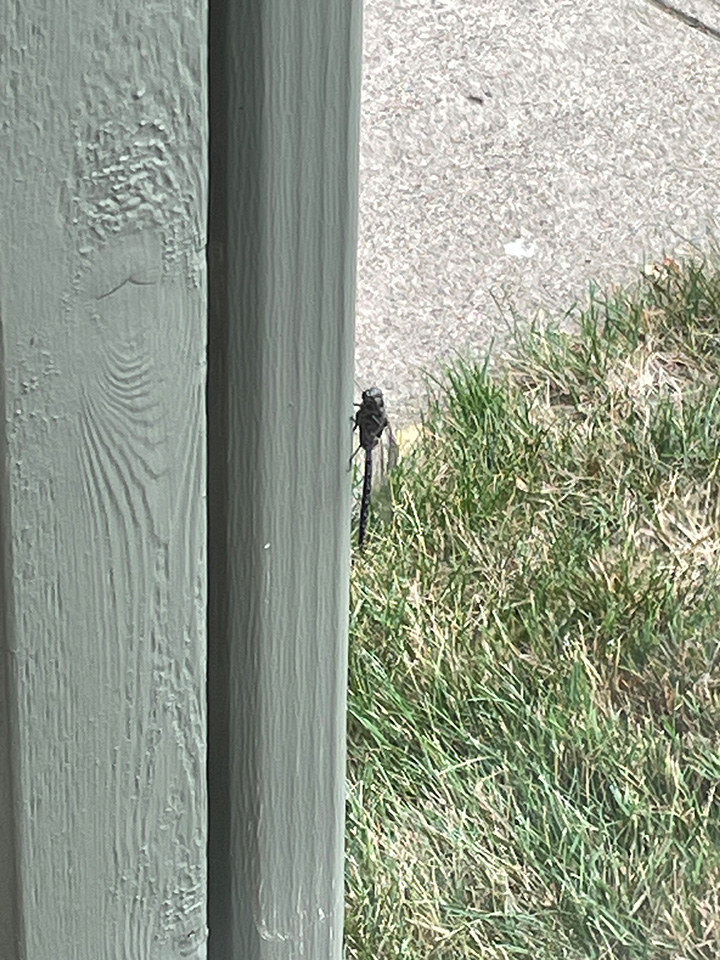
Adults are 2⅝″ to 2¾″ (65 to 71 mm) in length. The body is dark brown with blue, green, or yellow markings that darken in cool temperatures. On males, the head, eyes, and markings are blue. Females have two color forms, blue and green. Most females are green form. Blue form females are uncommon to rare.
There are two large compound eyes on the sides of the head and three small simple eyes (ocelli) in a triangle on the top of the head. The compound eyes of both sexes meet along a long margin at the top of the head. The antennae are tiny. There is a black T-shaped spot on the upper part of the face (frons) just below where the eyes meet. This is best seen when viewed from above. There is also a black, horizontal band across the middle of the face. On the male, the eyes and face are blue. On the female, the eyes are brown and the face is green on the green form, blue on the blue form.
The thorax of both males and females has a pair of shoulder stripes on the top and a pair of parallel lateral stripes on each side. The lateral stripes are straight. The rear (posterior) lateral stripe is not notched. On the green form female, the thoracic stripes are yellow or green. On the blue form female, the color and markings closely resemble the male.
The abdomen is slender with both large and small spots. On males all 10 abdominal segments have a pair of blue top (dorsal) spots and a blue lateral spot on each side, but sometimes the lateral spots on segment 10 are greenish. On green form females all of the spots are yellowish to green. On blue form females the spots are blue. On the male the upper pair of appendages at the end of the abdomen (cerci) are distinctly forked.
On the female, the wings are often tinted yellow in front between the nodus and the stigma.
Size
Total length: 2⅝″ to 2¾″ (65 to 71 mm)
Similar Species
Habitat
Lakes, ponds, slow streams , and open fields
Ecology
Season
Late April to October
Behavior
Adults feed before sunrise and after sunset
Life Cycle
Naiad Food
Insect larvae, freshwater shrimp, tadpoles, and small fish
Adult Food
Soft-bodied flying insects
Distribution
Sources
Biodiversity occurrence data published by: Minnesota Biodiversity Atlas (accessed through the Minnesota Biodiversity Atlas Portal, bellatlas.umn.edu. Accessed 8/30/2026).
Rhionaeschna multicolor (Hagen, 1861) in Bánki, O., Roskov, Y., Döring, M., Ower, G., Hernández Robles, D. R., Plata Corredor, C. A., Stjernegaard Jeppesen, T., Örn, A., Pape, T., Hobern, D., Garnett, S., Little, H., DeWalt, R. E., Miller, J., Orrell, T., Aalbu, R., Abbott, J., Abreu, C., Acero P, A., et al. (2026). Catalogue of Life (2026-07-17 XR). Catalogue of Life Foundation, Amsterdam, Netherlands. https://doi.org/10.48580/dgykv
Abbott, J.C. 2006-2026. OdonataCentral: An online resource for the distribution and identification of Odonata. Available at https://www.odonatacentral.org/. (Accessed: 8/30/2026).
Occurrence
Common in western U.S., uncommon in Minnesota.
Taxonomy
Order
Odonata (Dragonflies and Damselflies)
Suborder
Superfamily
Aeshnoidea
Family
Aeshnidae (Darners)
Genus
Rhionaeschna (Neotropical Darners)
Subordinate Taxa
Synonyms
Aeschna multicolor
Aeshna multicolor
Aeshna furcifera
Common Names
blue-eyed darner
