chalk-fronted corporal - Species Profile
Conservation • Description • Habitat • Ecology • Distribution • Taxonomy

Conservation Status
IUCN Red List
not listed
NatureServe
N5 - Secure
SNR - Unranked
Minnesota
not listed
Description
Chalk-fronted corporal is a medium-sized skimmer, 1⅝″ to 1 13 ⁄16″ long.
Juveniles are light orangish-brown. There is a broad, dark stripe down the top of the abdomen and a pair of pale “shoulder” stripes on the top of the thorax. There is a small, triangular, brown patch at the base of the hindwing, where the wing attaches to the thorax. Aside from the basal patch and the stigma, the wing is clear. The face is brown and the forehead is gray.
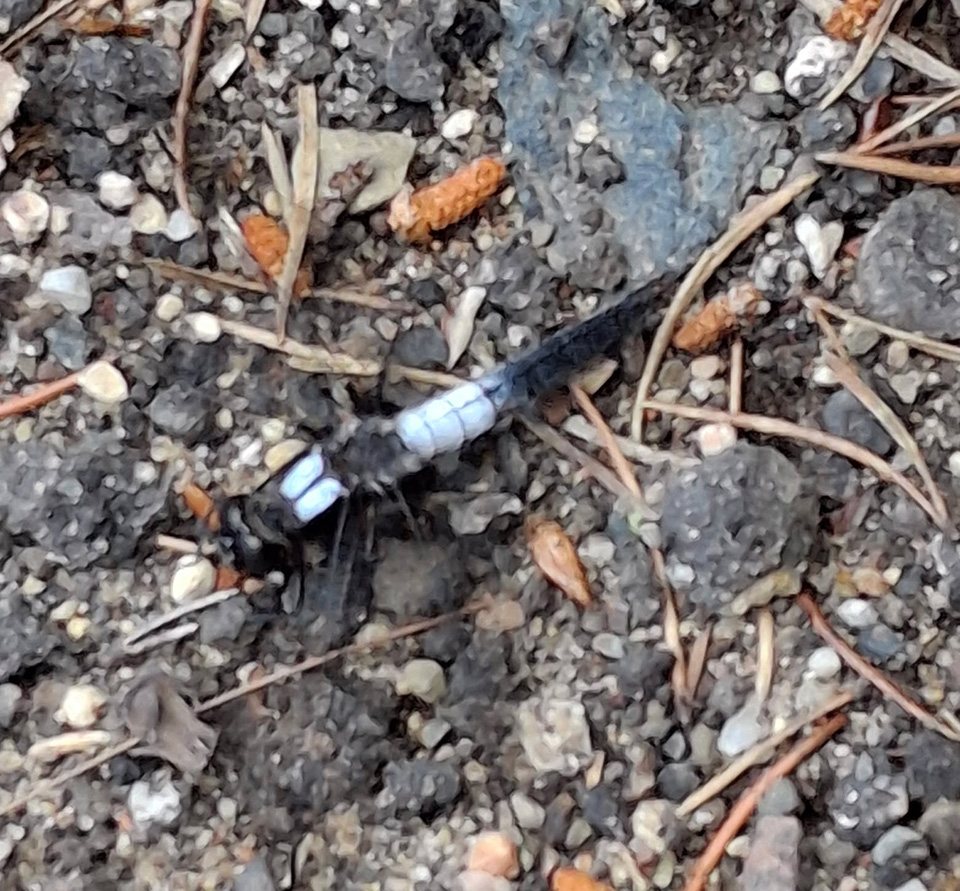
As they mature, they develop a waxy bloom (pruinescence) at segments 2 through 4 or 5 of the abdomen. On males, the pruinescence is white and the abdomen turns black. On females, the pruinescence is gray and the abdomen turns dark brown. Males also develop two stripes of white pruinescence, “corporal stripes”, on the top of their thorax. Females have a shorter, blunt abdomen, about ⅔ as long as the wing.
Size
Wingspan: 3″
Total length: 1⅝″ to 1 13 ⁄16″
Similar Species
Common whitetail (Libellula lydia) wings have a broad, dark band.
Frosted whiteface (Leucorrhinia frigida) is smaller and more slender.
Widow skimmer (Libellula luctuosa) wings are boldly patterned, not clear.
Habitat
Lakes, ponds, marshes, peat bogs, slow streams.
Ecology
Season
Late May to early August
Behavior
Adults perch horizontally on the ground, on objects in water, or on other flat surfaces, and fly up to snatch prey.
Life Cycle
The female hovers just above the surface of shallow water, dips the tip of her abdomen into the water, and deposits the eggs. The male does not guard the female as she deposits her eggs.
The naiads live on the bottom in a layer of decaying vegetation. They emerge as adults at night.
Naiad Food
Mosquito larvae, mayfly naiads, other aquatic fly larvae, and freshwater shrimp.
Adult Food
Mosquitoes, flies, butterflies, moths, mayflies, and flying ants or termites, and other soft-bodied flying insects.
Distribution

Sources
Biodiversity occurrence data published by: Minnesota Biodiversity Atlas (accessed through the Minnesota Biodiversity Atlas Portal, bellatlas.umn.edu. Accessed 6/26/2024).
Ladona julia (Uhler, 1857) in GBIF Secretariat (2023). GBIF Backbone Taxonomy. Checklist dataset https://doi.org/10.15468/39omei accessed via GBIF.org. Accessed 6/26/2024.
Abbott, J.C. 2006-2026. OdonataCentral: An online resource for the distribution and identification of Odonata. Available at https://www.odonatacentral.org/. (Accessed: 6/26/2024).
Haarstad, J. 1997. The dragonflies of selected eastern Minnesota rivers. Report submitted to the Minnesota Department of Natural Resources. Unpaged.
Steffens, W. P., and W. A. Smith. 1999. Status survey for special concern and endangered dragonflies of Minnesota: population status, inventory and monitoring recommendations. Final report submitted to the Natural Heritage and Nongame Research Program, Minnesota Department of Natural Resources. 54 pp.
Occurrence
Common, often abundant
Taxonomy
Order
Odonata (Dragonflies and Damselflies)
Suborder
Superfamily
Libelluloidea
Family
Libellulidae (Skimmers)
Genus
Ladona (Corporals)
Species
Most authors separate corporals as a separate species, Ladona. Some consider them a subgenus of Libellula, and some consider Ladona a synonym of Libellula.
Subordinate Taxa
Synonyms
Libellula julia
Common Names
chalk-fronted corporal