common ectemnius - Species Profile
Conservation • Description • Habitat • Ecology • Distribution • Taxonomy
Conservation Status
IUCN Red List
not listed
NatureServe
NNR - Unranked
Minnesota
not listed
Description
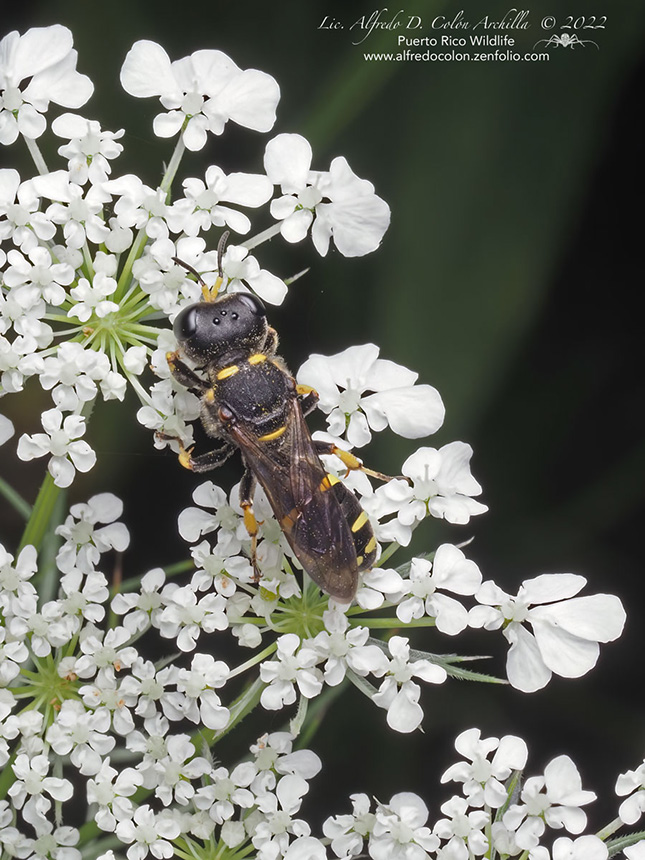
Common ectemnius is a small to medium-sized, predatory, square-headed wasp. It occurs in Europe, eastern Asia, and North America, where it is typically found in forest clearings and edges, agricultural areas, and urban areas. While it occurs throughout the United States and southern Canada, it is most common from Maine to Virginia, west to Minnesota and Illinois. In the rest of the country its distribution mirrors a map of human activity. In major metropolitan areas, ornamental tree pruning, stacked firewood, and irrigated gardens provide the microhabitats this wasp needs to survive in otherwise inhospitable terrain.
Adults are ⅜″ to ½″ (9 to 12 mm) in length and black with yellow markings.
The head is large, square, and black. On males, the back of the head is distinctly narrowed behind the compound eyes. There are two large compound eyes on the sides of the head and three small simple eyes (ocelli) in a triangle on top of the head. The compound eyes do not have a sharp groove (fovea) on the inner margin. The shape of the ocellar triangle is low, meaning the sides are shorter than the base. There is a longitudinal ridge in front of the ocelli and a transverse ridge behind the compound eyes. The upper part of the forehead (frons) is evenly pitted (punctate). The plate on the face (clypeus) has a large, polished, extension (bevel) on the upper margin. It is entirely black on both sexes. The jaws (mandibles) are mostly yellow above, black just near the tip, and are entirely black below.
The antennae rise low in the face. They consist of a long basal segment (scape), a short connecting segment (pedicel), and a whip-like end section (flagellum) with several segments (flagellomeres). The scape is yellow with a black spot near the base below. The flagellum is black above and brown below. The first flagellomere is more than twice as long as wide. The second flagellomere is depressed on the underside near the base, the first flagellomere is not.
The thorax is black and has three segments, the prothorax, mesothorax, and metathorax. However, the first segment of the abdomen (propodeum) is fused to the thorax, giving the thorax the appearance of having four segments. The upper plate on the prothorax (pronotum) is short and collar-like. It extends rearward on the sides to the plate at the base of each wing (tegula). It appears horseshoe-shaped when viewed from above, triangular when viewed from the side. It is mostly black except for a yellow band on the front margin of the upper surface. The band is interrupted in the middle. On the mesothorax, the large front plate (mesoscutum or scutum) is black with no yellow markings. The smaller rear plate (scutellum) has a pair of narrowly separated yellow spots. The upper surface of the metathorax (metanotum) is entirely black, with no yellow markings. On the lower front of each side of the thorax there is a small yellow spot.
On the rear part of the body there is a narrow yellow band on the front margin of the second and fourth segments (tergites). The bands may be complete or interrupted in the middle. Tergites one and three are entirely black.
The wings are tinted brown. On the forewing there is a single submarginal cell. The recurrent vein ends in the outer third of the submarginal cell.
On all legs the third segment (femur) is black, and the fourth segment (tibia) is yellow. On the front legs the femur has a sharp, rearward-pointing spur near the middle. It does not have a sharp ridge or tooth on the underside near the base. The last part of the leg (tarsus), corresponding to the foot, has five segments. The first segment (basitarsus) is yellow, the remaining segments are black. On the middle legs of the male, the second tarsal segment has a tiny pointed projection on the inner side. This can be seen only under high magnification.
Size
Total length: ⅜″ to ½″ (9 to 12 mm)
Similar Species
Habitat
Forest clearings and edges, agricultural areas, and urban areas
Ecology
Season
May to September
Behavior
Life Cycle
The nest is constructed in a burrow in a dead and rotting tree stump, log, or fallen branch, in a fence post, in lumber, or in the pith of a plant stem. Each cell of the nest is provisioned with six to eight adult flies.
Larva Food/Hosts
Flies
Adult Food
Distribution
Sources
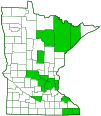
Biodiversity occurrence data published by: Minnesota Biodiversity Atlas (accessed through the Minnesota Biodiversity Atlas Portal, bellatlas.umn.edu. Accessed 4/22/2026).
Ectemnius continuus (Fabricius, 1804) in GBIF Secretariat (2023). GBIF Backbone Taxonomy. Checklist dataset https://doi.org/10.15468/39omei accessed via GBIF.org. Accessed 4/22/2026.
Occurrence
Common
Taxonomy
Order
Hymenoptera (Ants, Bees, Wasps, and Sawflies)
Suborder
Apocrita (Narrow-waisted Wasps, Ants, and Bees)
Infraorder
Aculeata (Ants, Bees, and Stinging Wasps)
Superfamily
Apoidea (Bees and Apoid Wasps)
Family
Crabronidae (Square-headed Wasps, Sand Wasps, and Allies)
Subfamily
Tribe
Crabronini (Square-headed Wasps)
Subtribe
Crabronina
Genus
Ectemnius
Subgenus
Hypocrabro
Subordinate Taxa
Ectemnius continuus continuus
Ectemnius continuus punctatus
Ectemnius continuus rufitarsis
Ectemnius continuus sulphureipes
Synonyms
Crabro agrestis
Crabro bisexmaculatus
Crabro continuus
Crabro divisus
Crabro fuscitarsis
Crabro fuscitarsus
Crabro granulatus
Crabro rugosopunctatus
Crabro sayi
Crabro sexmaculatus
Crabro vagans
Crabro vagatus
Crabro vagus ssp. validus
Crabro validus
Crossocerus sexmaculatus
Crossocerus vagus
Ectemnius fuscitarsis
Hypocrabro continuus
Hypocrabro punctatus
Solenius continuus
Solenius fuscitarsis
Solenius giffardi
Solenius sayi
Xestocrabro sayi
Xestocrabro sexmaculatus
Xylocrabro slossonae
Common Names
common ectemnius
