copper underwing - Species Profile
Conservation • Description • Habitat • Ecology • Distribution • Taxonomy

Hodges #
9638
Conservation Status
IUCN Red List
not listed
NatureServe
NNR - Unranked
SNR - Unranked
Minnesota
not listed
Description
Copper underwing is a mid-sized owlet moth. It occurs throughout the United States and in southern Canada. It is common in Minnesota. Adults are found from July through October in forests, woodlands, and field edges. Larvae feed on the leaves of many woody trees and shrubs, including apple, basswood, blueberry, cherry, grape, greenbrier, hawthorn, hickory, lilac, maple, oak, walnut, raspberry, viburnum, virginia creeper, and willow.
Adults are ⅞″ to 1⅛″ (23 to 28 mm) in length and have a wingspan of 1½″ to 2 1⁄16″ (38 to 52 mm).
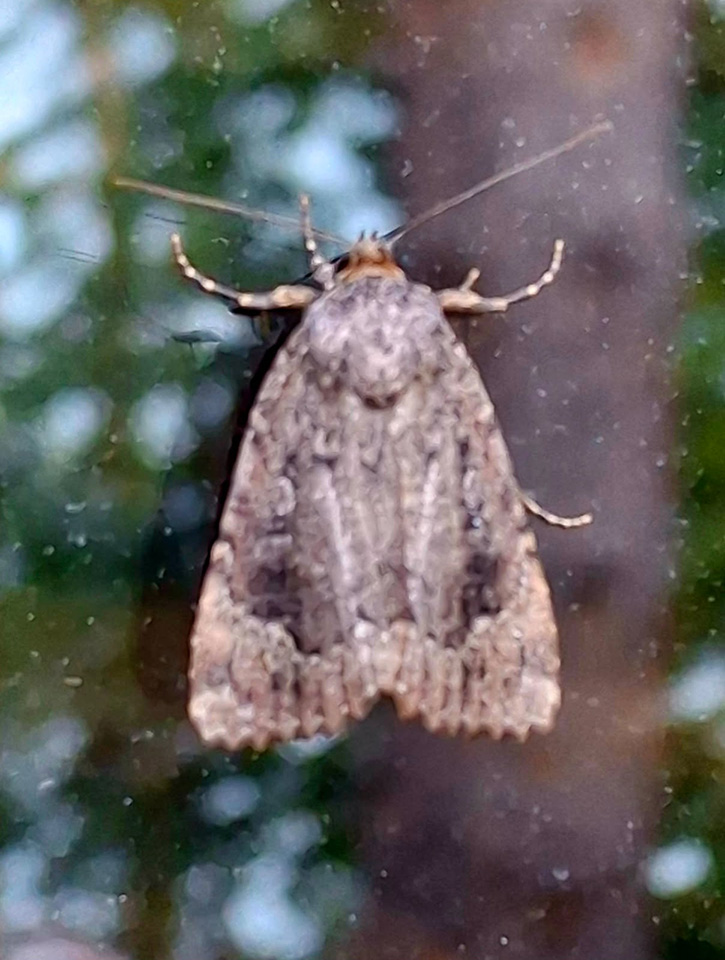
The forewings are shiny and grayish-brown, and are peppered with pale, grayish-brown scales. There are four dark lines crossing each wing. From the base to the wingtip, these are an antemedial (AM) line, a postmedial (PM) line, a subterminal (ST) line, and a terminal line. The AM line is jagged and often incomplete, appearing as a row of four downward pointing chevrons. The PM line is slightly jagged and is bordered with white below. The ST line is jagged and often indistinct. The terminal line is thin and dark. The area above the PM line is darker, while the area between the PM line and the outer margin is paler. There is a round spot (orbicular spot) in the upper median area and a kidney-shaped spot (reniform spot) in the lower median area. The orbicular spot is and distinct. It is pale with a dark center and a thin black outline. The reniform spot similar but crescent-shaped, darker, and usually indistinct. The hindwings are coppery-red and unmarked. They are rarely seen except briefly when taking flight.
The legs have alternating pale and dark lines.
The antennae are slender and thread-like.
The caterpillar is plump, bluish-green, and less than 1¾″ (4.5 cm) in length. It is covered with many small, scattered, yellow spots. The breathing pores (spiracles) are black and are outlined with white. There is a yellow line (spiracular stripe) running through the spiracles and continuing around the rear. The spiracular stripe is missing from the third segment of the thorax. The eighth segment of the abdomen is conspicuously humped. Mature caterpillars are found from May through June.
Size
Total length: ⅞″ to 1⅛″ (23 to 28 mm)
Wingspan: 1½″ to 2 1⁄16″ (38 to 52 mm)
Similar Species
Habitat
Forests, woodlands, and field edges
Ecology
Season
One generation per year: July through October
Behavior
Adults are active at night and will come to lights. They rest with the wings held flat over the body. They often aggregate in groups beneath bark and in other dark, close places.
Life Cycle
Eggs overwinter. Before pupating the larva rolls a leaf edge creating a shelter.
Larva Food/Hosts
Leaves of many woody trees and shrubs, including apple, basswood, blueberry, cherry, grape, greenbrier, hawthorn, hickory, lilac, maple, oak, walnut, raspberry, viburnum, virginia creeper, and willow.
Adult Food
Distribution

Sources
Biodiversity occurrence data published by: Minnesota Biodiversity Atlas (accessed through the Minnesota Biodiversity Atlas Portal, bellatlas.umn.edu. Accessed 9/16/2026).
Amphipyra pyramidoides Guenée, 1852 in Bánki, O., Roskov, Y., Döring, M., Ower, G., Hernández Robles, D. R., Plata Corredor, C. A., Stjernegaard Jeppesen, T., Örn, A., Pape, T., Hobern, D., Garnett, S., Little, H., DeWalt, R. E., Miller, J., Orrell, T., Aalbu, R., Abbott, J., Abreu, C., Acero P, A., et al. (2026). Catalogue of Life (2026-08-26 XR). Catalogue of Life Foundation, Amsterdam, Netherlands. https://doi.org/10.48580/dgyy9
Quinn, Edward. M., and Ron Danielson. April 27, 2009. A Survey of Lepidoptera in Three Priority Areas of the Minnesota State Parks System. https://files.dnr.state.mn.us/eco/nongame/projects/consgrant_reports/2009
/2009_quinn_danielson.pdf.
Occurrence
Common in Minnesota
Taxonomy
Order
Lepidoptera (Butterflies and Moths)
Superfamily
Noctuoidea (Owlet Moths and Allies)
Family
Noctuidae (Cutworm Moths and Allies)
Subfamily
Amphipyrinae
Tribe
Amphipyrini
Genus
Amphipyra
Subordinate Taxa
Synonyms
Amphipyra carbonita
Amphipyra conspersa
Amphipyra inornata
Common Names
copper underwing
rearhumped caterpillar