dark-spotted palthis - Species Profile
Conservation • Description • Habitat • Ecology • Distribution • Taxonomy

Hodges #
8397
Conservation Status
IUCN Red List
not listed
NatureServe
N5 - Secure
SNR - Unranked
Minnesota
not listed
Description
Dark-spotted palthis is a medium-sized litter moth. It occurs across the United States and southern Canada, and in Mexico. It is common in Minnesota. Adults are found from May through August in deciduous and mixed forests. Larvae feed on both living and dead leaves of deciduous and coniferous shrubs and trees, including alder, ash, basswood, birch, willow, pine, and spruce; and of forbs, including aster and goldenrod.
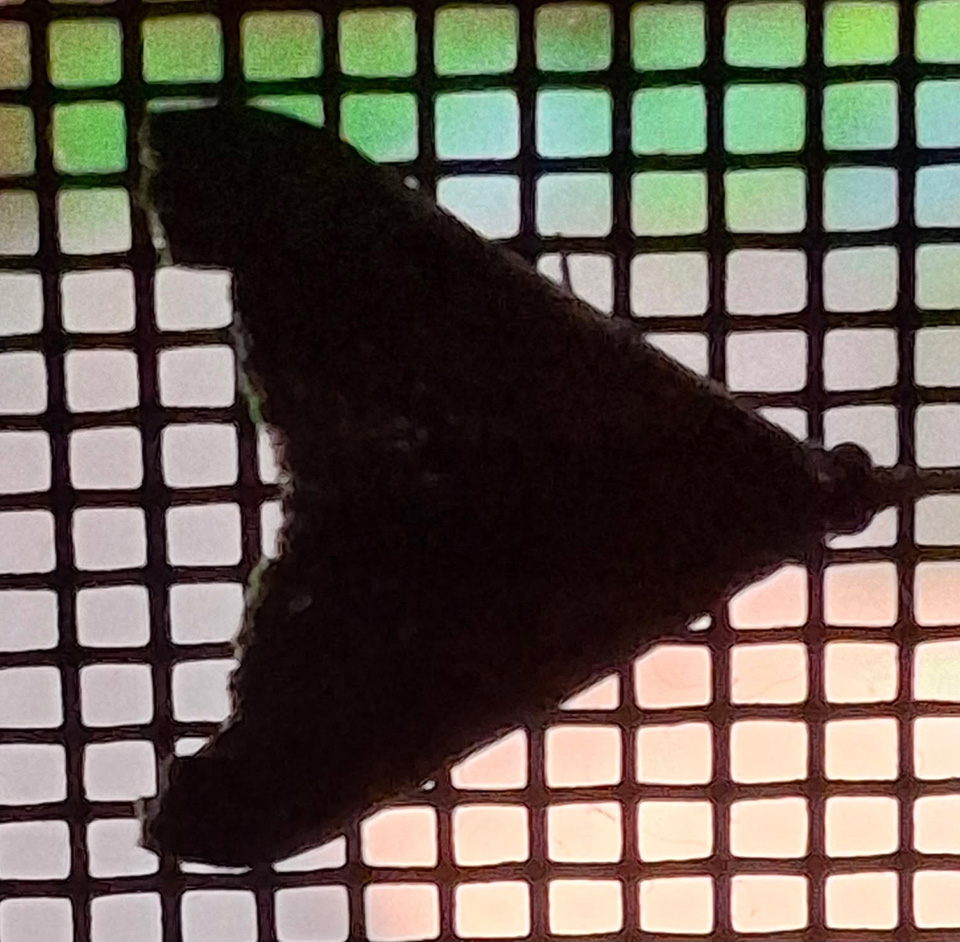
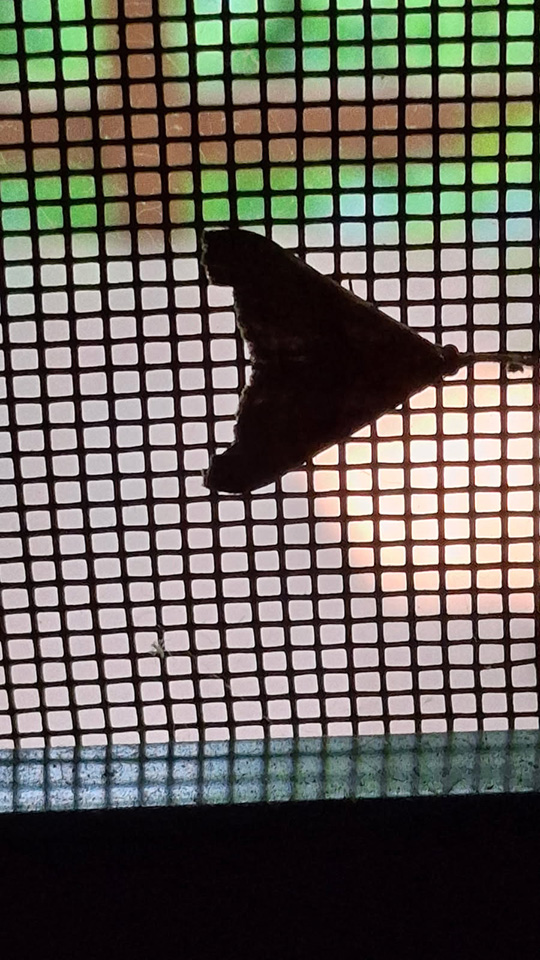
Adults are roughly triangular in shape, are 11⁄16″ (18 mm) in length, and have a ¾″ to 1″ (20 to 26 mm) wingspan.
The forewings are long and strongly angled on the outer margin, making the outer third distinctly longer than the inner third. They are light tan and are crossed with dark lines and bands. From the wing base to the tip there is an antemedial (AM) line, a median band, a postmedial (PM) line, a subterminal (ST) line, and a terminal line. The AM line is is narrow and jagged. The median band is broad, oblique, and usually dark brown, sometimes orangish-brown. It strongly curves up near the inner margin. It does not reach either the AM line or the leading (costal) margin. The PM and ST lines are jagged. The ST line is often incomplete and sometimes inconspicuous. The terminal line is thin. There is a kidney-shaped spot (reniform spot) above the PM line near the outer (costal) margin. The reniform spot is crescent-shaped, slanting, and dark brown. It is solid, sometimes with an orangish-brown center, but not interrupted with a white line. There is no round spot (orbicular spot) in the upper median area. At the wing tip (apex) on the costal margin there is a rusty-brown outer patch and a yellow inner patch.
On the male, the finger-like sensory organs (palps) attached to the mouth are very long, densely hairy, projected forward, and turned upward at the tip.
The caterpillar is mottled brown and small, up to ¾″ (2 cm) in length. It is densely covered with minute white spines. There is a low hump on the first abdominal segment (A1) and an angled hump on A8. On A7 there is an oblique white line that continues up the hump on A8, sometimes changing to black on A8. There is a similar but less conspicuous line on A1, A2, and A3 that continue onto A2, A3, and A4 respectively. Mature caterpillars are found from June through fall.
Size
Total length: 11⁄16″ (18 mm)
Wingspan: ¾″ to 1″ (20 to 26 mm)
Similar Species
Habitat
Deciduous and mixed forests and woodlands
Ecology
Season
Two generations per year: May through August
Behavior
Life Cycle
Larva Food/Hosts
Living and dead leaves of deciduous and coniferous shrubs and trees, including alder, ash, basswood, birch, willow, pine, and spruce; and of forbs including aster and goldenrod.
Adult Food
Distribution

Sources
Biodiversity occurrence data published by: Minnesota Biodiversity Atlas (accessed through the Minnesota Biodiversity Atlas Portal, bellatlas.umn.edu. Accessed 7/25/2026).
Palthis angulalis Hübner, 1796 in Bánki, O., Roskov, Y., Döring, M., Ower, G., Hernández Robles, D. R., Plata Corredor, C. A., Stjernegaard Jeppesen, T., Örn, A., Pape, T., Hobern, D., Garnett, S., Little, H., DeWalt, R. E., Miller, J., Orrell, T., Aalbu, R., Abbott, J., Abreu, C., Acero P, A., et al. (2026). Catalogue of Life (2026-07-17 XR). Catalogue of Life Foundation, Amsterdam, Netherlands. https://doi.org/10.48580/dgykv
Quinn, Edward. M., and Ron Danielson. April 27, 2009. A Survey of Lepidoptera in Three Priority Areas of the Minnesota State Parks System. https://files.dnr.state.mn.us/eco/nongame/projects/consgrant_reports/2009
/2009_quinn_danielson.pdf.
Occurrence
Common in Minnesota
Taxonomy
Order
Lepidoptera (Butterflies and Moths)
Superfamily
Noctuoidea (Owlet Moths and Allies)
Family
Erebidae (Underwing, Tiger, Tussock, and Allied Moths)
Subfamily
Herminiinae (Litter Moths)
Genus
Palthis (Palthis Moths)
Subfamily
Until recently, the subfamily Herminiinae was treated either as the separate family Herminiidae or as a subfamily of Noctuidae. A molecular phylogenetic analysis of the family Erebidae (Zahiri, Reza; et al., 2011) determined that Herminiinae are closely related to Aganainae, which is a subfamily of Erebidae, and Herminiinae was moved as a whole to Erebidae.
Subordinate Taxa
Synonyms
Mardara aracinthusalis
Palthis aracinthusalis
Common Names
dark-spotted palthis