elm sphinx - Species Profile
Conservation • Description • Habitat • Ecology • Distribution • Taxonomy
Hodges #
7786
Conservation Status
IUCN Red List
not listed
NatureServe
N4N5 - Apparently Secure to Secure
SNR - Unranked
Minnesota
not listed
Description
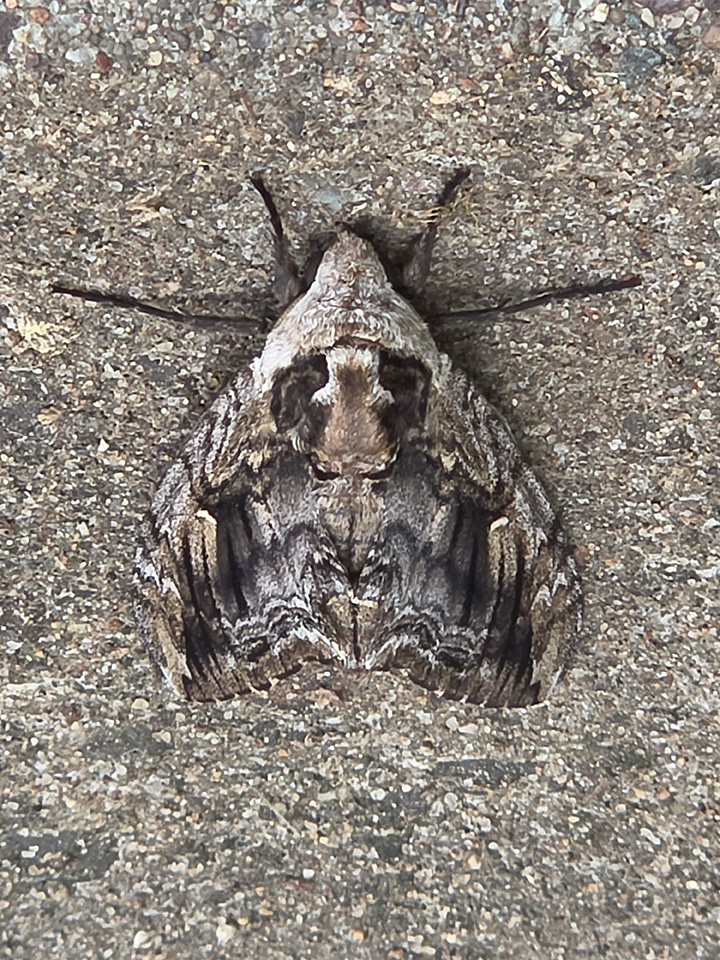
Elm sphinx is a very large sphinx moth. It occurs in the United States and southern Canada east of the Rocky Mountains. It is common in Minnesota. Larvae feed on the foliage mostly of elms and birches but also of basswood. Reports of larvae feeding on cherry may be erroneous. Adults probably do not feed. They are found in June and July in deciduous woodlands and open areas where its hosts occur.
Adults are 2″ to 2⅜″ (50 to 60 mm) in length and have a 3¼″ to 4½″ (82 to 115 mm) wingspan. The forewing length is 1¾″ to 1 15⁄16″ (44 to 48 mm). Both sexes are similar in appearance, but females are larger than males. The body is robust. The overall coloration is light and dark shades of brown, grayish-brown, or yellowish-brown.
The upper side of the thorax is densely hairy and brown, with dark brown on the front margin and lateral margins. The antennae are pale and are club-shaped at the tip.
The abdomen is light brown and tapers in the rear to a point. There is a narrow, black, longitudinal stripe in the middle (middorsal), and a broader stripe on each side.
The forewing is long, narrow, and pointed. The outer margin is slightly concave. The upper side is strongly mottled with several shades of light to dark brown. The leading edge (costal margin) is whitish. The basal area is light brown. The median area is light brown on the outer third, dark brown on the inner two thirds, with a small, bar-shaped spot (reniform spot), and a pale patch beyond the reniform spot. The reniform spot is whitish and is not bordered. There are several bold, black dashes along the veins: two long dashes in the median area near the center of the wing, one long dash extending from the lower median area to the subterminal area, one shorter dash in the subterminal area, and two short dashes near the wing tip. From a distance, the overall effect is a dark longitudinal stripe from the wing base to the wingtip. The postmedial (PM) line is represented by three jagged lines with a pale area between them.
The hindwing is mostly dark brown but paler at the base. The PM line is similar in width to the one on the forewing, but it is entirely dark. The fringe on both wings is checkered brown and white.
The caterpillar is up to 3½″ (9 cm) in length. It may be brown or green, and it has several pale diagonal lines on each side. There is a pair of spiny horns on both the second and third segments of the thorax. This is the feature that gives the caterpillar the common name four-horned sphinx. There is a line of white, scale-like plates down the middle (middorsal), and the entire body is moderately covered with white-tipped granules.
Size
Total length: 2″ to 2⅜″ (50 to 60 mm)
Wingspan: 3¼″ to 4½″ (82 to 115 mm)
Similar Species
Habitat
Deciduous woodlands and open areas
Elm, birch, and basswood
Ecology
Season
One generation per year: June and July
Behavior
Larvae feed on the underside of leaves.
Life Cycle
Larva Food/Hosts
Foliage of mostly elm and birch but also basswood
Adult Food
Flower nectar
Distribution

Sources
Biodiversity occurrence data published by: Minnesota Biodiversity Atlas (accessed through the Minnesota Biodiversity Atlas Portal, bellatlas.umn.edu. Accessed 6/10/2026).
Ceratomia amyntor Geyer in GBIF Secretariat (2023). GBIF Backbone Taxonomy. Checklist dataset https://doi.org/10.15468/39omei accessed via GBIF.org. Accessed 6/10/2026.
Quinn, Edward. M., and Ron Danielson. April 27, 2009. A Survey of Lepidoptera in Three Priority Areas of the Minnesota State Parks System. https://files.dnr.state.mn.us/eco/nongame/projects/consgrant_reports/2009
/2009_quinn_danielson.pdf.
Occurrence
Common
Taxonomy
Order
Lepidoptera (Butterflies and Moths)
Superfamily
Bombycoidea (Hawk, Sphinx, Silk, Emperor, and Allied Moths)
Family
Subfamily
Sphinginae (Large Sphinx Moths)
Tribe
Sphingini
Subtribe
Sphingina
Genus
Ceratomia
Subordinate Taxa
Synonyms
Agrius amyntor
Ceratomia quadricornis
Ceratomia ulmi
Common Names
elm sphinx
elm sphinx moth
four-horned sphinx (caterpillar)

