grapevine beetle - Species Profile
Conservation • Description • Habitat • Ecology • Distribution • Taxonomy

Conservation Status
IUCN Red List
not listed
NatureServe
NNR - Unranked
Minnesota
not listed
Description
Grapevine beetle is a common and widespread, large, showy, shining leaf chafer beetle. It occurs in the United States and southern Canada east of the Great Plains. In Minnesota it is relatively common in the southern half of the state, mostly absent from the northern half. Adults are found from June to August in and near deciduous forests and thickets, in vineyards, and in gardens. They eat the leaves and fruit of both wild and cultivated grapevines, but they do not occur in numbers large enough to be considered a pest. The larvae dwell in the soil and feed on the rotting wood of many species of deciduous trees.
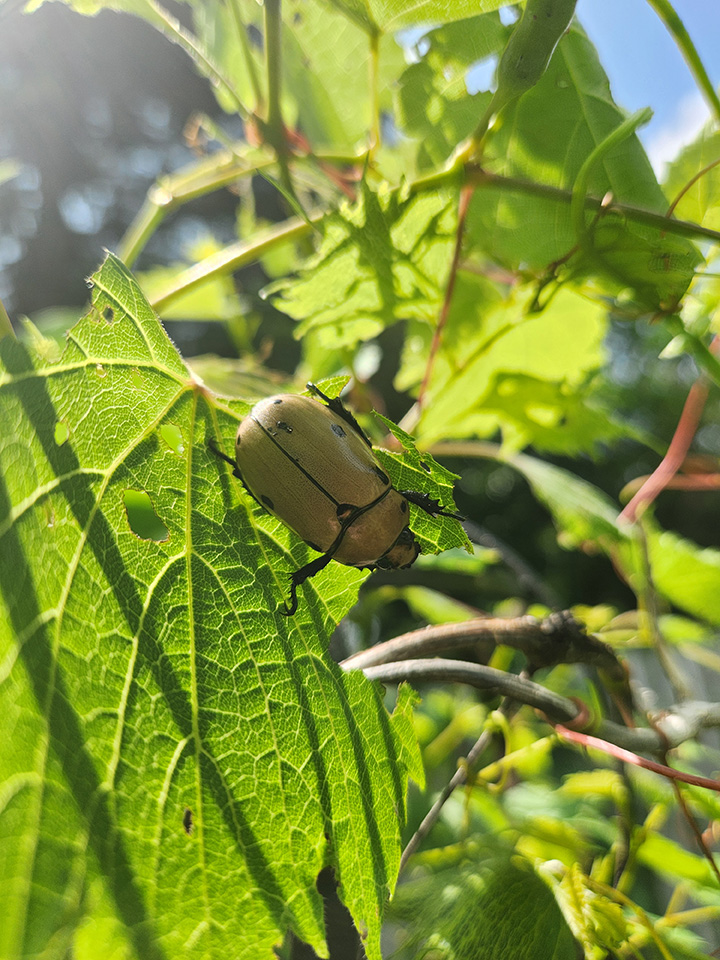
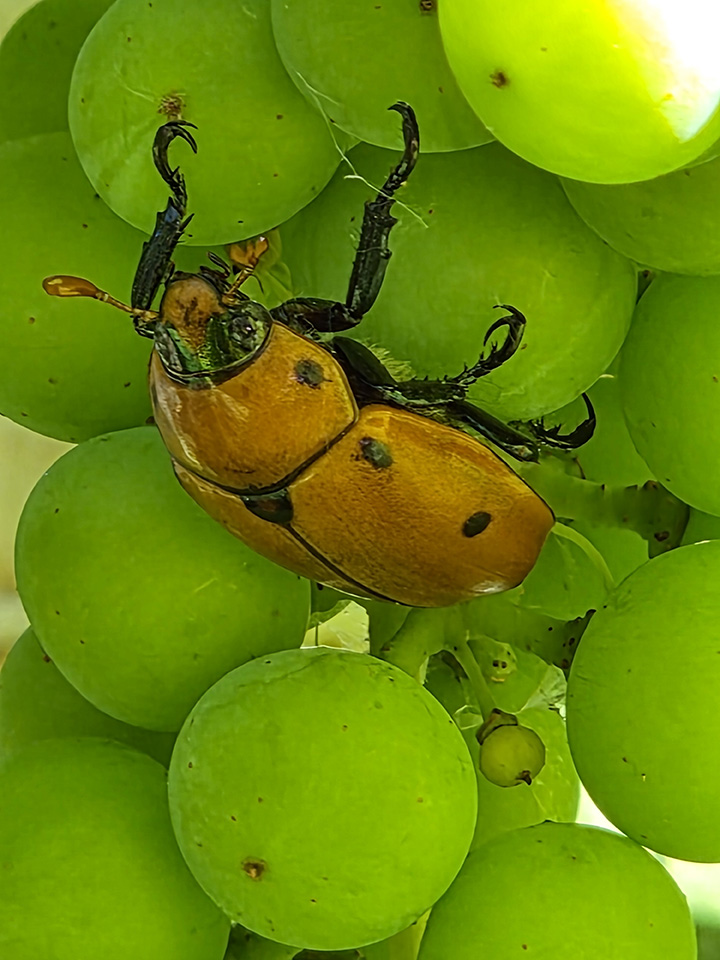
Adults are 11⁄16″ to 1 1⁄16″ (18 to 27 mm) in length, shiny, and brownish-yellow, yellowish-orange, or yellowish-brown. The body is stout, elongated oval when viewed from above, and convex when viewed from the side.
The jaws (mandibles) are black. The antennae are orange and have 9 or 10 segments. The last 3 or 4 segments are expanded sideways on one side into long flattened lobes. The antennal lobes can be closed into a tight club or fanned out to detect odors.
The plate covering the thorax (pronotum) has a bead along the front margin that is complete, uninterrupted. The sides are narrowly but distinctly flattened (margined). There is a single black spot on each side near the lateral margin. The plate between the wing bases (scutellum) is small and nearly triangular.
The hardened wing covers (elytra) are finely and shallowly but distinctly pitted (punctate). This is the feature that gives the beetle its species epithet. The sides are narrowly margined. There are three black spots near the lateral margin of each elytron, one in front in the shoulder (humeral) area, one in the middle, and one near the tip. The black markings on the pronotum and elytra is the feature that gives the genus its name: pelidnos is Greek for “black” and nota is Latin for “markings”. The underside of the abdomen ranges from yellowish-brown to black.
The legs are strong, spiny, and optimized for digging. On the front legs, the fourth segment (tibia) is widened and toothed on the outside. The last part of each leg (tarsus), corresponding to the foot, has five segments.
The coloration of this species is variable, both geographically and between populations, resulting in ten subspecies having been described. All of those subspecies are now considered synonyms of a single polymorphic species. In some populations the scutellum is black, in others it is the same color as the elytra. In some populations the spots on the pronotum and elytra are larger and distinct, in some they are smaller, and in some they are indistinct or even absent. In northern populations the legs are dark, the same color as the underside. In southern populations, they are light, the same color as the elytra.
Size
Total length: 11⁄16″ to 1 1⁄16″ (18 to 27 mm)
Similar Species
Habitat
Deciduous forests, thickets, vineyards, and gardens
Ecology
Season
June to August
Behavior
Adults are active at night and will come to lights. They are found clinging to vegetation during the day. They fly fast, usually with a curving flight pattern.
Life Cycle
In Minnesota larvae take two years to become adults. In the south they may develop faster.
Larva Food/Hosts
Rotting wood of deciduous trees
Adult Food
Leaves and fruit of grapevines
Distribution

Sources
Biodiversity occurrence data published by: Minnesota Biodiversity Atlas (accessed through the Minnesota Biodiversity Atlas Portal, bellatlas.umn.edu. Accessed 7/21/2026).
Pelidnota punctata (Linnaeus, 1758) in Bánki, O., Roskov, Y., Döring, M., Ower, G., Hernández Robles, D. R., Plata Corredor, C. A., Stjernegaard Jeppesen, T., Örn, A., Pape, T., Hobern, D., Garnett, S., Little, H., DeWalt, R. E., Miller, J., Orrell, T., Aalbu, R., Abbott, J., Abreu, C., Acero P, A., et al. (2026). Catalogue of Life (2026-06-19 XR). Catalogue of Life Foundation, Amsterdam, Netherlands. https://doi.org/10.48580/dgy8b
Occurrence
Common
Taxonomy
Order
Coleoptera (Beetles)
Suborder
Polyphaga (Water, Rove, Scarab, Long-horned, Leaf, and Snout Beetles)
Infraorder
Scarabaeiformia
Superfamily
Scarabaeoidea (Scarabs, Stag Beetles, and Allies)
Family
Scarabaeidae (Scarabs)
Subfamily
Rutelinae (Shining Leaf Chafers)
Tribe
Rutelini
Subtribe
Pelidnotina
Genus
Pelidnota (Precious Metal Scarabs)
Subordinate Taxa
Synonyms
Melolontha lutea
Pelidnota brevicollis
Pelidnota brevis
Pelidnota debiliceps
Pelidnota francoisgenieri
Pelidnota genieri
Pelidnota hudsonica
Pelidnota lutea brevicollis
Pelidnota lutea hudsonica
Pelidnota lutea pallidipes
Pelidnota oblonga
Pelidnota oblonga debiliceps
Pelidnota oblonga ssp. ponderella
Pelidnota pallidipes
Pelidnota ponderella
Pelidnota punctata brevis
Pelidnota punctata strenua
Pelidnota strenua
Pelidnota tarsalis
Scarabaeus punctatusCommon Names
grapevine beetle
spotted june beetle
spotted pelidnota