greater angle-wing katydid - Species Profile
Conservation • Description • Habitat • Ecology • Distribution • Taxonomy
No Image Available
Conservation Status
IUCN Red List
not listed
NatureServe
NNR - Unranked
Minnesota
not listed
Description
Greater angle-wing katydid, also known as broad-winged katydid, is a common, large, leaf katydid. It occurs throughout the United States, Mexico, Central America, and the Caribbean.
Adults are active from July through September. They are found on deciduous trees and shrubs, often in the crown of trees.
Size of katydids is usually given in the literature in terms of male and female body length, length of the first segment of the thorax (pronotum), length of the wing covers (tegmina), and length of the third segment (femur) of the hind leg. The male body length is 1″ to 1⅛″ (25 to 28 mm), the tegmina are 1⅝″ to 1¾″ (42 to 45 mm) long, and the hind femur is ⅞″ to 15⁄16″ (22.5 to 24.0 mm) long. The female is a little larger: the body length is 1⅛″ to 1 3⁄16″ (28 to 30 mm), the tegmina are 1 11⁄16″ to 1⅞″ (43 to 47 mm) long, and the hind femur is ⅞″ to 1″ (23 to 25 mm) long. In both sexes, the pronotum is ¼″ (6 to 7 mm) long. Adults measure 2″ to 2½″ (52 to 63 mm) in total length from the head to the tips of the hind wings. The body is slender and entirely green or yellowish green.
The head is short. The top of the head (vertex) is broad and hollowed out in the middle, forming a shallow pit. The extension on the upper part of the forehead between the eyes (fastigium) is blunt and broadly rounded, sloped downward toward the face, and marked with a shallow longitudinal groove. The face is nearly vertical. The eyes are prominent and broadly oval. The antennae are hair-like and long, much longer than the body but not reaching beyond the end of the tegmina. They are attached high on the face and close together.
The pronotum is saddle-shaped and short, about as wide as long. The upper side is flat, the sides are parallel, and the rear margin is broadly rounded. The lateral lobes of the pronotum are bent downward at right angles to the top. They are flat and they are broadly rounded on the bottom. The angles where the sides turn downward (lateral carinae) are rather sharp and are often yellowish or pale. At the upper rear corner of each lateral lobe there is a concave depression (humeral sinus). The humeral sinus is deep.
The tegmina are leathery and long, longer than the body in both sexes. They are broadest at or near the middle, tapered to the rear, and rounded at the tip. The hindwings are longer than the tegmina and come to a sharp point at the tip.
The front legs are short, the middle legs are a little longer, and the hind legs are much longer. On all legs, the femur has several spines below, and the rear spines are short and slender. On the hind legs, the femur is much shorter than the tegmina, extending little beyond the middle of them, and the fourth segment (tibia) has a pair of spines at the tip.
On the male, there is a rearward, upper extension of the last abdominal segment, a dorsal process called the supra-anal plate. The supra-anal plate is large, oblong-triangular, and sharply bent downward between the claspers (cerci). The cerci are long, slender, almost cylindrical, and curved inward. The bottom plate at the end of the abdomen (subgenital plate) fuses together past the middle, has three raised ridges along its underside, and ends in two tips that each carry a long, peg-like finger (stylus).
On the female, the ovipositor is very short, it is abruptly bent upwards, and the tip is blunt.
Size
Total length: 2″ to 2½″ (52 to 63 mm)
Male body length: 1″ to 1⅛″ (25 to 28 mm)
Female body length: 1⅛″ to 1 3⁄16″ (28 to 30 mm)
Male tegmina length: 1⅝″ to 1¾″ (42 to 45 mm)
Female tegmina length: 1 11⁄16″ to 1⅞″ (43 to 47 mm)
Pronotum length: ¼″ (6 to 7 mm)
Male hind femur length: ⅞″ to 15⁄16″ (22.5 to 24.0 mm)
Female hind femur length: ⅞″ to 1″ (23 to 25 mm)
Voice
The song to attract females is a rapid series of tics, about four per second and lasting several seconds.
The call to warn off other males is a single loud “lisp” repeated every two to four seconds.
Similar Species
Habitat
Deciduous trees and shrubs
Ecology
Season
One generation per year: July through October
Behavior
They are sometimes attracted to lights.
Life Cycle
Females lay their eggs in late summer and the eggs overwinter.
Nymph Food
Adult Food
Distribution
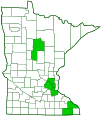
Sources
Microcentrum (Microcentrum) rhombifolium (Saussure, 1859) in Bánki, O., Roskov, Y., Döring, M., Ower, G., Hernández Robles, D. R., Plata Corredor, C. A., Stjernegaard Jeppesen, T., Örn, A., Pape, T., Hobern, D., Garnett, S., Little, H., DeWalt, R. E., Miller, J., Orrell, T., Aalbu, R., Abbott, J., Abreu, C., Acero P, A., et al. (2026). Catalogue of Life (2026-07-17 XR). Catalogue of Life Foundation, Amsterdam, Netherlands. https://doi.org/10.48580/dgykv
Hebard, Morgan. (1932). The Orthoptera of Minnesota. University of Minnesota. Minnesota Agricultural Experiment Station. Retrieved from the University of Minnesota Digital Conservancy, https://hdl.handle.net/11299/204015.
Occurrence
Very common
Taxonomy
Order
Orthoptera (Grasshoppers, Crickets, and Katydids)
Suborder
Ensifera (Katydids, Crickets, and Allies)
Infraorder
Tettigoniidea (Katydids, Wētā, and Allies)
Superfamily
Tettigonioidea
Family
Tettigoniidae (Katydids)
Subfamily
Phaneropterinae (Leaf Katydids)
Tribe
Microcentrini
Genus
Microcentrum (Angle-winged Katydids)
Subordinate Taxa
Synonyms
Orophus rhombifolia
Phylloptera rhombifolia
Microcentrum affiliatum
Historcally misapplied name
The influential European orthopterist Carl Brunner von Wattenwyl, in his 1878 monograph Monographie der Phaneropteriden, mistakenly listed Microcentrum rhombifolium as a synonym of Microcentrum laurifolium. As a result, Microcentrum laurifolium was widely and consistently misapplied to the greater angle-wing katydid across 19th- and early 20th-century American entomological literature.
In the 1910s and 1920s, the original type material was re-examined and determined to be a different species that occurs in the Caribbean and Central America. The name Microcentrum laurifolium is now a treated as a synonym of Stilpnochlora laurifolia.
Common Names
angle-winged katydid
broadwinged katydid
broad-winged katydid
greater anglewing
greater angle-wing
greater angle-wing katydid
greater angle-wing katydid
larger angular-winged katydid