harnessed tiger moth - Species Profile
Conservation • Description • Habitat • Ecology • Distribution • Taxonomy

Hodges #
8169
Conservation Status
IUCN Red List
not listed
NatureServe
NNR - Unranked
SNR - Unranked
Minnesota
not listed
Description
Harnessed tiger moth is a common, medium-sized moth. It occurs in the United States east of the Great Plains, in southern Quebec and Ontario Canada, and in eastern Mexico. The larvae feed on a wide variety of plants, including clover, corn, dandelion, plantain, prairie cordgrass, other grasses, and garden crops. Adults are active from May to August. They are found in a wide variety of habitats, including open woodlands, savannas, old fields, and gardens. They do not feed.
Adults are ⅝″ to ⅞″ (16 to 22 mm) in length and have a 1 3⁄16″ to 1⅝″ (30 to 42 mm) wingspan. The body is robust and hairy.
The antennae are black. On the male they are feathery, with extensions along both sides of the shaft (bipectinate).
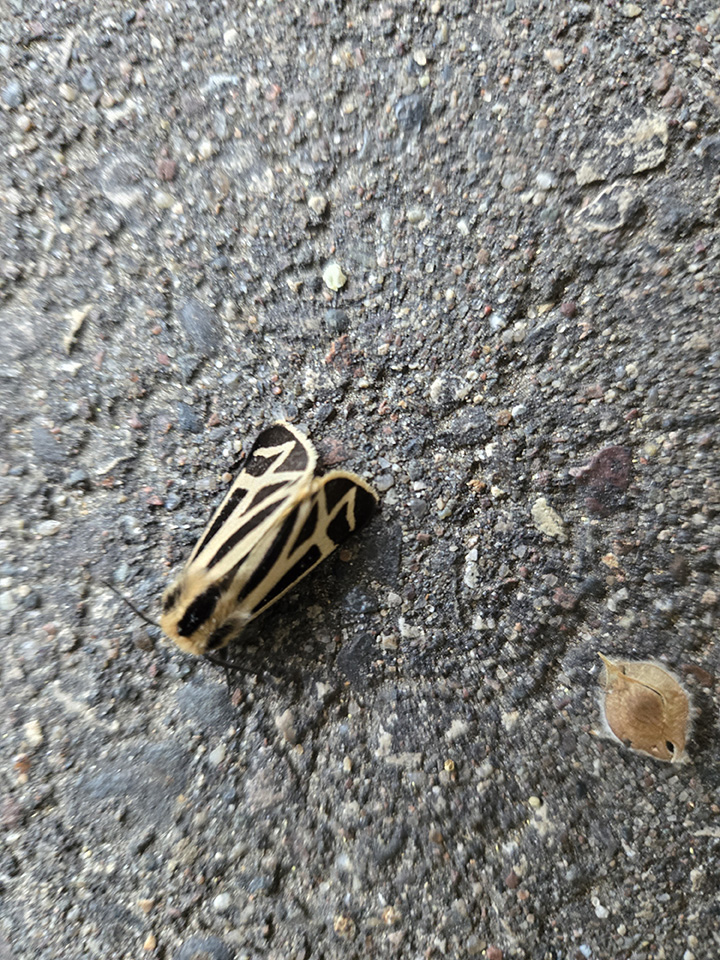
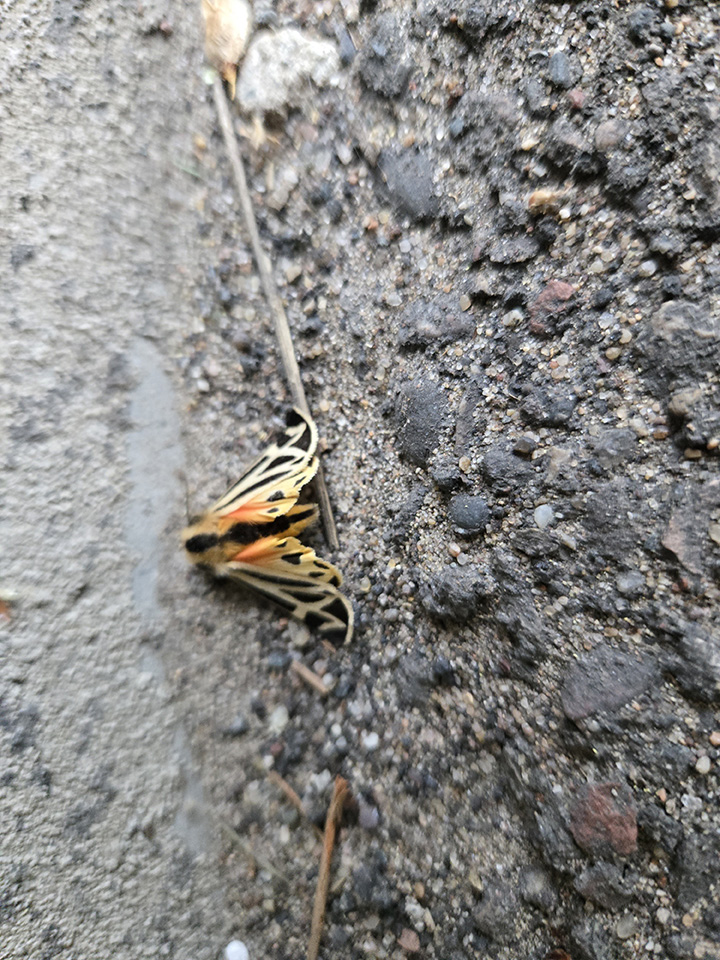
There is usually a pair of black spots on the collar. The thorax is striped black and buff or creamy buff. The abdomen is orange to orangish pink with a large black spot on the upper side of each segment (middorsal).
The forewing is black with broad, yellowish-buff to creamy-buff (pale) lines. The discal spot, leading edge (costal margin), inner margin, and fringe are also pale. The veins within a pale line are also pale, but the rest of the veins on the forewing are black. The postmedial (PM) and subterminal (ST) bands are bold lines. The PM line is present only from the costa to the discal spot, and a line continues from the discal spot to the anal angle. On the female, the lines are reduced, showing more black on the wing.
The hindwing is reddish, at least on the inner (basal) part, and usually yellowish on the outer part. There is a variable series of black spots near the outer margin that is usually described as a fragmented terminal line.
Caterpillars in the genus Apantesis are difficult to identify to the species level.
Size
Total length: ⅝″ to ⅞″ (16 to 22 mm)
Wingspan: 1 3⁄16″ to 1⅝″ (30 to 42 mm)
Similar Species
Nais tiger moth (Apantesis nais) is very similar. The collar usually has no black spots. The hindwing is usually entirely pale yellow, but sometimes there is a pale pink wash at the base. The black spots near the outer margin are larger, and the series is usually described as a wide black terminal band often fragmented into a row of spots. All of these markings on both nais and harnessed tiger moths are variable, and the two species are sometimes indistinguishable.
Habitat
A wide variety of habitats, including open woodlands, savannas, old fields, and gardens
Ecology
Season
One generation per year: May to August
Behavior
The wings are held over the body like a roof when at rest. When threatened, the wings are spread, exposing the colorful hindwings and warning predators that they are unpalatable.
Life Cycle
Larva Food/Hosts
A wide variety of plants, including clover, corn, dandelion, plantain, prairie cordgrass, grasses, and garden crops
Adult Food
Adults do not feed.
Distribution

Sources
Biodiversity occurrence data published by: Minnesota Biodiversity Atlas (accessed through the Minnesota Biodiversity Atlas Portal, bellatlas.umn.edu. Accessed 9/25/2024).
Apantesis phalerata Harris, 1841 in GBIF Secretariat (2023). GBIF Backbone Taxonomy. Checklist dataset https://doi.org/10.15468/39omei accessed via GBIF.org. Accessed 9/25/2024.
Quinn, Edward. M., and Ron Danielson. April 27, 2009. A Survey of Lepidoptera in Three Priority Areas of the Minnesota State Parks System. https://files.dnr.state.mn.us/eco/nongame/projects/consgrant_reports/2009
/2009_quinn_danielson.pdf.
Occurrence
Taxonomy
Order
Lepidoptera (Butterflies and Moths)
Superfamily
Noctuoidea (Owlet Moths and Allies)
Family
Erebidae (Underwing, Tiger, Tussock, and Allied Moths)
Subfamily
Arctiinae (Tiger Moths and Allies)
Tribe
Arctiini (Tiger Moths)
Subtribe
Arctiina
Genus
Apantesis
Family
In 2011 the family Arctiidae (Tiger Moths and Lichen Moths) was transferred to the family Erebidae mostly intact but demoted to a subfamily. The former subfamilies are now tribes, the former tribes now subtribes.
Subordinate Taxa
Synonyms
Apantesis incarnata
Apantesis incompleta
Apantesis naidella
Apantesis pulcherrima
Apantesis rhoda
Apantesis rhodana
Apantesis vittatula
Arctia incarnata
Arctia incompleta
Arctia phalerata
Arctia pulcherrima
Arctia rhoda
Common Names
harnessed tiger moth