honeylocust treehopper - Species Profile
Conservation • Description • Habitat • Ecology • Distribution • Taxonomy
Conservation Status
IUCN Red List
not listed
NatureServe
not listed
Minnesota
not listed
Description
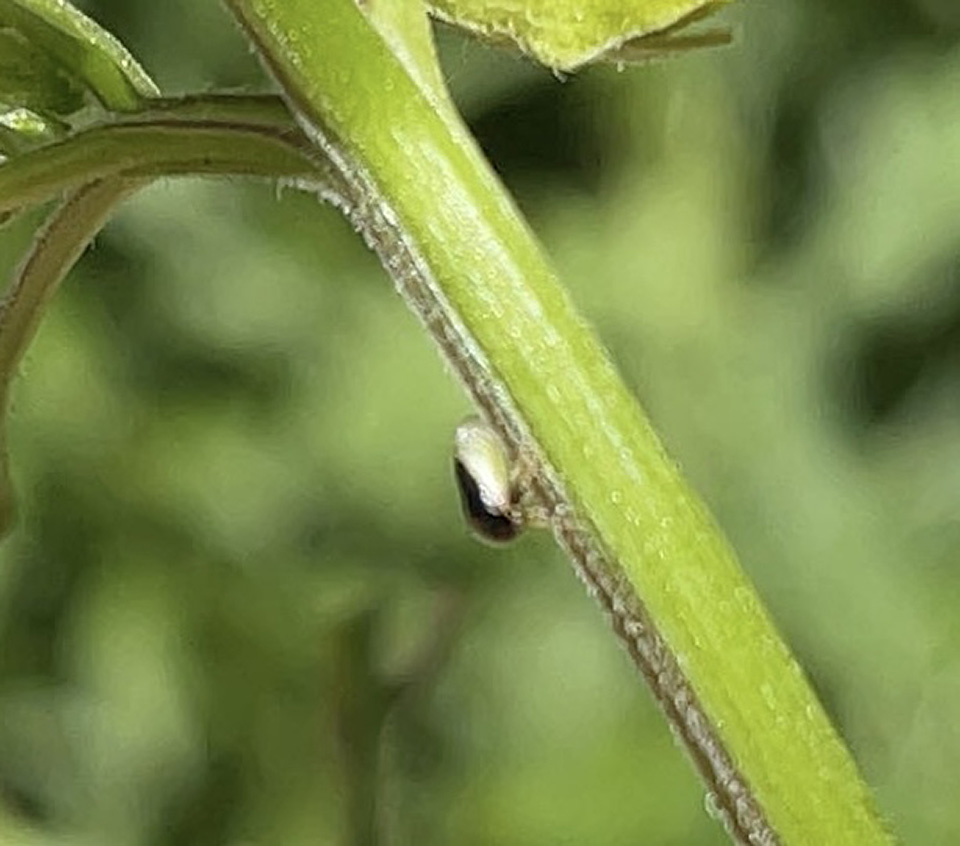
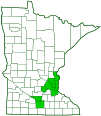
Honeylocust treehopper is a common, small, typical treehopper. It occurs in the United States east of the Great Plains, in Mexico, and in southern Quebec and Ontario Canada.
Adults are active in Minnesota mostly in June and July, though some have been seen as late as early September. Despite their common name, they are polyphagous, meaning they feed on a wide range of plants, both trees and herbaceous plants.
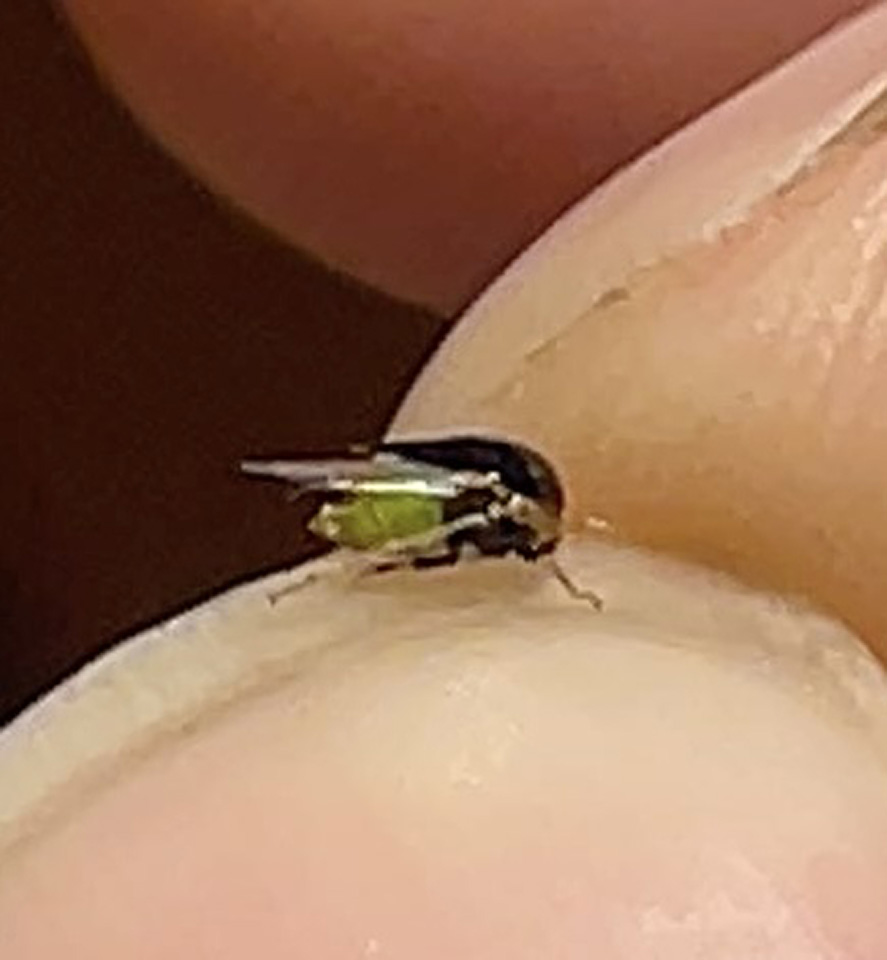
Adult females are ⅛″ (3.0 to 3.2 mm) in length and adult males are 3⁄32″ (2.6 to 2.7 mm) in length.
The head is convex and mostly yellow, black just at the base. There is sometimes a weak yellow band between the eye and the shoulder (humeral) angle.
The exoskeletal plate covering the thorax (pronotum) is very long, back over the abdomen at least to the tip of the hard part of the forewings when they are at rest. When viewed from the side it is broadly rounded in front and almost straight, not or only slightly wavy (sinuated) in the rear. The sides are straight and evenly tapered to a point in the rear. It is shiny and mostly black, but the amount of black is highly variable, from completely black, to black except for a clear or yellow tip, to black in the middle and clear or yellow with black tinting on the sides and at the tip.
The body is light green.
There are two pairs of wings, and they are held roof-like over the body when at rest. The forewings (tegmina) are longer than the body, are entirely clear and glassy, and completely cover the sides of the body. The veins are pale and indistinct. The R4+5 vein is merged with the M1+2 vein at least near the end. The radial-media (r-m) cross vein is absent. The narrow area (clavus) behind the scutellum when the wings are closed is squared off (truncate) at the end. There are four cells near the tip.
Size
Female total length: ⅛″ (3.0 to 3.2 mm)
Male total length: 3⁄32″ (2.6 to 2.7 mm)
Similar Species
Treehopper (Acutalis tartarea) forewings have 5 apical cells and the veins are prominent and usually dark.
Habitat
Ecology
Season
June through September
Behavior
The wings are held roof-like over the body when at rest.
Life Cycle
Adults overwinter
Nymph Food
Flowers and leaves of many trees and forbs
Adult Food
Flowers and leaves of many trees and forbs
Distribution
Sources
Micrutalis calva (Say, 1830) in Bánki, O., Roskov, Y., Döring, M., Ower, G., Hernández Robles, D. R., Plata Corredor, C. A., Stjernegaard Jeppesen, T., Örn, A., Pape, T., Hobern, D., Garnett, S., Little, H., DeWalt, R. E., Miller, J., Orrell, T., Aalbu, R., Abbott, J., Abreu, C., Acero P, A., et al. (2026). Catalogue of Life (2026-06-19 XR). Catalogue of Life Foundation, Amsterdam, Netherlands. https://doi.org/10.48580/dgy8b
Occurrence
Common
Taxonomy
Order
Hemiptera (True Bugs, Hoppers, Aphids, and Allies)
Suborder
Auchenorrhyncha (True Hoppers)
Infraorder
Cicadomorpha (Spittlebugs, Cicadas, Leafhoppers and Treehoppers)
Superfamily
Membracoidea (Leafhoppers and Treehoppers)
Family
Membracidae (Typical Treehoppers)
Subfamily
Tribe
Micrutalini
Genus
Micrutalis
Subordinate Taxa
Synonyms
Acutalis calva
Acutalis flavipennis
Acutalis illinoiensis
Ceresa calva
Ceresa semicrema calva
Cicada calva
Membracis calva
Micrutalis calva calva
Micrutalis calva illinoiensis
Micrutalis clava
Smilia flavipennis
Tragopa calva
Common Names
honeylocust treehopper