horned spanworm moth - Species Profile
Conservation • Description • Habitat • Ecology • Distribution • Taxonomy

Hodges #
7010
Conservation Status
IUCN Red List
not listed
NatureServe
NNR - Unranked
SNR - Unranked
Minnesota
not listed
Description
Horned spanworm moth is a small geometer moth. It occurs across the United States and southern Canada. In the U.S. it is common east of the Great Plains and in the northwest but is rare or absent elsewhere. Adults are found from early June to late September in deciduous and mixed forests and woodlands, in meadows, and in parks. Mature caterpillars are found in late spring. They feed on more than 60 species of plants from at least 20 families, including deciduous and coniferous trees, shrubs, and herbaceous plants.
Adults have a ¾″ to 1″ (19 to 25 mm) wingspan. Females are larger than males.
The female has a ½″ to 9⁄16″ (12 to 14 mm) forewing length. The outer margin of both wings is always angled, the forewing especially so. The ground color is almost always whitish or cream-colored, rarely yellowish, and the markings are reddish-brown. The antemedial (AM) line is a single line that is mostly straight but curved sharply forward approaching the leading edge (costal margin). The postmedial (PM) line is represented by two lines (doubled). The inner line is slightly wavy and sharply bent forward approaching the costal margin. The outer line is bolder, wavier, and straight to the costal margin. The two lines converge twice, almost touching, before spreading far apart at the costal margin. The subterminal (ST) area, beyond the PM line, is darker purplish-brown on the inner half, pale on the outer half. All of the pale areas on the forewing are lightly shaded with numerous short, fine, horizontal lines. The veins are also dark. The hindwing is similar, but the entire ST area is dark.
The male has a ⅜″ to 9⁄16″ (10 to 14 mm) forewing length. The wing shape, ground color, and markings are all variable. The forewing is usually rounded, sometimes angled. The ground color is usually yellowish, sometimes whitish. There is often a dark blotch in the ST area covering part of the darkened inner half and extending into the outer pale half.
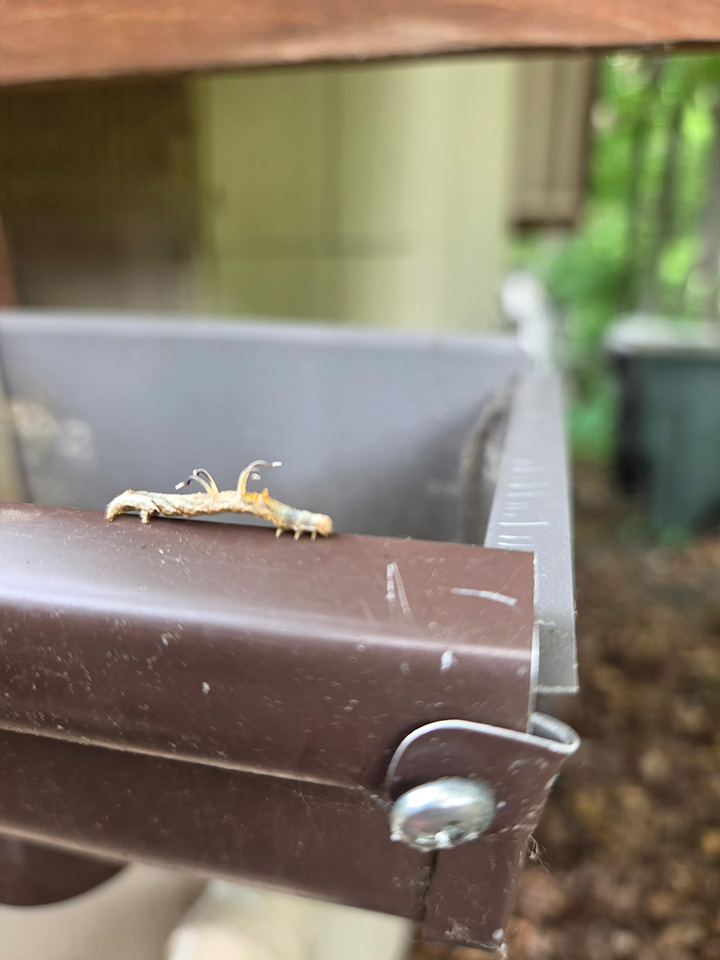
The caterpillar is up to ¾″ (2 cm) long and is instantly recognizable. The ground color varies from yellow to brown and is overlain by dark, medium, and light brown mottling. On each of the first and second abdominal segments there is a pair of curled, extendable, white-tipped tentacles (filaments).
Size
Wingspan: ¾″ to 1″ (19 to 25 mm)
Similar Species
Habitat
Deciduous and mixed forests and woodlands, meadows, and parks.
Ecology
Season
One generation per year: early June to late September
Behavior
The caterpillar often rests on an upper leaf surface with the body looped. It has been suggested that this mimics a fallen flower and its stamens. When alarmed, it inflates the filaments to twice their length.
The adult sometimes rests on the upper side of a leaf, where it resembles a dead leaf; on the underside of a leaf, where it resembles a dead patch; or on leaf litter on the ground, where it blends in with the background.
Life Cycle
Larva Food/Hosts
Plants from at least 20 families, including deciduous and coniferous trees, shrubs, and herbaceous plants.
Adult Food
Distribution
Sources
6, 7, 21, 22, 24, 27, 30, 75, 82, 83.
Biodiversity occurrence data published by: Minnesota Biodiversity Atlas (accessed through the Minnesota Biodiversity Atlas Portal, bellatlas.umn.edu. Accessed 6/5/2026).
Nematocampa resistaria (Herrich-Schäffer) in GBIF Secretariat (2023). GBIF Backbone Taxonomy. Checklist dataset https://doi.org/10.15468/39omei accessed via GBIF.org. Accessed 6/5/2026.
Quinn, Edward. M., and Ron Danielson. April 27, 2009. A Survey of Lepidoptera in Three Priority Areas of the Minnesota State Parks System. https://files.dnr.state.mn.us/eco/nongame/projects/consgrant_reports/2009
/2009_quinn_danielson.pdf.
Occurrence
Common
Taxonomy
Order
Lepidoptera (Butterflies and Moths)
Superfamily
Geometroidea (Geometrid and Swallowtail Moths)
Family
Subfamily
Ennominae (Typical Geometers)
Tribe
Ennomini
Genus
Nematocampa
Tribe
The genus Nematocampa was formerly in the tribe Ourapterygini. In 2008, Ourapterygini was synonymized with Ennomini; however, in that same year, Ferguson moved the genus out of this lineage entirely and into the tribe Cassymini based on physical traits. That Cassymini placement is currently retained by databases like ITIS and BugGuide. Despite this interim move, a later comprehensive molecular phylogenetic taxonomic revision of New World geometrid moths (Brehm et al., 2019) rejected the Cassymini placement and officially moved Nematocampa back into Ennomini.
Species
This species was formerly classified as Nematocampa limbata. In 1993 the North American species was separated from the Eurasian species and given the new species epithet.
Subordinate Taxa
Synonyms
Ania limbaria chagnoni
Eugonobapta brunneolineata
Microgonia vestitaria
Nematocampa expunctaria
Nematocampa filamentaria
Nematocampa limbata
Nematocampa orfordensis
Phalaena limbata
Common Names
bordered thorn
filament bearer
horned spanworm moth