hornworm tachinid fly - Species Profile
Conservation • Description • Habitat • Ecology • Distribution • Taxonomy

Conservation Status
IUCN Red List
not listed
NatureServe
not listed
Minnesota
not listed
Description
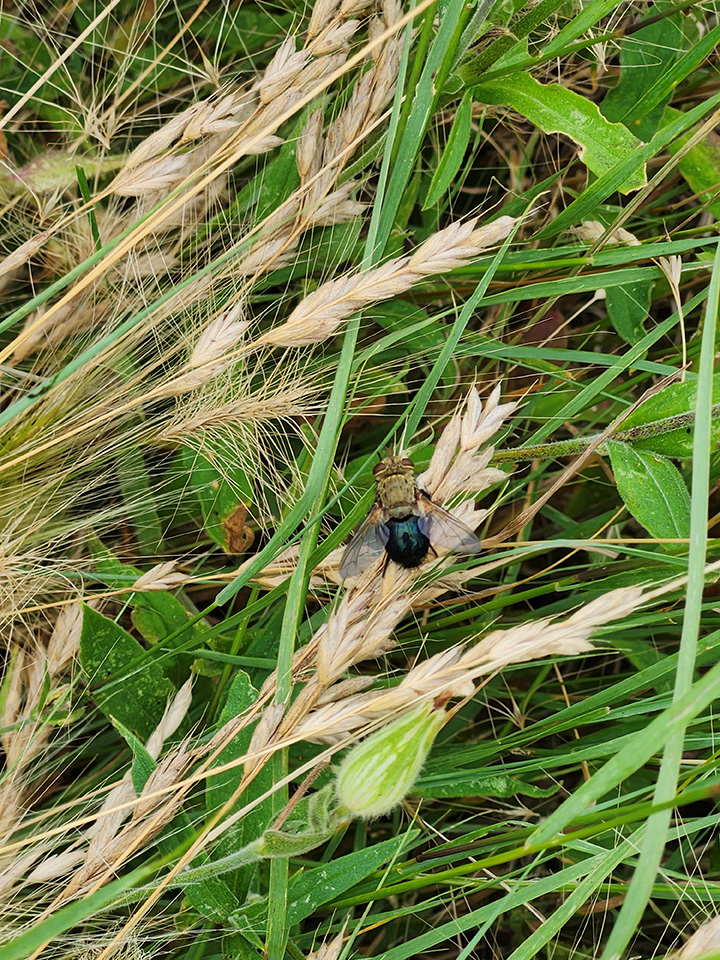
Hornworm tachinid fly is medium-sized to large fly. It occurs in the United States, southern Canada, Mexico, and Central America. It is by far the most common species in the genus Archytas. It is common in Minnesota. Adults feed on a variety of herbaceous plants. Larvae, called hornworms, are parasites on the caterpillars of several species of owlet moths (family Noctuidae).
Adults are ⅜″ to ⅝″ (10 to 15 mm) long.
There are two large compound eyes, one on each side of the head, and three simple eyes (ocelli) in a small triangle on top of the head. The compound eyes on both sexes are bare and are broadly separated at the top of the head. The antennae are are short and have three segments. The first segment is orange and short. The second segment is orange and elongated, much longer than wide. The third segment is black and has a large, black, forward-pointing bristle (arista) at the base. The arista is bare, not feather-like (plumose). The face is silvery-white to off-white. On each side of the face below the antenna there is a sunken area (parafacial) defined by the inner margin of the compound eye on the outside and an inverted V-shaped groove (ptilinal suture) on the inside. The parafacial is silvery-white to off-white with areas tinted brown to black. The hairs on the parafacial are short and off-white to white.
The thorax is olive-gray to yellowish-gray and slightly shiny. It is covered with numerous short, black, bristle-like hairs (setae), and several parallel rows of long black bristles. There is a small black spot on the thorax at the base of each bristle. Three grooves across the thorax delineate the three thoracic sections. The front (anterior) section of the thorax (prescutum) is light on the front half, darker on the back half. There is a black longitudinal stripe on each side of the prescutum in the shoulder (humeral) area that does not reach the front or rear margin, and matching but smaller stripes on the second section (scutum). The sides of the first thoracic section (propleuron) are covered with yellow to off-white hairs.
The abdomen is dark reddish-brown or black and slightly shiny. It often has a metallic bluish tinge.
The wings are mostly clear but the front third is darkened. The fifth radial cell (R5) is narrowed but open at the wingtip.
Size
Total length: ⅜″ to ⅝″ (10 to 15 mm)
Similar Species
Habitat
Ecology
Season
Early spring to late fall
Behavior
Life Cycle
The female lays eggs on the foliage. After the eggs hatch, the first stage (instar) larvae wait for a suitable host to pass. Overwintering is determined by the host caterpillar.
Larva Food/Hosts
Owlet moth caterpillars
Adult Food
Flower nectar of a variety of herbaceous plants
Distribution

Sources
Archytas apicifer (Walker, 1849) in Bánki, O., Roskov, Y., Döring, M., Ower, G., Hernández Robles, D. R., Plata Corredor, C. A., Stjernegaard Jeppesen, T., Örn, A., Pape, T., Hobern, D., Garnett, S., Little, H., DeWalt, R. E., Miller, J., Orrell, T., Aalbu, R., Abbott, J., Abreu, C., Acero P, A., et al. (2026). Catalogue of Life (2026-07-17 XR). Catalogue of Life Foundation, Amsterdam, Netherlands. https://doi.org/10.48580/dgykv
Occurrence
Common
Taxonomy
Order
Suborder
Brachycera
Infraorder
Cyclorrhapha
Zoosection
Schizophora
Zoosubsection
Calyptratae (Calyptrate Flies)
Superfamily
Oestroidea (Bot Flies, Blow Flies, and Allies)
Family
Subfamily
Tachininae
Tribe
Tachinini
Genus
Archytas
Subgenus
Archytas
Complex
Archytas analis complex
Subordinate Taxa
Synonyms
Archytas vulgaris
Tachina apicifera
Common Names
hornworm tachinid fly