hummingbird clearwing - Species Profile
Conservation • Description • Habitat • Ecology • Distribution • Taxonomy

Hodges #
7853
Conservation Status
IUCN Red List
not listed
NatureServe
N5 - Secure
SNR - Unranked
Minnesota
not listed
Description
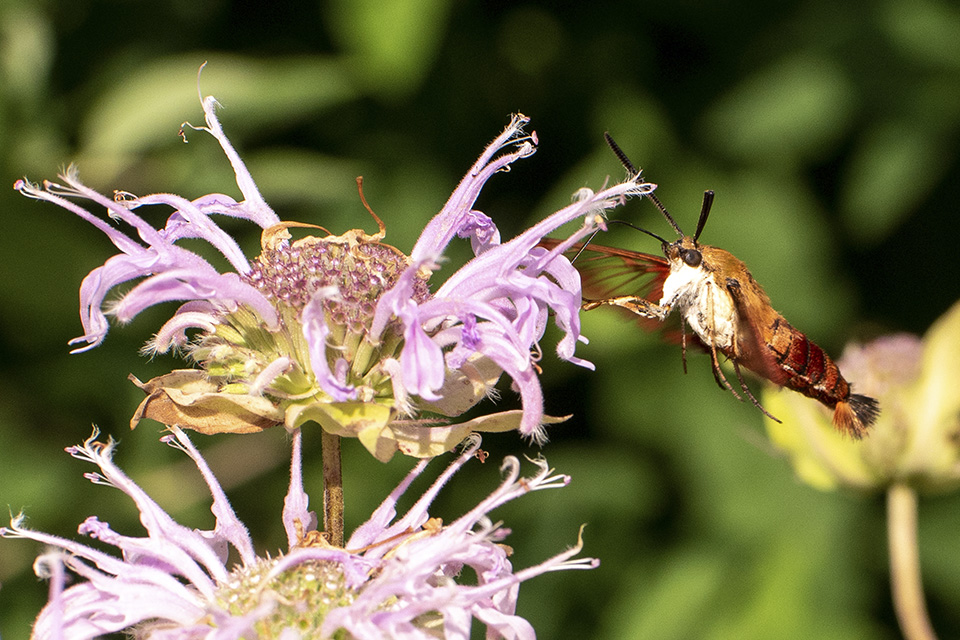
Hummingbird clearwing is a common, medium to large, sphinx moth. In poor light or at a distance it is easily mistaken for a hummingbird, due to similarities in both appearance and behavior. It has a wingspan of 1 9 ⁄16″ to 2 3 ⁄16″.
When the adult first emerges from the cocoon the wings are completely covered with dark wine-red scales. The scales begin to drop off with the first flight, eventually leaving the wings clear except on the margins and along the veins. The forewing is long and narrow with a smooth, slightly convex outer margin. The forewing cell is boldly outlined and is either mostly covered with dark scales or is bisected by a thin, dark line that looks like, but is not, a vein.
The appendage (tegula) covering the forewing base is olive green. The thorax is unbanded, olive green above, and yellow below.
The abdomen is banded with five colors. Abdominal segments 1 and 2 are olive green; segments 3 through 5 are tan with a few olive-green hairs; segments 6 and 7 are dark wine-red; segments 8 and 9 are olive green, often with a small to large, dark wine red patch in the middle; and segment 10 is black. Tufts of long hairs flare outward from the tenth abdominal segment and look like feathers.
The head is olive green. The antennae are black, thickened, and club-like. The proboscis is long and is coiled under the head when not in use. The legs are yellowish or pale colored.
The legs are pale.
The caterpillar is lime green and up to 2″ long. The head, thorax, and abdominal segments 1 through 7 and 10 are moderately covered with prominent, minute, white bumps. Abdominal segments 8 and 9 have much fewer, scattered, less prominent bumps. The leading edge of the thorax has a yellow, warty collar. A long, curved, often bluish horn extends from the eighth abdominal segment. A yellow subdorsal stripe extends from the first thoracic segment to the horn. The spiracles are white with a red center and an orange base. The leg-like structures (prolegs) on the abdomen are yellow at the base, black in the middle, and green at the end with an brownish-red band. Mature caterpillars can be found from May onward.
Size
Total length: 1″ to 1 3 ⁄16″
Wingspan: 1 9 ⁄16″ to 2 3 ⁄16″
Similar Species
Snowberry clearwing (Hemaris diffinis) legs are black.
Habitat
Meadows, gardens, woodland openings.
Ecology
Season
Two broods: May to September
Behavior
Adults fly during the day.
Life Cycle
Females attract males by releasing pheromones. After mating, she lays spherical green eggs on the underside of host leaves. The eggs hatch in about one week and the caterpillars begin feeding on leaves and fruit of the host plant. They molt five times in four weeks before pupating. The first generation pupates in a cocoon among the leaf litter on the ground. Adults emerge two to four weeks later. The second generation caterpillar burrows into the soil and overwinters as a pupa and emerges in as an adult in May or June.
Larva Food/Hosts
Mostly viburnum (Viburnum spp.), but also honeysuckle (Lonicera spp.), snowberry (Symphoricarpos), hawthorn (Crataegus spp.), and cherry (Prunus spp.).
Adult Food
Flower nectar.
Distribution

Sources
7, 21, 24, 27, 30, 75, 82, 83.
Biodiversity occurrence data published by: Minnesota Biodiversity Atlas (accessed through the Minnesota Biodiversity Atlas Portal, bellatlas.umn.edu. Accessed 8/6/2022).
Hemaris thysbe Fabricius, 1775 in GBIF Secretariat (2023). GBIF Backbone Taxonomy. Checklist dataset https://doi.org/10.15468/39omei accessed via GBIF.org. Accessed 8/6/2022.
Quinn, Edward. M., and Ron Danielson. April 27, 2009. A Survey of Lepidoptera in Three Priority Areas of the Minnesota State Parks System. https://files.dnr.state.mn.us/eco/nongame/projects/consgrant_reports/2009
/2009_quinn_danielson.pdf.
Occurrence
Taxonomy
Order
Lepidoptera (Butterflies and Moths)
Superfamily
Bombycoidea (Hawk, Sphinx, Silk, Emperor, and Allied Moths)
Family
Subfamily
Macroglossinae
Tribe
Dilophonotini
Subtribe
Hemarina
Genus
Hemaris (Clearwings and Bee Hawkmoths)
Subordinate Taxa
Synonyms
Hemaris buffaloensis
Hemaris cimbiciformis
Hemaris etolus
Hemaris floridensis
Hemaris fuscicaudis
Hemaris pelasgus
Hemaris pyramus
Hemaris ruficaudis
Hemaris uniformis
Common Names
common clear-wing
hummingbird clearwing
hummingbird clearwing moth
hummingbird moth
sphinx colibri