luna moth - Species Profile
Conservation • Description • Habitat • Ecology • Distribution • Taxonomy

Hodges #
7758
Conservation Status
IUCN Red List
not listed
NatureServe
N5 - Secure
SNR - Unranked
Minnesota
not listed
Description
Luna moth is a large, easily recognized, very common but seldom seen, emperor moth. It occurs throughout the United States east of the Great Plains. It also occurs in southern Canada from Nova Scotia to Alberta. It occurs in virtually every forested or woodland patch in the eastern United States and southern Canada except in some parts of New England.
Adults are active in Minnesota mostly from late May to mid-August. They do not feed. They are short lived, lasting only about a week. They fly only at night, beginning a few hours after dusk. Throughout the range of the luna moth, the larvae feed on many species of deciduous trees and shrubs. However, they show a distinct preference for one or more codominant tree species, and that preference varies by region. In northern Minnesota, Wisconsin, and Michigan, and in southern Ontario, the preferred species appears to be paper birch. In the Twin Cities Metro region, they have been recorded feeding on alder, cherry, and hazel.
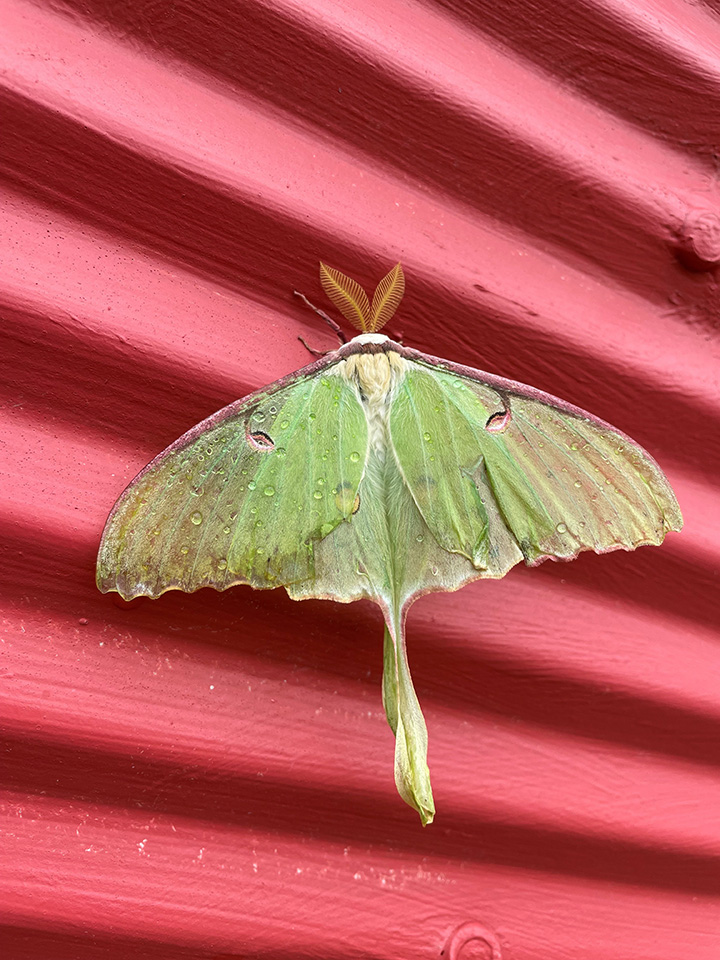
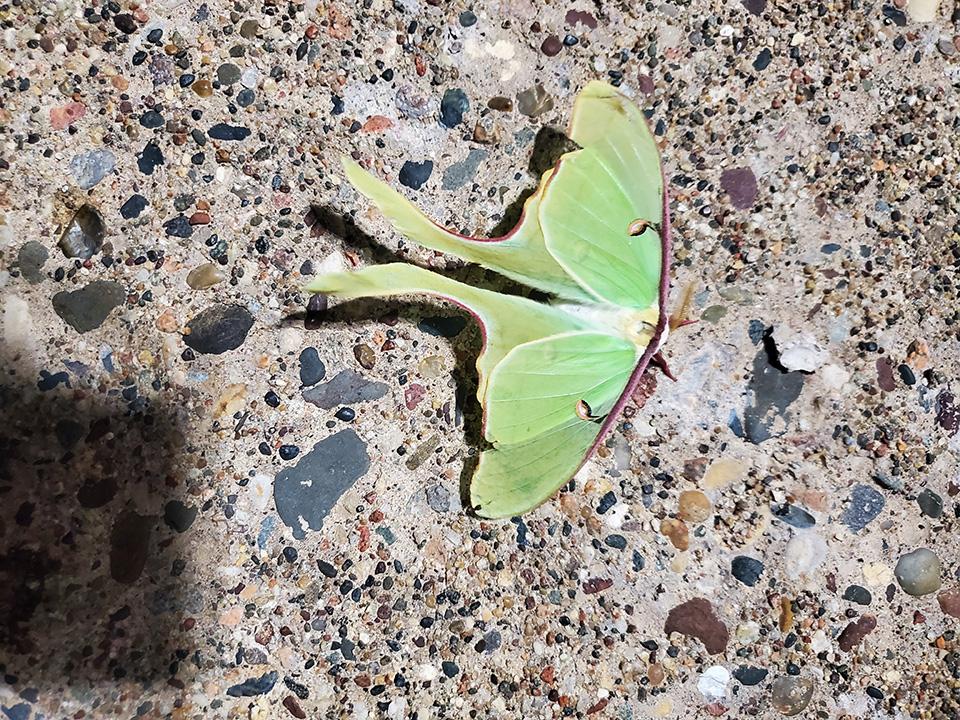
Adults have a 3″ to 4½″ (75 to 115 mm) wingspan. Males and females are similar in both size and appearance.
The eyes are large. The antennae on the male are feather-like with four long branches (rami) on each segment (quadripectinate) continuing nearly to the tip. The antennae on the female are also quadripectinate, but with short rami alternating with long rami.
The wing color is somewhat variable, both by region and by time of year. On the first generation, the only generation in Minnesota, the wings are mostly pale green, but they are gradually more bluish green in the north and more yellowish green in the south. The gradation is continuous over 800 to 1,000 miles, making it impractical to separate the color forms as subspecies. On later generations in the south, the wings are more yellow. There is a thick, deep reddish-purple border on the leading edge (costal margin) of both the forewings and hindwings. On the forewing, there is a sleepy-looking, oval eyespot in the median area. It is outlined with yellow, white, and black, and it is connected to the reddish-purple border by a thick line of the same color. There is a similar eyespot on the hindwing, but it is round and it is isolated, not connected to the border. In the south there is a narrow, brown, postmedial (PM) band on both wings, but this feature gradually fades going north, and it is absent on Minnesota individuals. Each hindwing has a long tail.
Size
Wingspan: 3″ to 4½″ (75 to 115 mm)
Similar Species
No similar species in North America
Habitat
Forests and woodlands
Ecology
Season
One generation per year in the north: late May to mid-August
Behavior
Life Cycle
Larva Food/Hosts
Many species of deciduous trees and shrubs
Adult Food
Adults do not feed.
Pests and Diseases
European tachinid fly (Compsilura concinnata) was introduced into North America in 1906 as a biocontrol agent for spongy moth (Lymantria dispar). It also parasitizes moths in the Nymphalidae and Saturniidae families.
Distribution

Sources
Biodiversity occurrence data published by: Minnesota Biodiversity Atlas (accessed through the Minnesota Biodiversity Atlas Portal, bellatlas.umn.edu. Accessed 11/25/2024).
Actias luna Linnaeus, 1758 in GBIF Secretariat (2023). GBIF Backbone Taxonomy. Checklist dataset https://doi.org/10.15468/39omei accessed via GBIF.org. Accessed 11/25/2024.
Quinn, Edward. M., and Ron Danielson. April 27, 2009. A Survey of Lepidoptera in Three Priority Areas of the Minnesota State Parks System. https://files.dnr.state.mn.us/eco/nongame/projects/consgrant_reports/2009
/2009_quinn_danielson.pdf.
Occurrence
Taxonomy
Order
Lepidoptera (Butterflies and Moths)
Superfamily
Bombycoidea (Hawk, Sphinx, Silk, Emperor, and Allied Moths)
Family
Saturniidae (Emperor and Giant Silk Moths)
Subfamily
Tribe
Saturniini
Genus
Actias (Moon Moths)
Subordinate Taxa
Synonyms
Actias bolli
Actias dictynna
Actias lacrimans
Actias maasseni
Actias mariae
Actias rossi
Actias rubromarginata
Actias rubrosuffusa
Phalaena luna
Tropaea luna
Common Names
luna moth