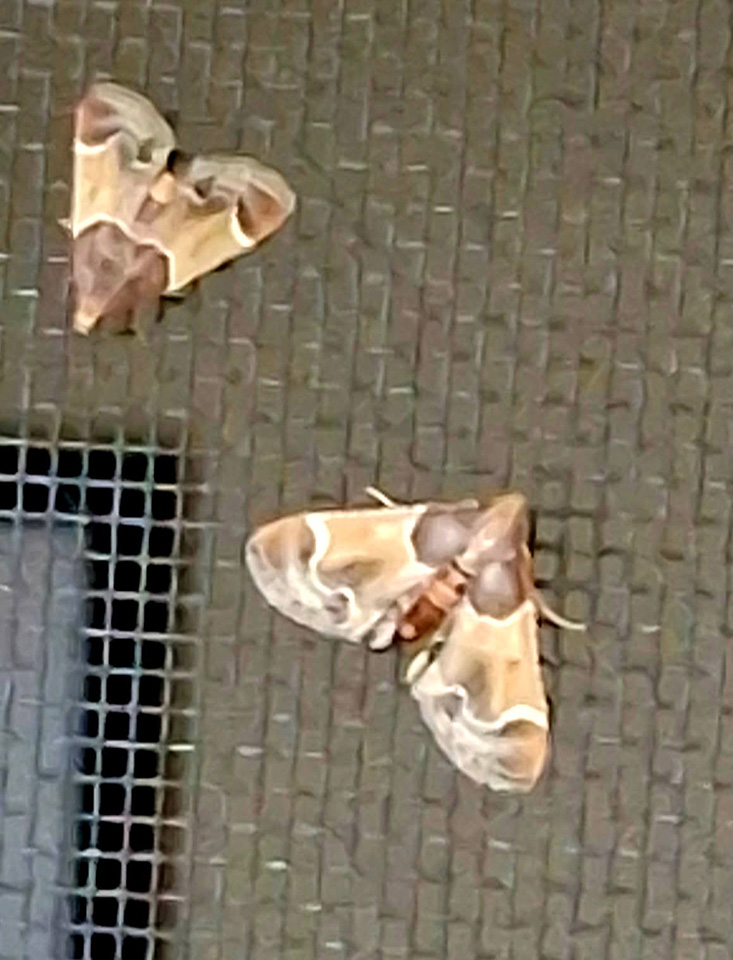
meal moth - Species Profile
Conservation • Description • Habitat • Ecology • Distribution • Taxonomy

Hodges #
5510
Conservation Status
IUCN Red List
not listed
NatureServe
NNA - Not applicable
SNA - Not applicable
Minnesota
not listed
Description
Meal moth is a small, broad-winged, triangular, pyralid moth. It is cosmopolitan, occurring around the world, but is most common in Europe and the United States. It is found anywhere grain is processed or stored, including warehouses, barns, and most home pantries. It is not the only moth common to home pantries, nor is it the most common. That distinction belongs to Indian meal moth. Other common pantry moths are Mediterranean flour moth, brown house moth, and white shouldered house moth.
Meal moth larva feed on cereals (plants in the Poaceae [grass] family), grains (edible seeds of cereals), and vegetables, including potatoes. Adults do not feed and are short-lived. They mate as soon as possible after emerging, then die after nine or ten days.
Adults are 9⁄16″ to ⅝″ (14 to 16 mm) in length and have a 11⁄16″ to 1 3⁄16″ (18 to 30 mm) wingspan. The protruding mouthparts (proboscis) are scaled at the base. The sensory appendages (palps) attached to the upper lip (labrum) are long and turned upward in front of the head.
The forewing is elongate triangular. The basal area is chestnut brown, the median area is fawn-colored, and the subterminal area is chestnut brown. The antemedial (AM) and postmedial (PM) lines are white.
The hindwing is broad and rounded. The subcostal plus first branch of the radial vein (Sc+R1) is fused beyond the discal cell to the radial sector (Rs), then separated for more than half of its length.
Size
Total length: 9⁄16″ to ⅝″ (14 to 16 mm)
Wingspan: 11⁄16″ to 1 3⁄16″ (18 to 30 mm)
Similar Species
Habitat
Cereals, grains, and vegetables
Ecology
Season
Four generations per year: May to August outdoors, year round indoors
Behavior
Adults rest with their wings spread wide, their abdomen raised at a right angle to the body, and their antennae folded back over the body.
Life Cycle
Larva Food/Hosts
Mostly cereals but also other grains and vegetables, including potatoes.
Adult Food
Adults do not feed
Distribution

Sources
Biodiversity occurrence data published by: Minnesota Biodiversity Atlas (accessed through the Minnesota Biodiversity Atlas Portal, bellatlas.umn.edu. Accessed 6/13/2026).
Pyralis farinalis Linnaeus, 1758 in GBIF Secretariat (2023). GBIF Backbone Taxonomy. Checklist dataset https://doi.org/10.15468/39omei accessed via GBIF.org. Accessed 6/13/2026.
Occurrence
Common and widespread
Taxonomy
Order
Lepidoptera (Butterflies and Moths)
Superfamily
Pyraloidea (Pyralid and Crambid Snout Moths)
Family
Pyralidae (Pyralid Snout Moths)
Subfamily
Pyralinae
Tribe
Pyralini
Genus
Pyralis (Meal Moths)
Subordinate Taxa
Synonyms
Asopia domesticalis
Asopia farinalis
Phalaena erecta
Phalaena farinalis
Pyralis domesticalis
Pyralis erecta
Pyralis farinatis
Pyralis fraterna
Pyralis manihotalis
Pyralis marianii
Pyralis meridionalis
Pyralis orientalis
Pyralis sardoplumbea
Pyralis tenerifensis
Common Names
meal moth