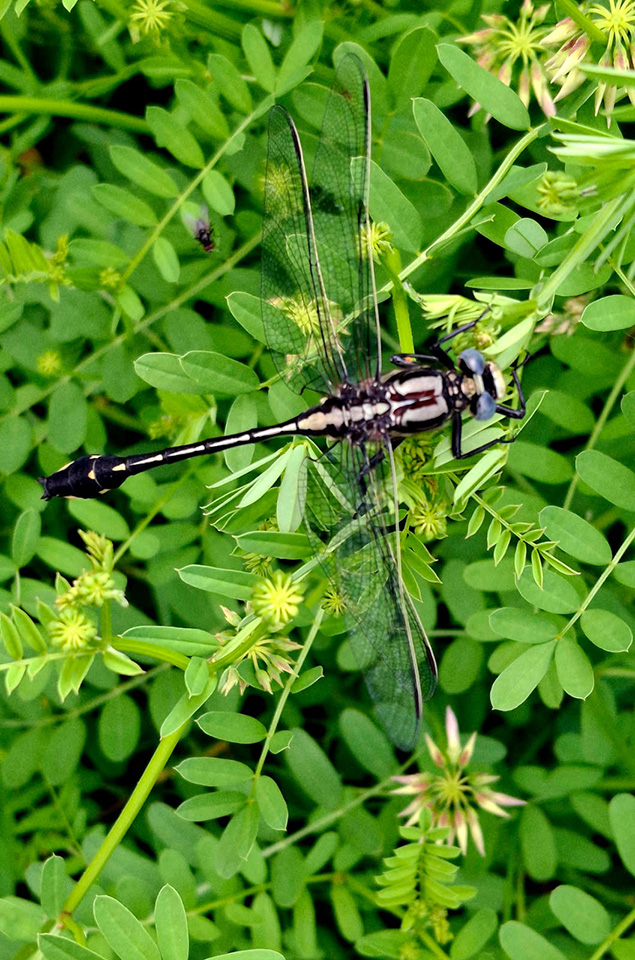
midland clubtail - Species Profile
Conservation • Description • Habitat • Ecology • Distribution • Taxonomy

Conservation Status
IUCN Red List
not listed
NatureServe
N5 - Secure
SNR - Unranked
Minnesota
not listed
Description
Midland clubtail is an early season, medium-sized clubtail.
The thorax is large and yellow with black markings including two lateral thoracic stripes. The first (anterior) stripe is incomplete or interrupted. The second (posterior) is variable or absent.
The abdomen is slender and black with yellow markings. The upper (dorsal) surface or abdominal segments 1 through 7 have narrow, elongated, lance-shaped spots. Segment 8 has a small yellow triangle. Segments 7, 8, and 9 are expanded into a “club” that is only slightly narrower than the thorax. They have no dorsal markings but have large yellow spots on the sides.
The color of this dragonfly varies with the temperature. In warm temperatures the light areas on the thorax and abdomen are yellow. In cool temperatures these areas are grayish-green. The markings on the side of expanded abdominal segments 8 and 9 are always yellow.
The head is small. The face lacks the black horizontal stripe found on many other species of dragonflies. The large compound eyes do not meet at the top of the head. They are gray in warm temperatures, aqua blue in cool temperatures.
The legs are black. The fourth segment of the hind leg of the female often has a pale lateral stripe.
The wings are clear except for dark stigmas. The wing triangle, a section of intersecting veins about 20% of the way from the base to the wingtip, is about the same size in the forewing and the hindwing.
Size
Total length: 2″ to 2⅜″
Similar Species
Plains clubtail (Gomphurus externus) has a large yellow dorsal spot on abdominal segment 9.
Splendid clubtail (Gomphus lineatifrons) is larger. It has a black horizontal face stripe and usually no dorsal spot on abdominal segment 8.
Habitat
Moderately to fast flowing rivers and large streams, large lakes with emergent vegetation.
Ecology
Season
Early June to late July
Behavior
The adult perches on the ground or a rock on a bank or shoreline. It is a very strong flier and often patrols open water far from land.
Life Cycle
The female does not have an ovipositor. She lays eggs by washing them off in fast-flowing water in streams or rivers, or in waves on lakes.
Naiad Food
Adult Food
Flying insects, including other dragonflies.
Distribution

Sources
Biodiversity occurrence data published by: Minnesota Biodiversity Atlas (accessed through the Minnesota Biodiversity Atlas Portal, bellatlas.umn.edu. Accessed 6/21/2026).
Gomphurus fraternus (Say, 1840) in Bánki, O., Roskov, Y., Döring, M., Ower, G., Hernández Robles, D. R., Plata Corredor, C. A., Stjernegaard Jeppesen, T., Örn, A., Pape, T., Hobern, D., Garnett, S., Little, H., DeWalt, R. E., Miller, J., Orrell, T., Aalbu, R., Abbott, J., Abreu, C., Acero P, A., et al. (2026). Catalogue of Life (2026-05-15 XR). Catalogue of Life Foundation, Amsterdam, Netherlands. https://doi.org/10.48580/dgxsq
Abbott, J.C. 2006-2026. OdonataCentral: An online resource for the distribution and identification of Odonata. Available at https://www.odonatacentral.org/. (Accessed: 6/21/2026).
Haarstad, J. 1997. The dragonflies of selected eastern Minnesota rivers. Report submitted to the Minnesota Department of Natural Resources. Unpaged.
Occurrence
Taxonomy
Order
Odonata (Dragonflies and Damselflies)
Suborder
Superfamily
Gomphoidea
Family
Gomphidae (Clubtails)
Genus
Gomphurus
Genus
This species was formerly classified as Gomphus fraternus. In an attempt to clarify the relationships of species in the genus Gomphus (Needham, 1947) , five subgenera were proposed. This species was placed in the subgenus Gomphurus. In later years, several other subgenera were defined. Nine of the genera were grouped in what was called the Gomphus complex. A recent phylogenetic analysis (Ware, et al., 2017) raised all nine subgenera in the complex to genus level, and Gomphus fraternus became Gomphurus fraternus.
Subordinate Taxa
midland clubtail (Gomphurus fraternus fraternus) 
midland clubtail (Gomphurus fraternus manitobanus)
Synonyms
Aeshna fraternus
Gomphus fraternus
Gomphurus manitobanus
Common Names
midland clubtail