narrow-headed marsh fly - Species Profile
Conservation • Description • Habitat • Ecology • Distribution • Taxonomy
Conservation Status
IUCN Red List
not listed
NatureServe
not listed
Minnesota
not listed
Description
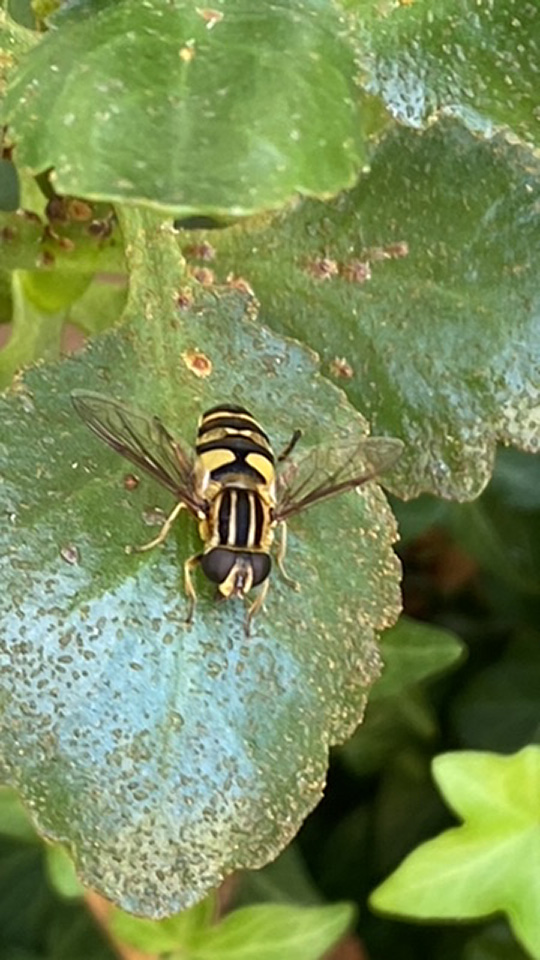
Narrow-headed marsh fly is a robust, medium-sized, ⅜″ to ⅝″ long hoverfly. It is somewhat bee-like in appearance.
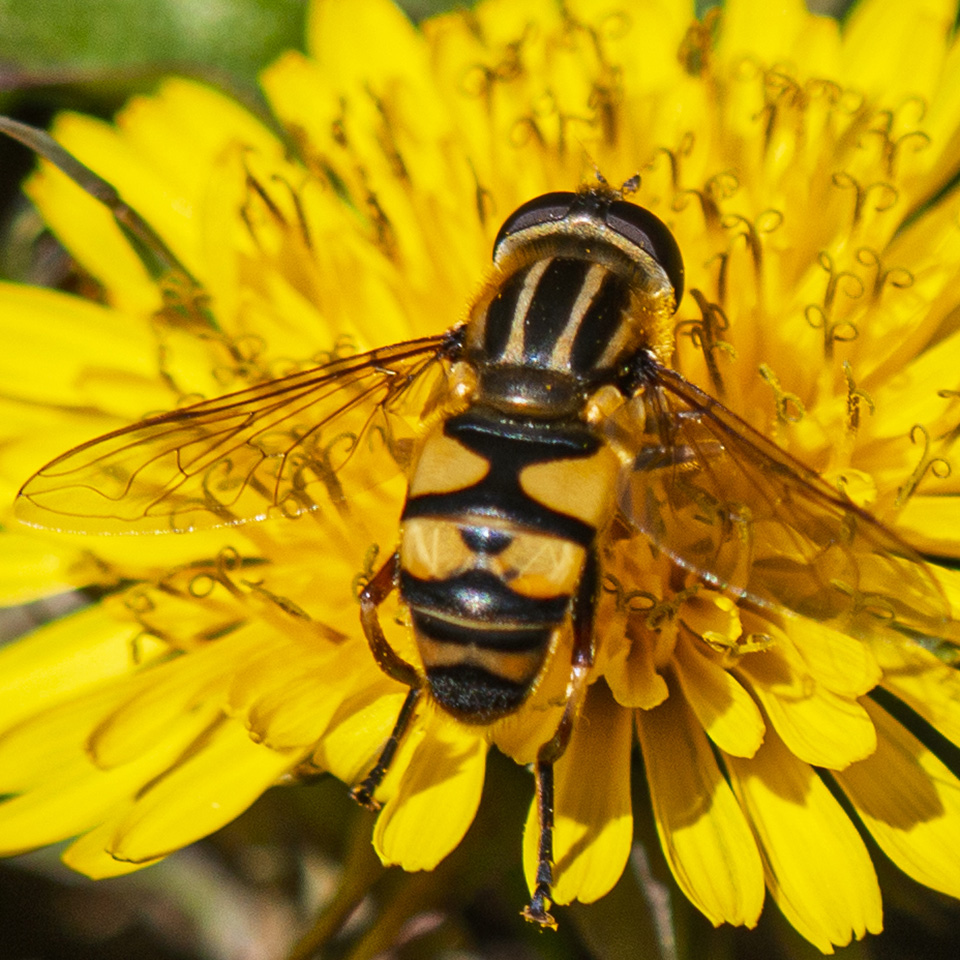
The head is rounded in the front, not flattened. There is a shiny, orange, vertical stripe on the front on the face. There are two large compound eyes and three very small simple eyes (occelli). The compound eyes of the male, like the female, do not meet at the top of the head, and are narrowed abruptly at the top of the face. On the female the margin is straight. This gives the male a much narrower area between the compound eyes at the top of the head (vertex). The occelli are are arranged in a triangle on the vertex. On the female the vertex and upper part of the face (frons) are completely covered with short black hairs and are narrower than the width of the pair of tubercles that bear the antennae (antennal process). The antennae are short.
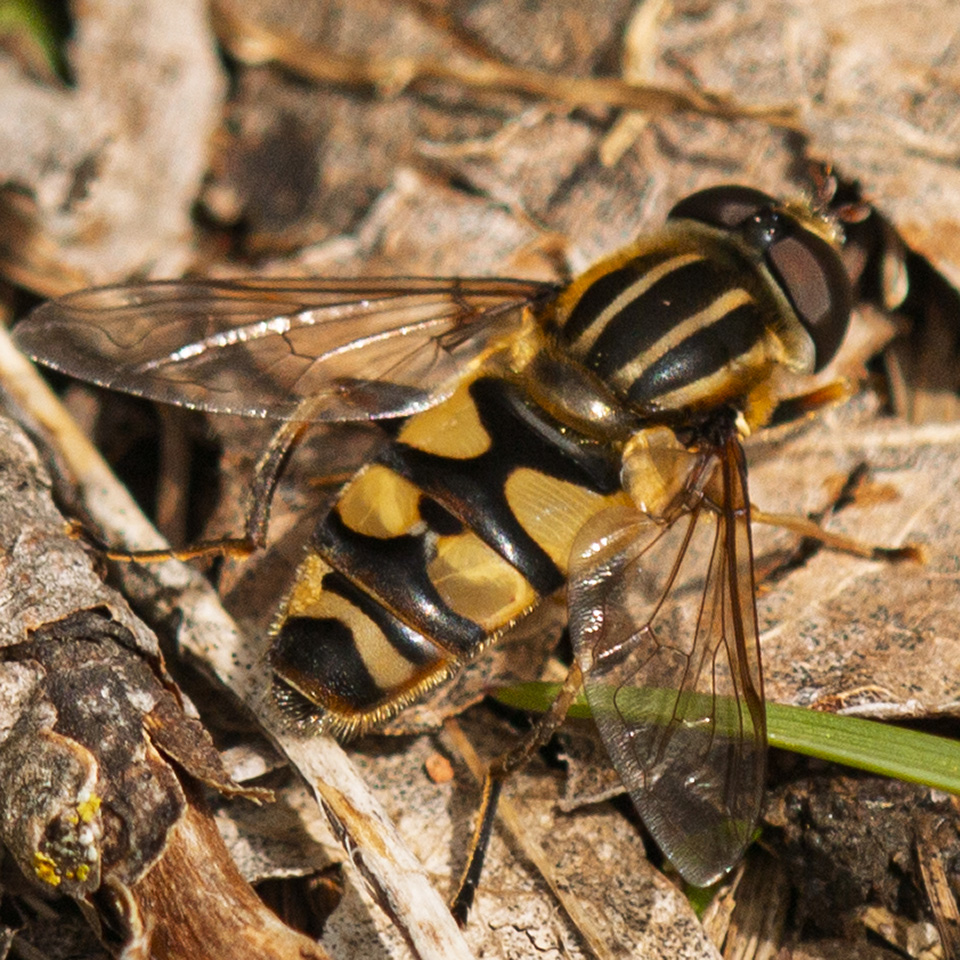
The thorax is brownish-black with four longitudinal stripes. The two middle (dorsal) stripes are white, whitish, or pale yellow.
The abdomen is brownish-black with lemon yellow horizontal stripes. The first stripe is incomplete, interrupted in the middle (dorsally). The others are usually complete but not always. The male has 3 yellow stripes. The female abdomen is longer and has 4 yellow stripes. The plate between the abdomen and thorax (scutellum) is large, convex, and more or less translucent.
The wings are relatively large. The second cell on the leading edge of each wing toward the tip (pterostigma) is relatively broad and tinted brown. It does not resemble a cross vein. The marginal cell (R1) is open.
The legs are mostly yellow with some dark brown or blackish-brown markings. The third segment of the hind leg (femur) is not spurred.
Size
Total length: ⅜″ to ⅝″
Similar Species
Broad-headed marsh fly (Helophilus latifrons) yellow abdominal stripes are broader. The male vertex is broad, not narrowed. The lower third if the female frons is covered with yellow hairs. The frons and vertex are wider than the antennal process. The legs are less extensively marked with black.
Habitat
Ecology
Season
Late March to early October
Behavior
Life Cycle
Larva Food/Hosts
Submerged plant litter in ponds, mud, manure, and silage.
Adult Food
Distribution

Sources
Biodiversity occurrence data published by: Minnesota Biodiversity Atlas (accessed through the Minnesota Biodiversity Atlas Portal, bellatlas.umn.edu. Accessed 9/17/2026).
Helophilus (Helophilus) fasciatus Walker, 1849 in Bánki, O., Roskov, Y., Döring, M., Ower, G., Hernández Robles, D. R., Plata Corredor, C. A., Stjernegaard Jeppesen, T., Örn, A., Pape, T., Hobern, D., Garnett, S., Little, H., DeWalt, R. E., Miller, J., Orrell, T., Aalbu, R., Abbott, J., Abreu, C., Acero P, A., et al. (2026). Catalogue of Life (2026-08-26 XR). Catalogue of Life Foundation, Amsterdam, Netherlands. https://doi.org/10.48580/dgyy9
Telford, Horace S.. (1939). The Syrphidae of Minnesota. University of Minnesota. Minnesota Agricultural Experiment Station.
Occurrence
Abundant
Taxonomy
Order
Suborder
Brachycera
Infraorder
Cyclorrhapha
Zoosection
Aschiza
Family
Syrphidae (Hover Flies)
Subfamily
Eristalinae (Drone Flies and Allies)
Tribe
Eristalini (Rat-tail Maggot Flies)
Subtribe
Helophiliina
Genus
Subgenus
Helophilus
Subordinate Taxa
Synonyms
Elophilus fasciatus
Eristalis decisus
Eristalis impositus
Helophilus appensus
Helophilus similis
Helophilus susurrans
Common Names
narrow-headed marsh fly
narrow-headed sun fly