oblong-winged katydid - Species Profile
Conservation • Description • Habitat • Ecology • Distribution • Taxonomy

Conservation Status
IUCN Red List
not listed
NatureServe
NNR - Unranked
Minnesota
not listed
Description
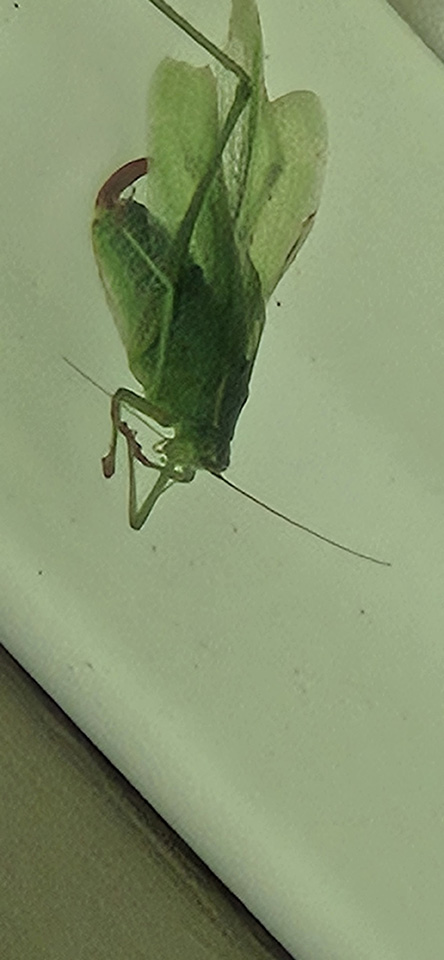
Oblong-winged katydid is a long-horned, round-headed katydid (genus Amblycorypha). It occurs in eastern North America, Mexico, and Central America. In the United States it is common east of the Great Plains. It is found mostly in damp areas on trees, shrubs, and tall weeds in the understory of deciduous forests, at the edges of thickets, and in gardens.
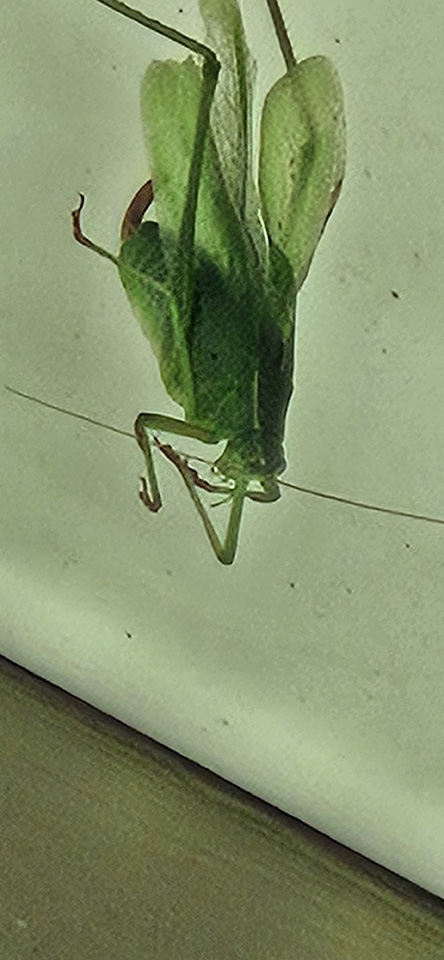
At 1⅝″ to 2″ (42 to 52 mm) long, oblong-winged katydid is the largest round-headed katydid. Their overall color varies but is genetically inherited. The head, body, wings, and legs are usually leaf green, occasionally yellow, rarely tan, orange, brown, or pink.
The head is oval. The top of the head is rounded and strongly curved backward. The face is vertical. The eyes are oval. The antennae are very long and extend well beyond the tip of the abdomen. They are thread-like and have many segments. They are attached high on the face and far apart. The forehead projects forward between the antennae.
The pronotum does not have two small dark spots on each side. On each side the lateral lobe of the pronotum has a deep sinus at the rear upper corner (humeral angle).
The leathery forewings (tegmina) are elongated-oval and 3.1 to 4 times as long as wide. They are held roof-like over the body. A small area at the base of the wing is horizontal and very dark. On the male, this is the stridulatory field. There is a row of bumps (a file) on the underside of the upper wing and a sharp edge (blade) on the upper side of the lower wing. By rubbing the file against the blade, the male produces its distinctive song, a short, high-pitched, 9 kHz “zeee-dik!” that is repeated every few seconds. The female wings are similar but do not have these two sound-producing structures.
The hindwings are membranous, broad, and long. They are folded fan-like under the tegmina when at rest. They are longer than, and not completely covered by, the tegmina.
On the female the ovipositor is shorter than the abdomen, flattened, curved upward.
The front legs are short, the middle legs a little longer, the hind legs much longer. The third segment (femur) of the hind leg extends almost but not quite to the tips of the tegmina. The end section of the leg (tarsus), corresponding to the foot, has four segments.
Size
Total length: 1⅝″ to 2″ (42 to 52 mm)
Song
Similar Species
Habitat
Deciduous forests, gardens
Ecology
Season
One generation per year: June through September
Behavior
Life Cycle
Eggs are deposited in the soil.
Nymph Food
Plant juices
Adult Food
Leaves of deciduous plants
Distribution

Sources
Amblycorypha oblongifolia (De Geer, 1773) in Bánki, O., Roskov, Y., Döring, M., Ower, G., Hernández Robles, D. R., Plata Corredor, C. A., Stjernegaard Jeppesen, T., Örn, A., Pape, T., Hobern, D., Garnett, S., Little, H., DeWalt, R. E., Miller, J., Orrell, T., Aalbu, R., Abbott, J., Abreu, C., Acero P, A., et al. (2026). Catalogue of Life (2026-07-17 XR). Catalogue of Life Foundation, Amsterdam, Netherlands. https://doi.org/10.48580/dgykv
Hebard, Morgan. (1932). The Orthoptera of Minnesota. University of Minnesota. Minnesota Agricultural Experiment Station. Retrieved from the University of Minnesota Digital Conservancy, https://hdl.handle.net/11299/204015.
Occurrence
Common
Taxonomy
Order
Orthoptera (Grasshoppers, Crickets, and Katydids)
Suborder
Ensifera (Katydids, Crickets, and Allies)
Infraorder
Tettigoniidea (Katydids, Wētā, and Allies)
Superfamily
Tettigonioidea
Family
Tettigoniidae (Katydids)
Subfamily
Phaneropterinae (Leaf Katydids)
Tribe
Amblycoryphini
Subtribe
Amblycoryphina
Genus
Amblycorypha (Round-headed Katydids)
Subordinate Taxa
Synonyms
Amblycorypha scudderae
Amblycorypha scudderi
Locusta oblongifolia
Phylloptera oblongifolia
Common Names
oblong-winged katydid