Painted Lady - Species Profile
Conservation • Description • Habitat • Ecology • Distribution • Taxonomy

Conservation Status
IUCN Red List
not listed
NatureServe
N5 - Secure
SNRB - Unranked Breeding
Minnesota
not listed
Description
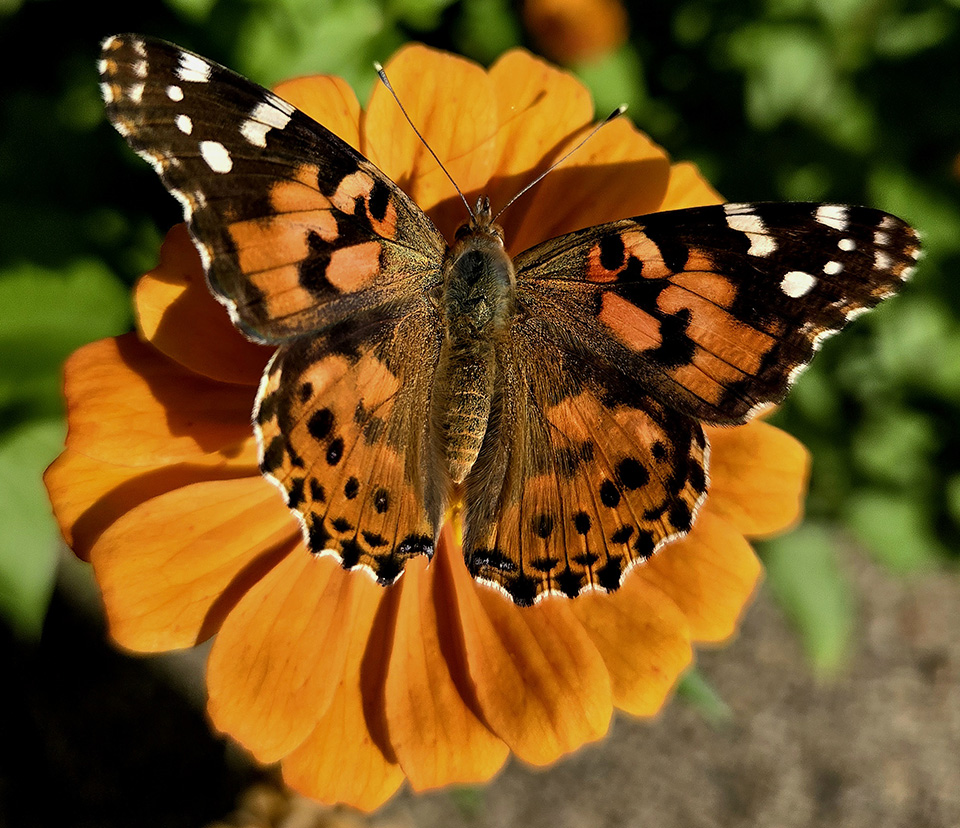
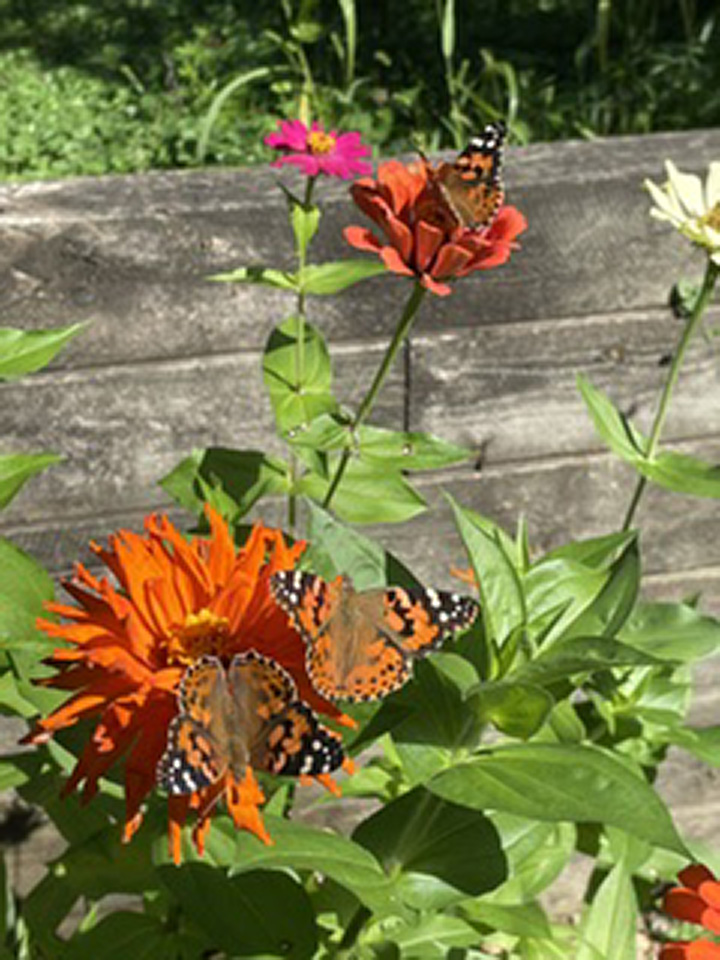
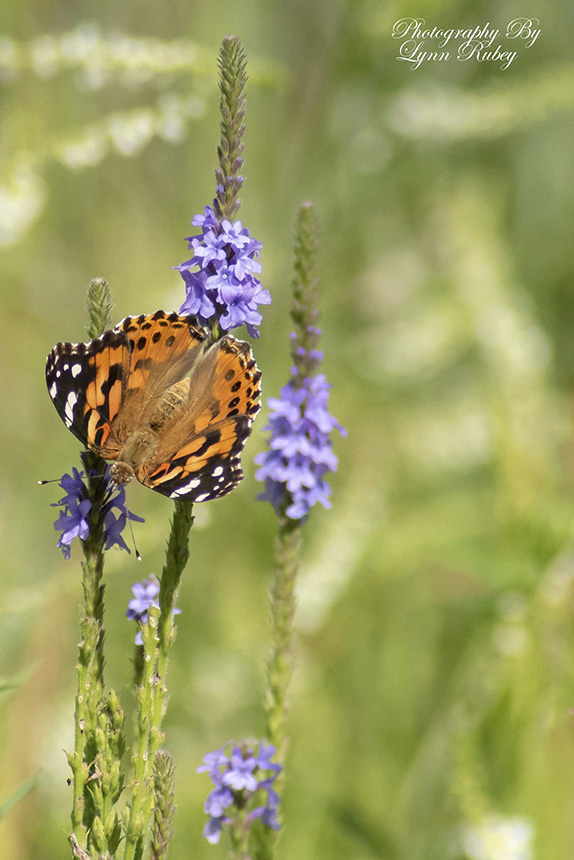
Painted lady is a migratory, medium-sized, brushfooted butterfly. It has a wingspan of 2″ to 2⅞″. Males and females look alike. The summer form is larger and brighter orange, the winter form is paler and has smaller black marks.
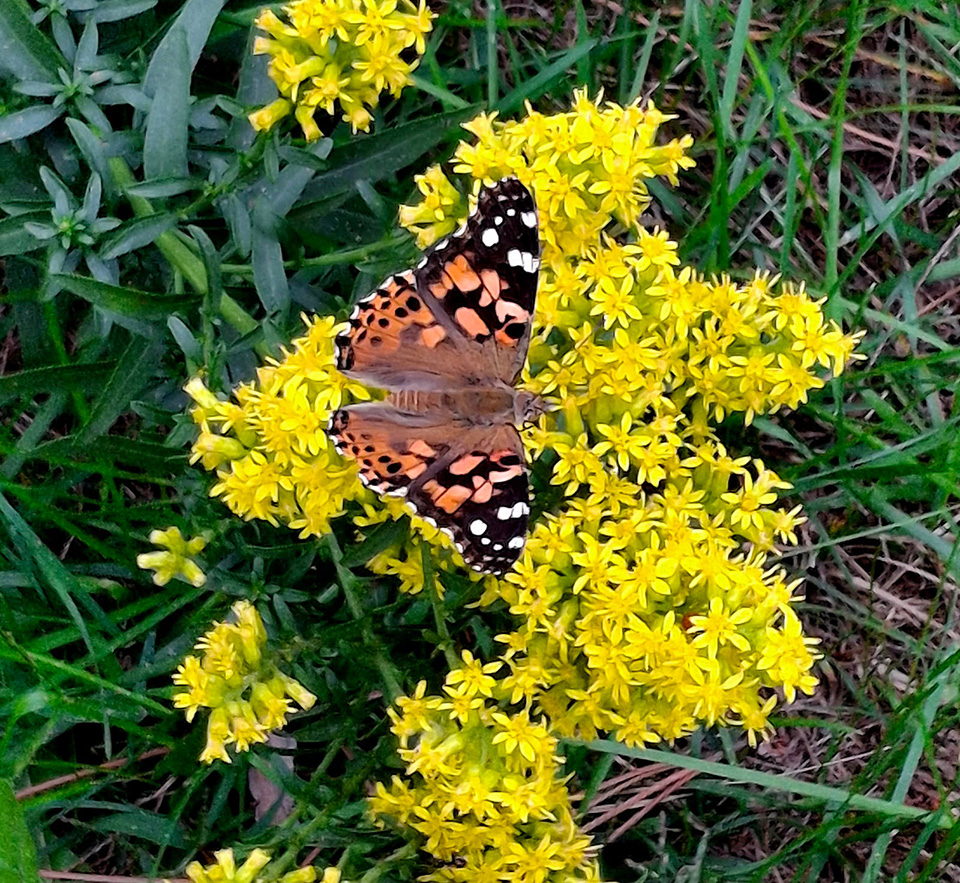
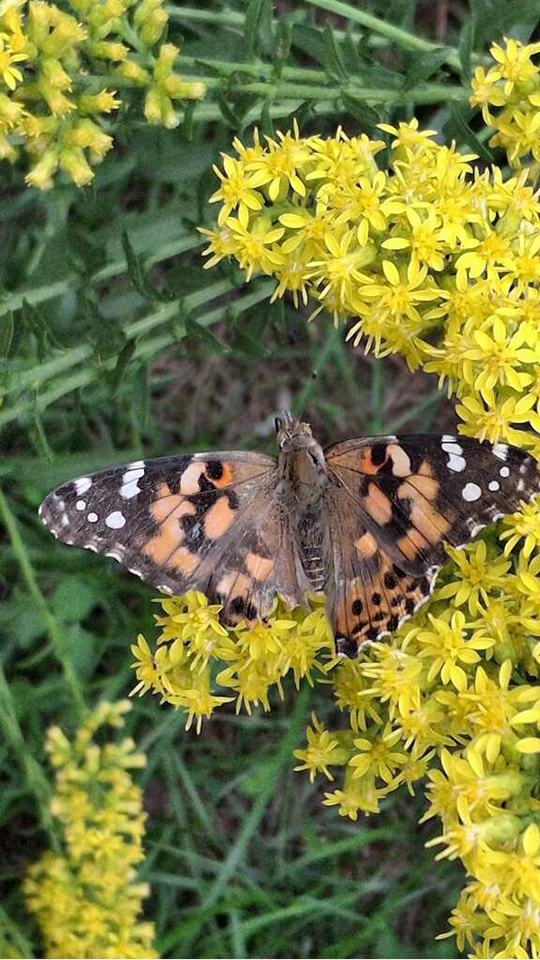
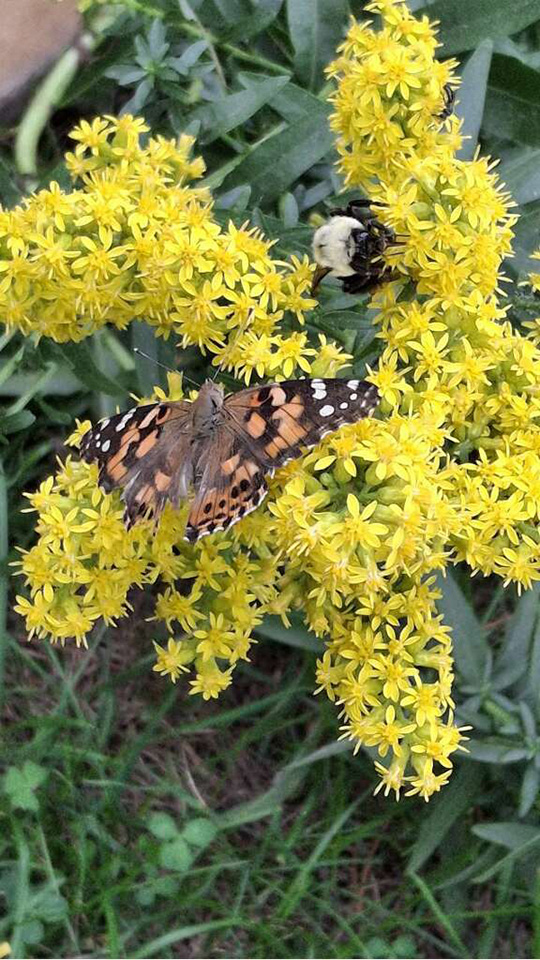
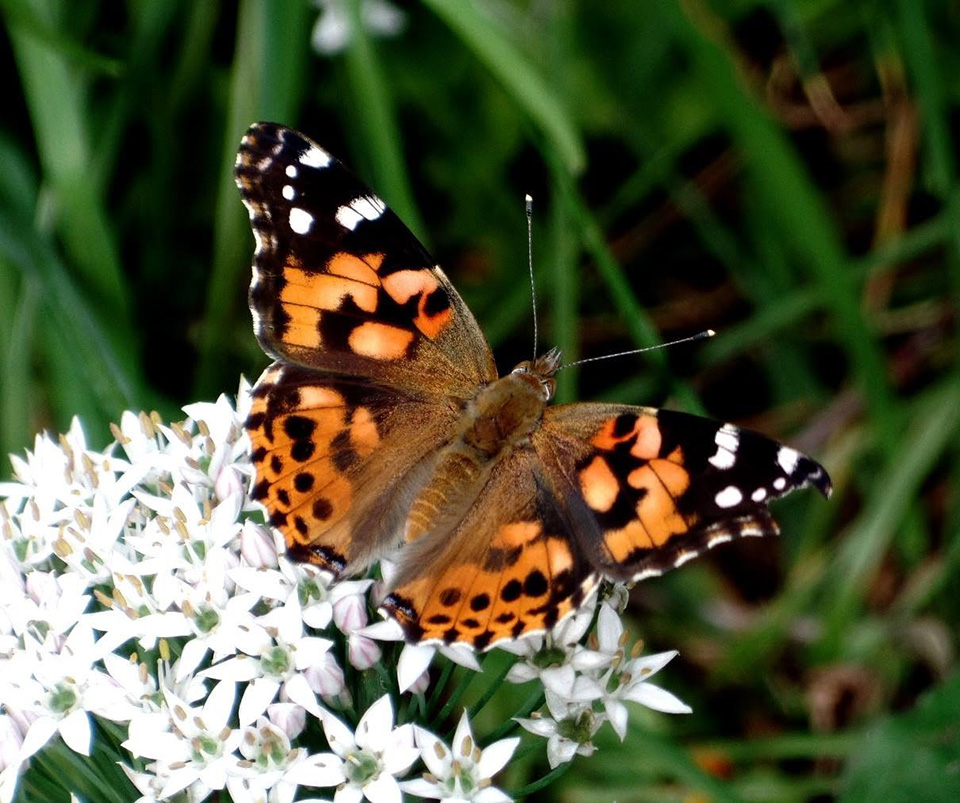
The outer edge of the forewing is slightly scalloped and the tip (apex) is pointed. The upperside of the forewing is orangish-brown at the base, pinkish- or reddish-orange in the median area, and brownish-orange in the postmedian and marginal areas. The margin has a broad, black border with a prominent series of white, crescent-shaped marks (lunules) on the outer margin. Within the marginal border in the apical area there is a row of round, disconnected, orange spots and a row of thin, crescent-shaped, white spots. The apical area is black with a large, elongated, postmedian, always white spot at the leading (costal) edge and a curved row of smaller, round, submarginal, white spots. A jagged, black, interrupted, median band completely isolates an orange median spot.
The hindwing is rounded and slightly scalloped with series of white lunules on the outer margin that are sometimes connected to form a white fringe. The upper side of the hindwing is brownish-orange with a orangish-brown base and four bands of black spots: a marginal band of six disconnected spots; a submarginal band of six flattened spots, the outer four disconnected, the inner two (closest to the body) connected and with blue centers; a postmedian band of four round, disconnected spots; and a median band of four irregular, more or less connected spots. The postmedian spots on the summer form have blue centers, while those of the winter form do not.
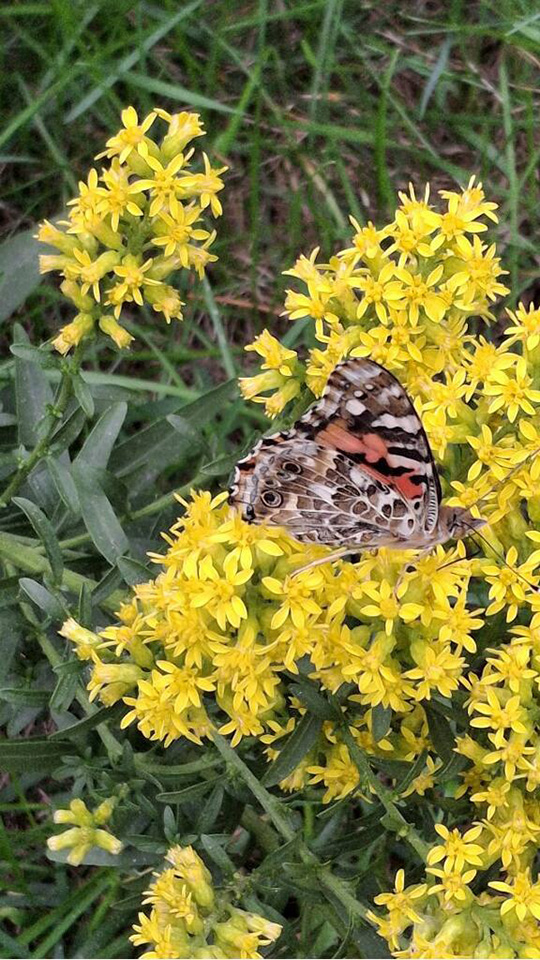
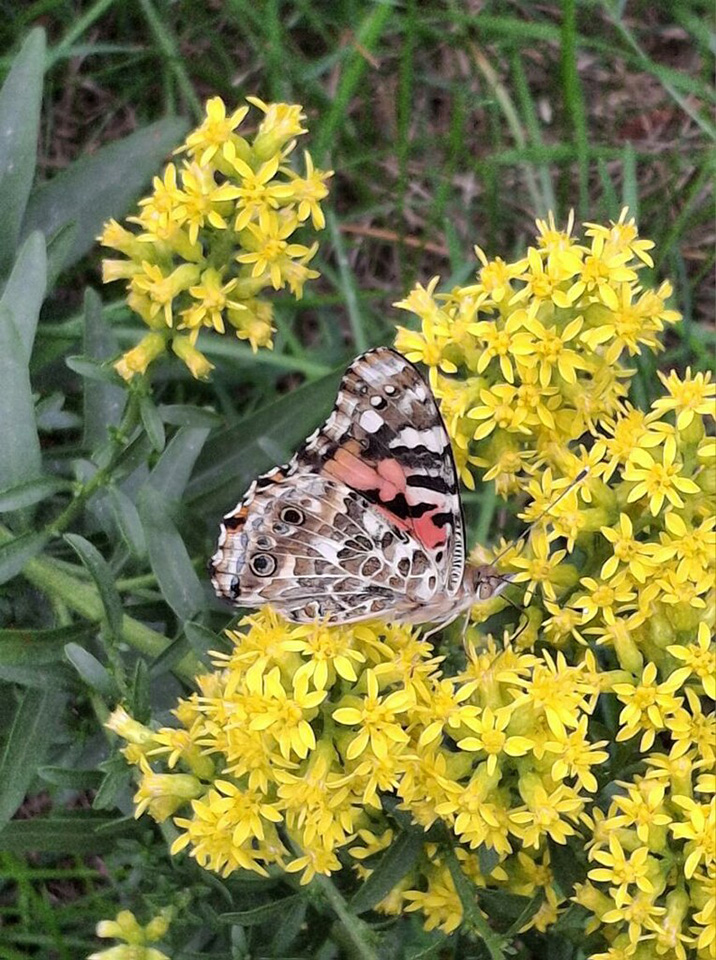
The underside of the forewing is pinkish-orange near the base, orange in the median area, grayish-brown in the apical area, with white and black markings mirroring those on the upper surface.
The underside of the hindwing is irregularly banded and mottled with light and dark brown edged with white. There are two rows of spots: a postmedian row of four large eyespots with blue centers; and a submarginal row of eight flattened blue spots rimmed with black, the inner two spots (closest to the body) connected.
The caterpillar is variable in color and up to 1¾″ long. Though fierce looking, they are harmless to the touch. The thorax and abdomen may be green, yellow, or pink to nearly black. They are finely spotted and moderately covered with long, straight, hair-like structures (seta). The spots are the expanded bases of the setae. There is usually a dark stripe bordered with two thin pale stripes in the middle of the upper (dorsal) surface. There are often light-colored spots between and just below the spiracles on most abdominal segments. These spots sometimes are joined into a single broad, jagged stripe. On the thorax and each abdominal segment there is a long, thick, stiff, branched spine (scolus) in the middorsal, subdorsal, and supraspiracular regions. The head is dark and is densely covered with long, straight, unbranched, white hairs but no scoli. The base of the leg-like structure (proleg) is densely hairy.
Mature caterpillars are found from May onward.
Size
Wingspan: 2¾″ to 2⅞″
Similar Species
American Lady (Vanessa virginiensis) is more orange above. The large spot in the apical area of the upperside of the forewing is often pale orange. The submarginal white spots in the apical area are smaller. The black medial band does not create an isolated orange spot. The postmedial spots on the hindwing are larger, are usually touching, and usually at least two of them have blue centers. There are only two eyespots on the underside of the hindwing, and those eyespots are larger. There is a large, pale, median band inward from the eyespots.
Habitat
Fields, meadows, pastures, woodland edges, roadsides, and other open areas.
Ecology
Season
Usually two broods: early May to late May and June to mid-October
Behavior
Early stage caterpillars create solitary shelters by folding upward the sides of the leaf and securing it with silk.
Life Cycle
The male alternately perches on open bare ground waiting for a receptive female to fly by, and patrols and defends an area in search of a receptive female. After mating, the female lays green, ribbed, barrel-shaped eggs singly on the upperside of host plant leaves. The larva molts four times before pupating. The second brood adult migrates south in small groups in the fall, overwinters in a warmer area, returns north in large numbers in early May, and dies by late May.
Larva Food/Hosts
Plants of the aster (Asteraceae) family, especially thistles (Carduus spp. and Cirsium spp.) and burdock (Arctium spp.); also legumes (Fabaceae), and mallow (Malvaceae).
Adult Food
Flower nectar, mostly from 3′ to 6′ tall plants in the aster (Asteraceae) family.
Distribution

Sources
6, 7, 21, 22, 24, 27, 30, 75, 82, 83.
Biodiversity occurrence data published by: Minnesota Biodiversity Atlas (accessed through the Minnesota Biodiversity Atlas Portal, bellatlas.umn.edu. Accessed 4/25/2026).
Vanessa cardui (Linnaeus, 1758) in GBIF Secretariat (2023). GBIF Backbone Taxonomy. Checklist dataset https://doi.org/10.15468/39omei accessed via GBIF.org. Accessed 4/25/2026.
Quinn, Edward. M., and Ron Danielson. April 27, 2009. A Survey of Lepidoptera in Three Priority Areas of the Minnesota State Parks System. https://files.dnr.state.mn.us/eco/nongame/projects/consgrant_reports/2009
/2009_quinn_danielson.pdf.
Occurrence
Common
Migration
Painted lady butterflies migrate south beginning in August and continuing through November. They overwinter in the southwestern United States and in northern Mexico. They migrate north in the spring in most years, temporarily repopulating the United States and Canada. Some years they do not migrate at all. In years of much rain on the wintering grounds the northward migrations are enormous. The El Niño of 2015 lasted into the spring of 2016 and brought much rain to the wintering grounds of the Painted Lady.
Minnesotans saw a huge influx of Painted Lady butterflies in the summer of 2017. Observers from the Twin Cities to Detroit Lakes and Pennington County have reported seeing “15 plus,” “dozens”, “lots and lots,” and “plentiful” Painted Lady butterflies. Lora in Corcoran reports them “swarming the soy bean field across the road.” Ruth in Big Stone County reports seeing “clouds of them.”
Taxonomy
Order
Lepidoptera (Butterflies and Moths)
Superfamily
Papilionoidea (Butterflies)
Family
Nymphalidae (Brush-footed Butterflies)
Subfamily
Nymphalinae (Checkerspots, Anglewings, Peacocks, and Allies)
Tribe
Nymphalini (Ladies, Anglewings, and Allies)
Genus
Vanessa (Ladies and Related Admirals)
Subordinate Taxa
Synonyms
Cynthia cardui
Cynthia elymi
Cynthia litoralis
Papilio belladonna
Papilio carduelis
Papilio cardui
Parameis cardui
Pryrameis martha-maria
Pyrameis brunnea-albimaculata
Pyrameis carduelina
Pyrameis carduelis
Pyrameis cardui
Pyrameis cardui brunnea-albimaculata
Pyrameis cardui conjuncta
Pyrameis cardui emielymi
Pyrameis cardui huntera
Pyrameis cardui infaochracea
Pyrameis cardui infrabrunnea
Pyrameis cardui infraflava
Pyrameis cardui infragrisea
Pyrameis cardui infranigrans
Pyrameis cardui inops
Pyrameis cardui japonica
Pyrameis cardui litoralis
Pyrameis cardui minor
Pyrameis cardui ochracea
Pyrameis cardui rosacea
Pyrameis cardui septiespupillata
Pyrameis cardui sexispupillata
Pyrameis cardui universa
Pyrameis elymnias
Pyrameis flava
Pyrameis japonica
Pyrameis johni
Pyrameis leachiana
Pyrameis minor
Pyrameis pallens
Pyrameis pallida
Pyrameis rogeri
Pyrameis rosacea
Pyrameis rosea
Pyrameis schoenfellneri
Pyrameis subfracta
Pyrameis takesakiana
Pyrameis varini
Vanessa albicans
Vanessa albipuncta
Vanessa ate
Vanessa belladonna
Vanessa carduelis
Vanessa cardui albipuncta
Vanessa cardui nigripuncta
Vanessa cardui pallida
Vanessa cardui stictus
Vanessa carnea
Vanessa elymi
Vanessa inops
Vanessa inornata
Vanessa jacksoni
Vanessa koreana
Vanessa minor
Vanessa nigripuncta
Vanessa pulchra
Vanessa takesakiana
Vanessa universa
Vanessa wiskotti
Common Names
Cosmopolitan
Painted Lady