pine tree spur-throat grasshopper - Species Profile
Conservation • Description • Habitat • Ecology • Distribution • Taxonomy
Conservation Status
IUCN Red List
not listed
NatureServe
NNR - Unranked
Minnesota
not listed
Description
Pine tree spur-throat grasshopper is a common, medium-sized, short-horned grasshopper. It occurs in the United States and southern Canada east of the Great Plains.
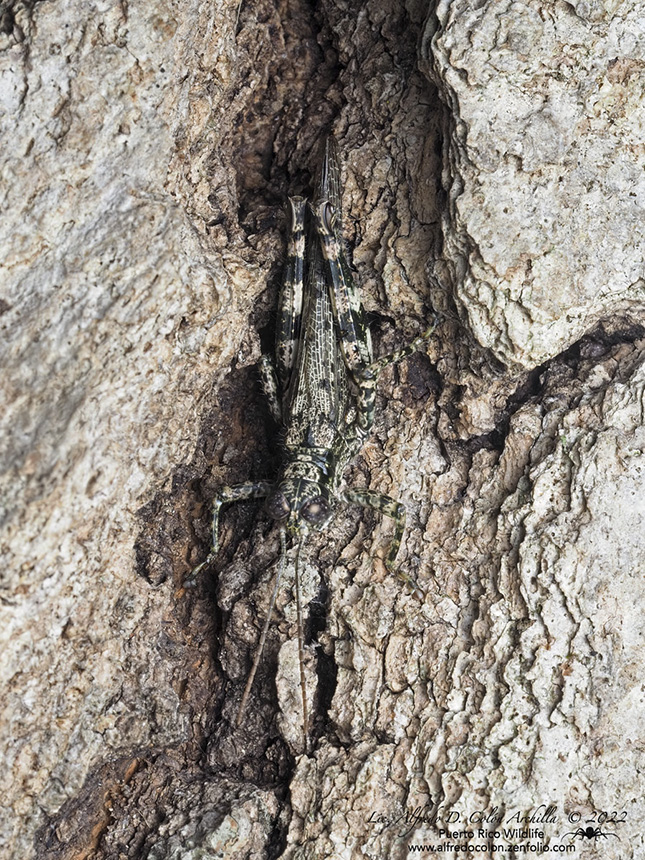
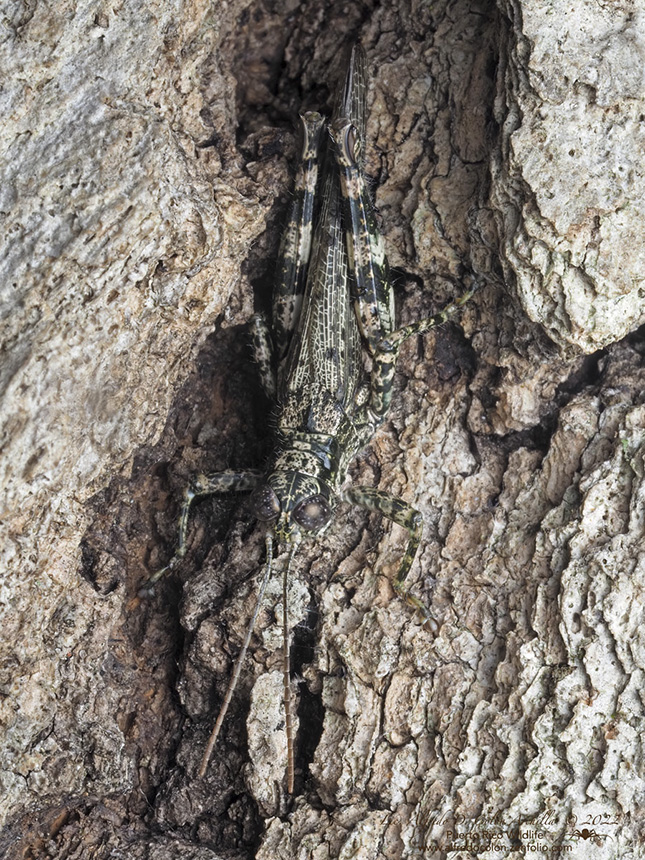
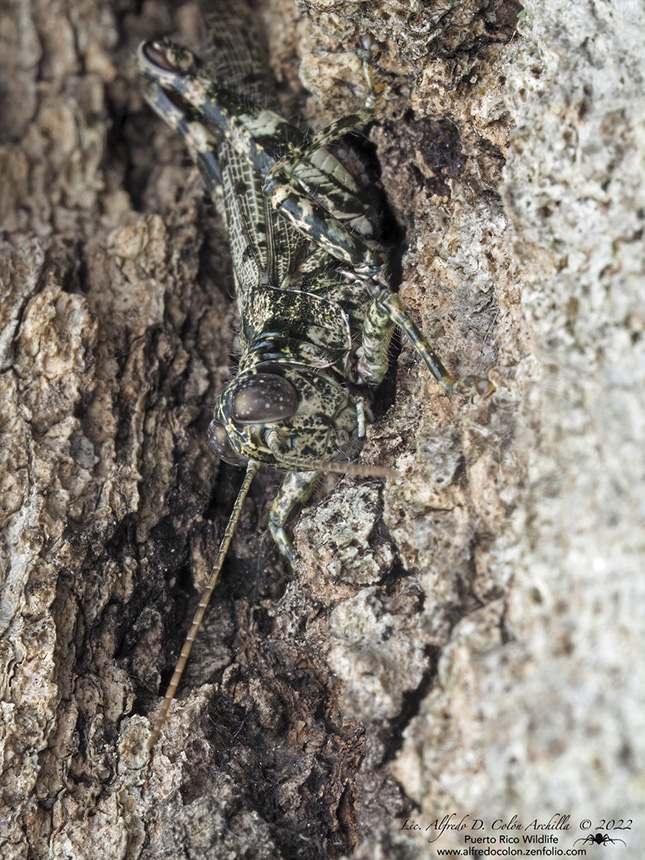
In Minnesota, adults are active from June through October in coniferous and mixed forests, as well as oak savannas. Males are seldom seen because they spend most of their time in the canopy, where they feed on leaves and needles. Females are more frequently noticed perched on tree trunks, two or three feet above the ground, where they bore into soft rotting bark to deposit their eggs. Even then, their cryptic coloration provides excellent camouflage against the bark.
Despite its common name, pine tree spur-throat grasshopper is found on both coniferous and deciduous trees. It shows a strong preference for tamaracks and pines where they are available, but it adapts completely to hardwood trees where coniferous trees are uncommon or absent.
Females have a standard body length of 1 1⁄16″ to 1⅛″ (27 to 29 mm), but a mature gravid female can reach up to a total length of 1 7⁄16″ to 1¾″ (37 to 45 mm) from the head to the tip of the extended abdomen. The body is moderately robust. The overall coloration above is a light or medium grayish brown (pale) background, mottled with brownish black (dark), and often tinged dull olive green.
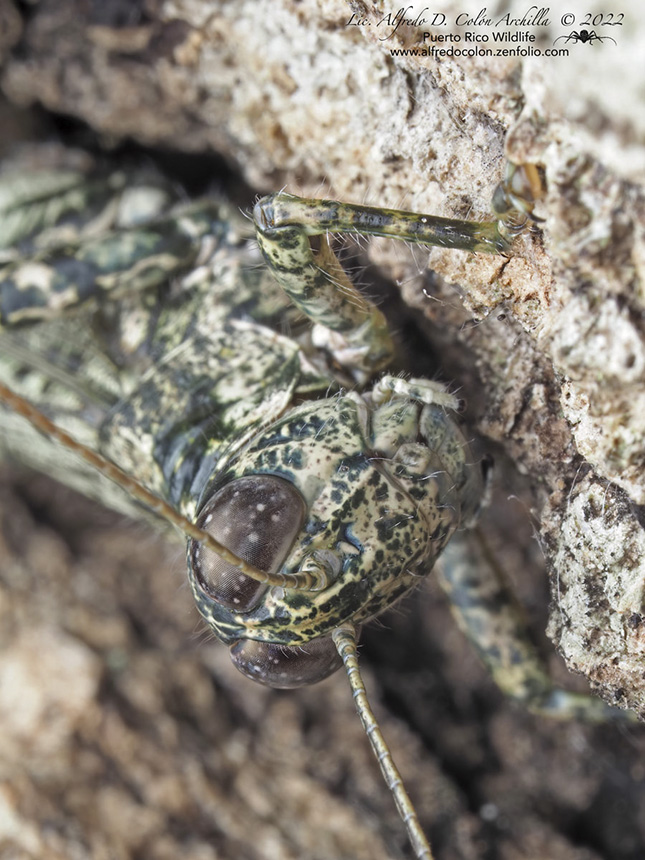
The top of the head is rounded in profile. The rear of the head (occiput) is swollen and elevated above the level of the pronotum. The face is nearly vertical. The eyes are slightly bulging when viewed from the front. The head is irregularly mottled. There is a longitudinal stripe on the top in the middle extending from the base of the antennae and widening to the rear margin, and a broad dark stripe behind each compound eye that continues on the upper plate covering the thorax (pronotum).
The pronotum is saddle-shaped and is broadly convex above. There is a longitudinal ridge (carina) in the middle that is low but distinct on the rear half, indistinct or absent at the front margin, and absent between. The sides of the pronotum are abruptly angled downward. When viewed from above, they flare out noticeably toward the lower front corners. On each side, a dark, distinct stripe extends from behind the compound eye onto the lateral lobe of the pronotum, terminating cleanly at the principal transverse groove, leaving the rear section of the pronotum unstriped and mottled. On the underside of the thorax there is a distinct, spiny bump (spur) below at the base of the neck, between the base of the forelegs.
The abdomen is compressed and the ovipositor is short.
The forewings (tegmina) are lance-shaped and long, extending beyond the tips of the femurs and beyond the tip of the abdomen. However, in mature gravid females, the abdomen stretches out considerably, causing it to project well past the wingtips. The tegmina are slightly overlapping toward the base, angled toward the rear, and well-rounded at the tip. They are pale with round dark spots.
On the hind pair of legs, the robust, third segment (femur) is pale with usually three distinct dark bands on the upper and outer surfaces: one near the base, one in the middle, and one before the knee. The fourth segment (tibia) is mostly pale and mottled like the rest of the body, but the inner surface, hidden on live perched individuals, is dull yellowish or grayish. The spines are black. On all of the legs, the end section corresponding to the foot (tarsus) has three segments.
Males are smaller, though the difference in size between the male and female is less than in most Melanoplus species. The body length is ¾″ to 15⁄16″ (19 to 24 mm) and the total length, from head to wingtip, is 1 1⁄16″ to 1¼″ (27 to 31 mm). The occiput is conspicuously swollen and bulbous. The eyes are larger and conspicuously bulging. The abdomen is abruptly and distinctly curved upward at the end. The sensory appendages at the end of the abdomen (cerci) are roughly boot shaped. They have a broadly rounded upper margin on a relatively symmetrical top lobe.
--------------------------------
There are three subspecies. The description above refers to the Midwestern subspecies Melanoplus punctulatus griseus.
Size
Female
Total length: 1 7⁄16″ to 1¾″ (37 to 45 mm)
Body length: 1 1⁄16″ to 1⅛″ (27 to 29 mm)
Male
Total length: 1 1⁄16″ to 1¼″ (27 to 31 mm)
Body length: ¾″ to 15⁄16″ (19 to 24 mm)
Similar Species
Habitat
Coniferous and mixed forests, oak savannas
Ecology
Season
June through October in Minnesota
Behavior
Life Cycle
Nymph Food
Tree foliage
Adult Food
Tree foliage
Distribution
Sources
Melanoplus punctulatus (Uhler, 1862) in GBIF Secretariat (2023). GBIF Backbone Taxonomy. Checklist dataset https://doi.org/10.15468/39omei accessed via GBIF.org. Accessed 5/22/2026.
Haarstad, J. 1990. The Acrididae of Minnesota. Final report submitted to the Minnesota Department of Natural Resources. 28 pp.
Hebard, Morgan. (1932). The Orthoptera of Minnesota. University of Minnesota. Minnesota Agricultural Experiment Station. Retrieved from the University of Minnesota Digital Conservancy, https://hdl.handle.net/11299/204015.
Vickery, V. R., & Kevan, D. K. McE. (1985). The insects and arachnids of Canada: Part 14. The grasshoppers, crickets, and related insects of Canada and adjacent regions (Publication 1777). Research Branch, Agriculture Canada.
Occurrence
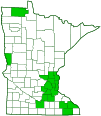
Common in the eastern United States, locally common in Minnesota.
Taxonomy
Order
Orthoptera (Grasshoppers, Crickets, and Katydids)
Suborder
Caelifera (Grasshoppers, Locusts, and Allies)
Infraorder
Acrididea (Grasshoppers)
Nanorder
Acridomorpha
Superfamily
Acridoidea (Short-horned Grasshoppers and Locusts)
Family
Acrididae (Short-horned Grasshoppers)
Subfamily
Melanoplinae (Spur-throated Grasshoppers)
Tribe
Melanoplini
Genus
Subordinate Taxa
grizzly locust (Melanoplus punctulatus punctulatus)
Melanoplus punctulatus arboreus
Melanoplus punctulatus griseus 
Synonyms
Caloptenus punctulatus
Common Names
grizzled spur-throat grasshopper
grizzly spur-throat grasshopper
pine tree spur-throat grasshopper