pure green sweat bee - Species Profile
Conservation • Description • Habitat • Ecology • Distribution • Taxonomy

Conservation Status
IUCN Red List
LC - Least Concern
NatureServe
NNR - Unranked
Minnesota
not listed
Description
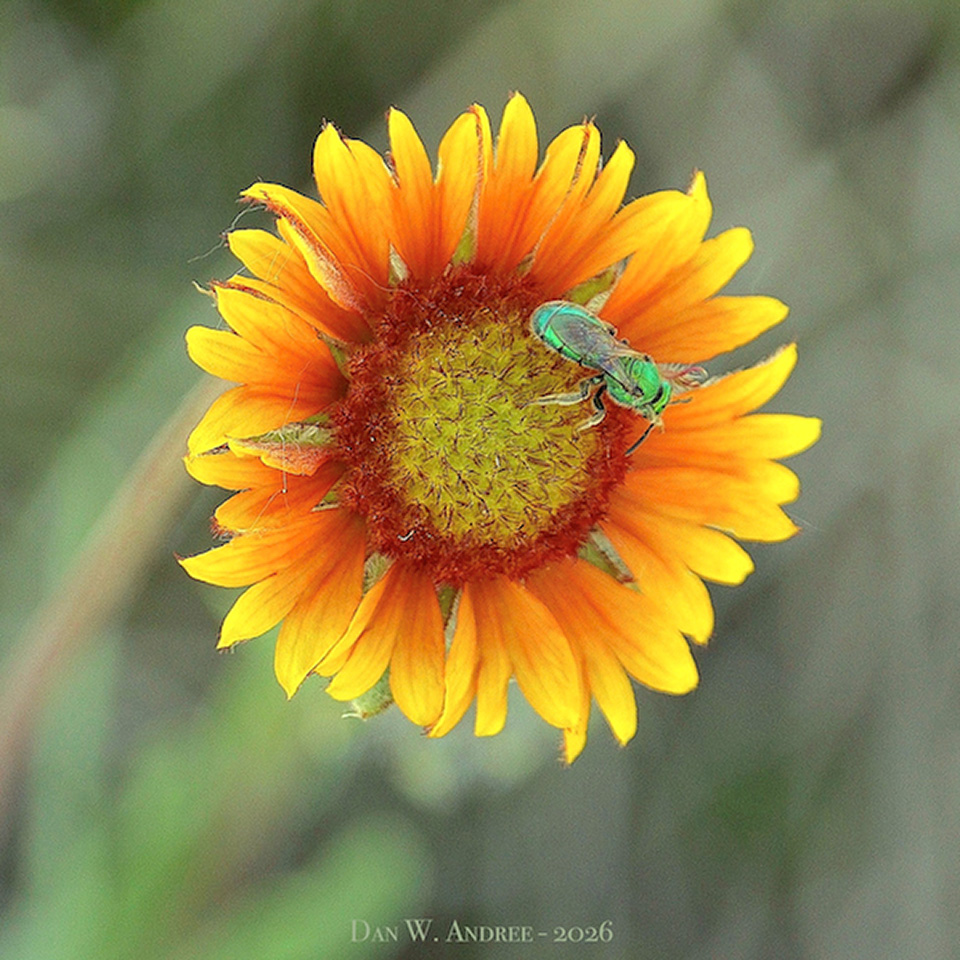
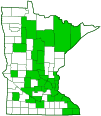
Pure green sweat bee is a moderate-size, solitary, metallic green bee. It occurs in the United States east of the Great Plains, and in adjacent Canadian provinces. It is common in the eastern two-thirds of Minnesota where it reaches the western extent of its range.
Males and females are the same size, 5 ⁄16″ long. The head, thorax, and abdomen are bright metallic green, sometimes with a coppery tint, sometimes just coppery, rarely blue. The body is covered with erect whitish hairs.
The head is covered with relatively short hairs. The face above the upper lip (clypeus) is shiny and moderately covered with well-spaced, shallow pits. The upper margin of the clypeus does not extend the width of the face, but is intruded upon by lobes of the plate above it (epistome). The tongue is short. The last segment of the tongue (glossa) is short and pointed. The antennae are black. Below each antennal socket there is a single vertical groove (suture).
The wings are clear and lightly tinted smoky brown. The lobe at the base of the hindwing (jugal lobe) is longer than the submedian cell. The marginal cell of the wing is squared off (truncate) at the end. There are three submarginal cells, the first one longer than the third. The basal vein is strongly arched. The structure at the base each the wing (tegula) is dark brown and oval.
Each abdominal segment has a very narrow dark margin but the abdomen is not conspicuously striped.
The legs are brown and brownish-black with short hairs. The female has a scopa, a dense patch of longer, branched hairs used to collect pollen, on the fourth segment (tibia). The male lacks this modification.
Size
Total length: 5 ⁄16″
Similar Species
Habitat
Woodlands and nearby thickets and pastures.
Ecology
Season
Two or three generations per year: April to October
Behavior
Males patrol an established route, flying quickly and continuously between specific flowers.
Life Cycle
The overwintered mated female emerges in April. Using an existing insect burrow in dead wood as a starting point, she digs a nest consisting of many branched burrows. She places a pollen ball and nectar in each burrow then lays a single egg on the pollen ball. The first generation offspring emerge as adults in June. By the end of June they have constructed their own nests. The larvae or pupa of the last generation overwinter and emerge as adults the following spring. Adult females overwinter beneath rotting logs in a state of diapause. Males die in the fall.
Nests may be placed close together but they do not interconnect. Females do not cooperate with others in raising the young.
Larva Food/Hosts
Flower pollen and nectar
Adult Food
Pollen and nectar of at least 41 species of flowering plants, especially maple in early spring.
Distribution
Sources
Biodiversity occurrence data published by: Minnesota Biodiversity Atlas (accessed through the Minnesota Biodiversity Atlas Portal, bellatlas.umn.edu. Accessed 8/23/2025).
Augochlora pura (Say, 1837) in GBIF Secretariat (2023). GBIF Backbone Taxonomy. Checklist dataset https://doi.org/10.15468/39omei accessed via GBIF.org. Accessed 8/23/2025.
Occurrence
Very common and widespread
Taxonomy
Order
Hymenoptera (Ants, Bees, Wasps, and Sawflies)
Suborder
Apocrita (Narrow-waisted Wasps, Ants, and Bees)
Infraorder
Aculeata (Ants, Bees, and Stinging Wasps)
Superfamily
Apoidea (Bees and Apoid Wasps)
Epifamily
Family
Halictidae (Sweat Bees)
Subfamily
Halictinae (Sweat and Furrow Bees)
Tribe
Augochlorini
Genus
Augochlora
Subgenus
Augochlora
Subordinate Taxa
pure green sweat bee (Augochlora pura mosieri)
pure green sweat bee (Augochlora pura pura)
Synonyms
Halictus purus
Common Names
pure golden green sweat bee
pure green augochlora
pure green sweat bee