Rough stink bug
(Brochymena arborea)
Conservation • Description • Habitat • Ecology • Distribution • Taxonomy
Conservation Status
IUCN Red List
not listed
NatureServe
NNR - Unranked
Minnesota
not listed
Description
Brochymena arborea is a medium-sized rough stink bug. It occurs in the United States east of the Great Plains, southern Quebec and Ontario Canada, Mexico, and Central America.
Adults are active from May to September. They are found on a wide variety of trees and shrubs.
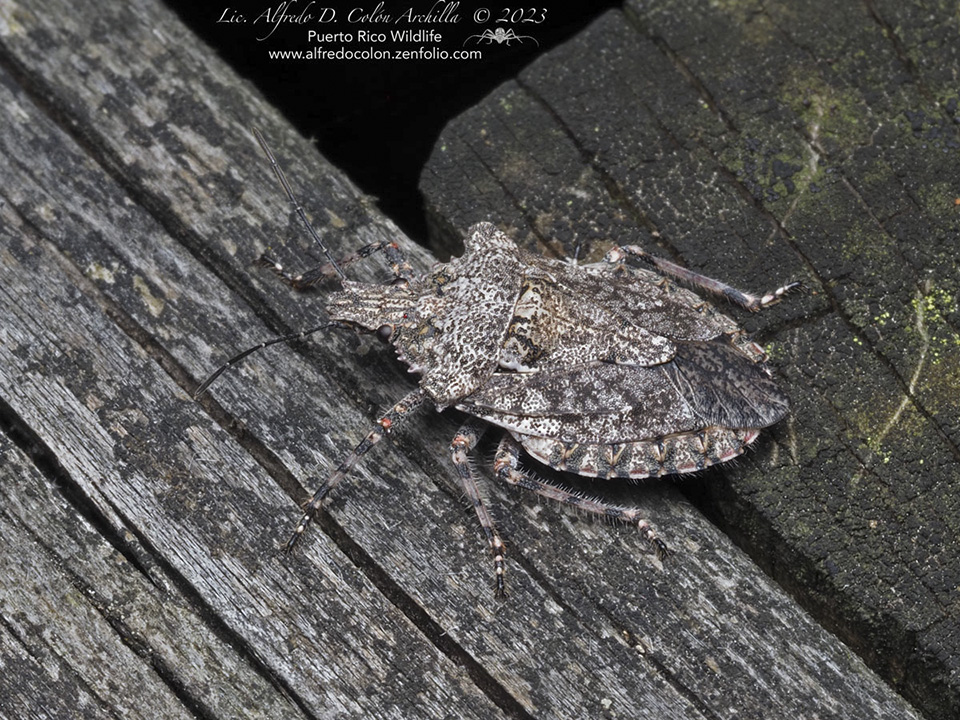
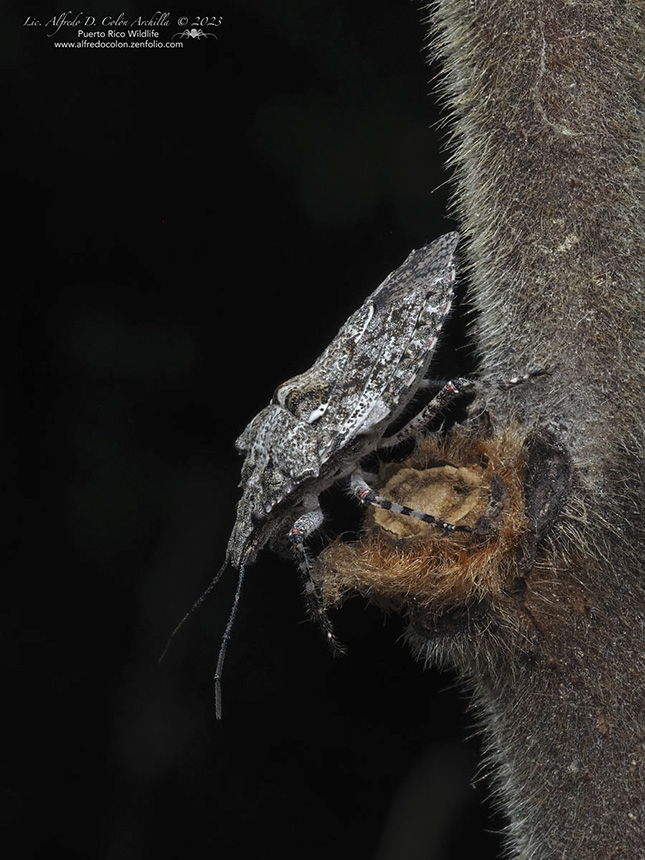
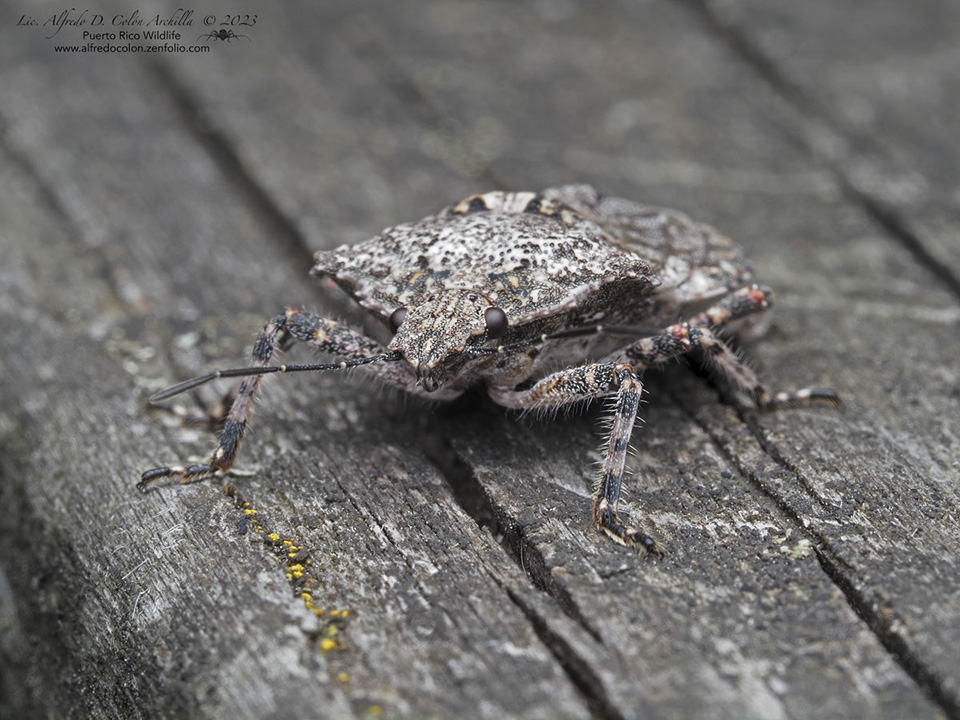
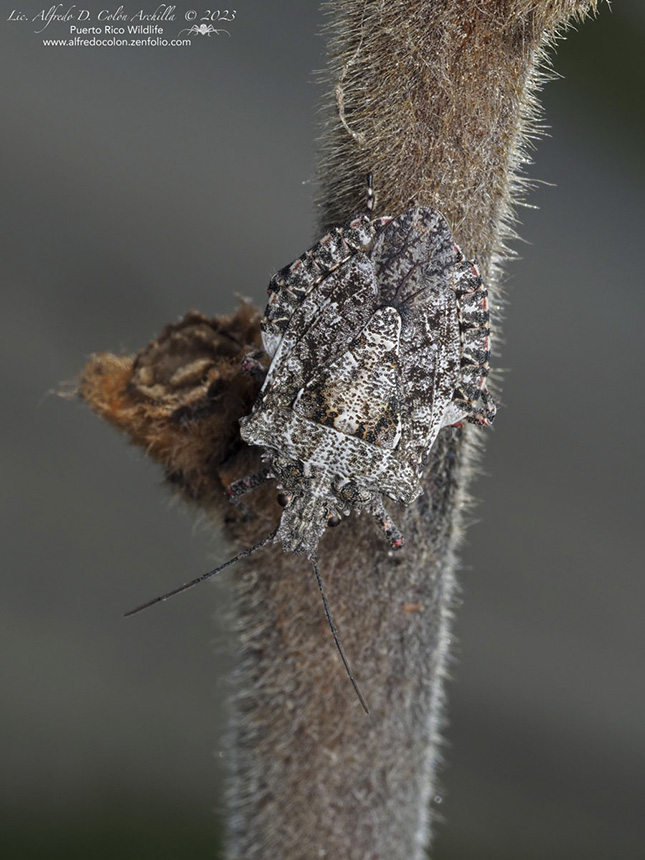
Adults are ⅜″ to 11⁄16″ (10 to 18 mm) in length. The body is broadly oval, somewhat shield-shaped in outline, slightly flattened, and pale with extensive dark markings. The coloration is variable: gray with black markings; light brown with dark brown and black markings; or brownish yellow with dark brown markings. It has many large, irregularly scattered, black pits, and is densely covered with numerous small, dark-bordered pits (punctate). The overall effect is a camouflaged, bark-like appearance
The head is small and narrow, much narrower than the thorax. It is tucked into a concave groove in the margin of the pronotum. There is no visible “neck” when viewed from above. The sides of the head are concave. There are two large, bulging, compound eyes and two small simple eyes (ocelli). There is no crosswise (transverse) groove between the compound eyes. The front of the head is divided into a central lobe (tylus) and two lateral lobes (juga). The juga are much longer than the tylus but do not converge in front of them. Each jugum has a single prominent tooth on the side (subapical tooth) between the compound eye and the tip, nearer to the tip. The subapical tooth has straight sides and forms a right angle at the tip. The mouth parts are optimized for piercing and sucking, and take the form of a slender, straight, 4-segmented beak (rostrum). The rostrum is longer than the head and fits into a groove on the underside (sternum) when not in use. The antennae have five segments. Segments 3, 4, and 5 are about equal in length and about one third longer than segment 2. They are brownish-black, slender, and long, much longer than the head but not as long as the body.
The thorax is twice as wide as long. The exoskeletal plate covering the thorax (pronotum) is coarsely and irregularly pitted. The front side margins have four or five large, triangular teeth and one or two smaller teeth. The shoulder (humeral) areas, above the wing bases, are distinctly swollen. The front corners (humeral angles) jut outward in a projection that is nearly square (subquadrate).
There are two pairs of wings, and they are held flat over the body when at rest. Between the wing bases there is a large plate (scutellum). The basal third or quarter of the scutellum is broadly triangular and distinctly elevated above the remainder. The rear portion is U-shaped and extends nearly to the tip of the abdomen.
The forewings (hemelytra) are as long as the abdomen but do not completely cover the sides of the abdomen. The abdomen appears to abruptly widen opposite the middle of the scutellum, exposing the flattened sides of each abdominal segment (connexivum) beyond this point. The connexiva are conspicuously striped with black and pale. The pale stripes are usually partly reddish, orangish, or whitish. The hemelytra have a thickened, leathery section at the base and a thin membranous section at the tip with a clear dividing line between the two. The membrane is pale with dark and black markings between the veins.
The legs are ringed with alternating black and pale bands. The fourth segment (tibia) of the hind legs has hairs but lacks long spines. The last part of each leg (tarsus), corresponding to the foot, has three segments.
Size
Total length: ⅜″ to 11⁄16″ (10 to 18 mm)
Similar Species
Four-humped stink bug (Brochymena quadripustulata): The front side margins of the pronotum have short, blunt teeth. The humeral angles are broadly triangular. The base of the scutellum is flat or only slightly elevated.
Habitat
Ecology
Season
One generation per year: May to September (CCESR)
Behavior
Life Cycle
Adults overwinter in leaf and plant litter. In the spring, the female lays clusters of barrel-shaped eggs in tight rows on the underside of leaves.
Nymph Food
Adult Food
A wide variety of trees and shrubs
Distribution
Sources
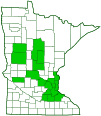
Biodiversity occurrence data published by: Minnesota Biodiversity Atlas (accessed through the Minnesota Biodiversity Atlas Portal, bellatlas.umn.edu. Accessed 10/4/2026).
Brochymena arborea (Say, 1825) in Bánki, O., Roskov, Y., Döring, M., Ower, G., Hernández Robles, D. R., Plata Corredor, C. A., Stjernegaard Jeppesen, T., Örn, A., Pape, T., Hobern, D., Garnett, S., Little, H., DeWalt, R. E., Miller, J., Orrell, T., Aalbu, R., Abbott, J., Abreu, C., Acero P, A., et al. (2026). Catalogue of Life (2026-08-26 XR). Catalogue of Life Foundation, Amsterdam, Netherlands. https://doi.org/10.48580/dgyy9
Ryder, D. A. (2012). The Heteroptera (Hemiptera) of North Dakota I: Pentatomomorpha: Pentatomoidea. The Great Lakes Entomologist, 45(3–4), 312–380.
Occurrence
Common
Taxonomy
Order
Hemiptera (True Bugs, Hoppers, Aphids, and Allies)
Suborder
Heteroptera (True Bugs)
Infraorder
Pentatomomorpha
Superfamily
Pentatomoidea (Stink Bugs, Shield Bugs, and Allies)
Family
Subfamily
Pentatominae
Tribe
Halyini
Genus
Brochymena (Rough Stink Bugs)
Genus
In a cladistic study (Larivière 1992), the genus Parabrochymena was erected to hold species with quadrate humeral angles (such as Brochymena arborea and B. carolinensis), leaving the narrow-shouldered species in Brochymena proper. However, Donald B. Thomas (1992) published a comprehensive revision of the North American Halyini / Brochymena complex in which he demonstrated that the morphological characters used to erect Parabrochymena—specifically the humeral angle structure and male genitalic traits—intergrade continuously across species or represent ancestral variations within a single monophyletic lineage. Parabrochymena was formally reduced to a junior synonym of Brochymena.
Subordinate Taxa
Synonyms
Parabrochymena arborea
Common Names
This species has no common name. The common name of the genus Brochymena is rough stink bugs, and it is applied here.
Visitor Photos
This button not working for you?
Simply email us at info@MinnesotaSeasons.com.
Attach one or more photos and, if you like, a caption.
Minnesota Seasons Photos
Slideshows
Visitor Videos
This button not working for you?
Simply email us at info@MinnesotaSeasons.com.
Attach a video, a YouTube link, or a cloud storage link.
Other Videos
Rough Stink Bug (Brochymena Arborea)
Hyperion
Rough Stinkbug (Brochymena arborea)
Generical FishTycoon
Visitor Sightings
This button not working for you?
Simply email us at info@MinnesotaSeasons.com.
Be sure to include a location.
Alfredo Colon
8/25/2022

Location: Albany, NY
Alfredo Colon
8/19/2022
Location: Albany, NY
Minnesota Seasons Sightings