saffron-winged meadowhawk - Species Profile
Conservation • Description • Habitat • Ecology • Distribution • Taxonomy
Conservation Status
IUCN Red List
not listed
NatureServe
N5 - Secure
SNR - Unranked
Minnesota
not listed
Description
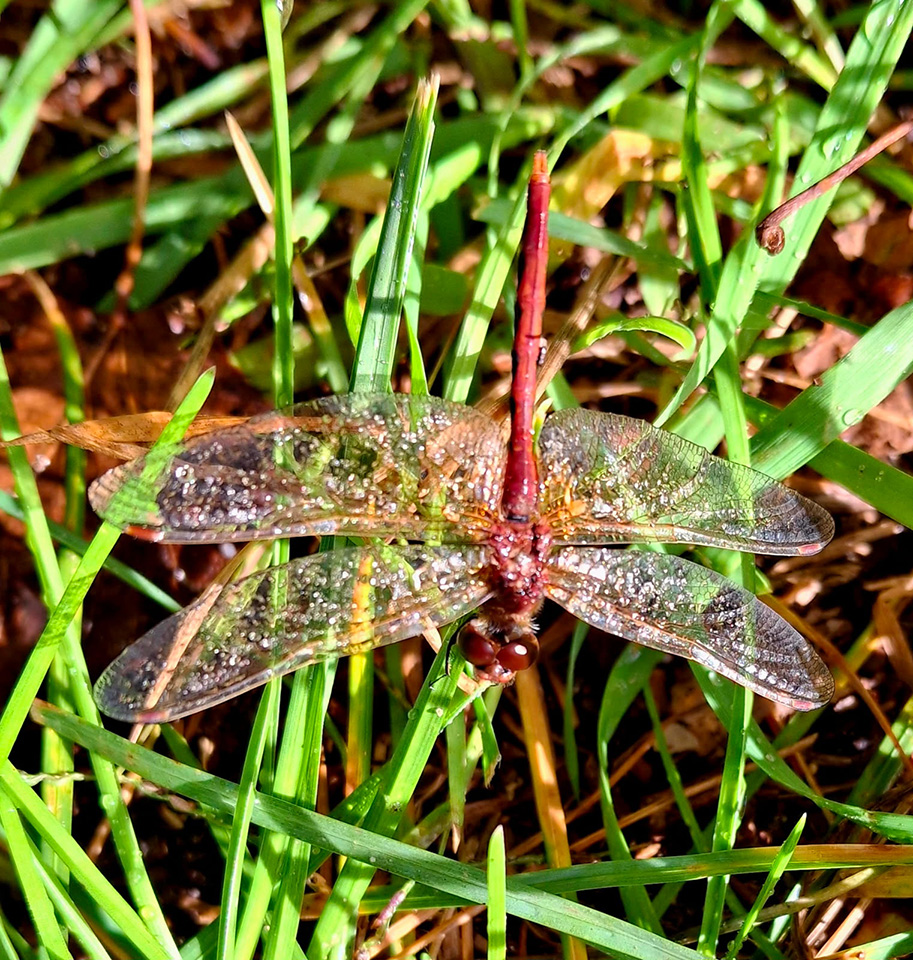
Saffron-winged meadowhawk is a medium-sized meadowhawk. It is one of the last dragonflies to be seen in the fall.
On males the thorax is brown on the top, red on the sides, and covered with brown hairs. The abdomen is red. On each side of the abdomen there is a line of low, poorly-formed triangles forming a black stripe. There is usually a thin black line on the upper (dorsal) surface of the 8th and 9th abdominal segments. The face is pale red. The legs are vertically striped yellow and black, becoming red and black in older individuals.
The leading edge of both wings is gold, becoming clear on older individuals. On all individuals the stigma is solid gold or red and the leading veins remain gold or reddish.
On females the abdomen is yellow and the face is light yellow or almost white. On juveniles the thorax is yellow without black markings.
Size
Total length: 1¼″ to 1½″
Similar Species
White-faced meadowhawk (Sympetrum obtrusum) has black legs. On juveniles, the veins near the base of the wing (where it attaches to the thorax) are yellow but the leading veins are black except at the base. The stigmas are black.
Habitat
Ponds, especially when bordered by marshes.
Ecology
Season
Early June to late October
Behavior
Life Cycle
After mating the female, still with the male still attached, lays eggs by dipping the tip of the abdomen into shallow water. Eggs overwinter and hatch in the spring. The nymphs emerge in at night from early June to late August.
Naiad Food
Mosquito larvae, other aquatic fly larvae, mayfly larvae, freshwater shrimp, very small fish, and tadpoles.
Adult Food
Mosquitoes, flies, small moths, mayflies, flying ants, termites, and other soft flying insects.
Distribution

Sources
Biodiversity occurrence data published by: Minnesota Biodiversity Atlas (accessed through the Minnesota Biodiversity Atlas Portal, bellatlas.umn.edu. Accessed 9/19/2026).
Sympetrum costiferum (Hagen, 1861) in Bánki, O., Roskov, Y., Döring, M., Ower, G., Hernández Robles, D. R., Plata Corredor, C. A., Stjernegaard Jeppesen, T., Örn, A., Pape, T., Hobern, D., Garnett, S., Little, H., DeWalt, R. E., Miller, J., Orrell, T., Aalbu, R., Abbott, J., Abreu, C., Acero P, A., et al. (2026). Catalogue of Life (2026-08-26 XR). Catalogue of Life Foundation, Amsterdam, Netherlands. https://doi.org/10.48580/dgyy9
Abbott, J.C. 2006-2026. OdonataCentral: An online resource for the distribution and identification of Odonata. Available at https://www.odonatacentral.org/. (Accessed: 9/19/2026).
Steffens, W. P., and W. A. Smith. 1999. Status survey for special concern and endangered dragonflies of Minnesota: population status, inventory and monitoring recommendations. Final report submitted to the Natural Heritage and Nongame Research Program, Minnesota Department of Natural Resources. 54 pp.
Occurrence
Common
Taxonomy
Order
Odonata (Dragonflies and Damselflies)
Suborder
Superfamily
Libelluloidea
Family
Libellulidae (Skimmers)
Genus
Subordinate Taxa
Synonyms
Diplax atripes
Diplax costiferum
Sympetrum atripes
Common Names
saffron-winged meadowhawk


