Soybean nodule fly
(Rivellia quadrifasciata)
Conservation • Description • Habitat • Ecology • Distribution • Taxonomy
Conservation Status
IUCN Red List
not listed
NatureServe
not listed
Minnesota
not listed
Description
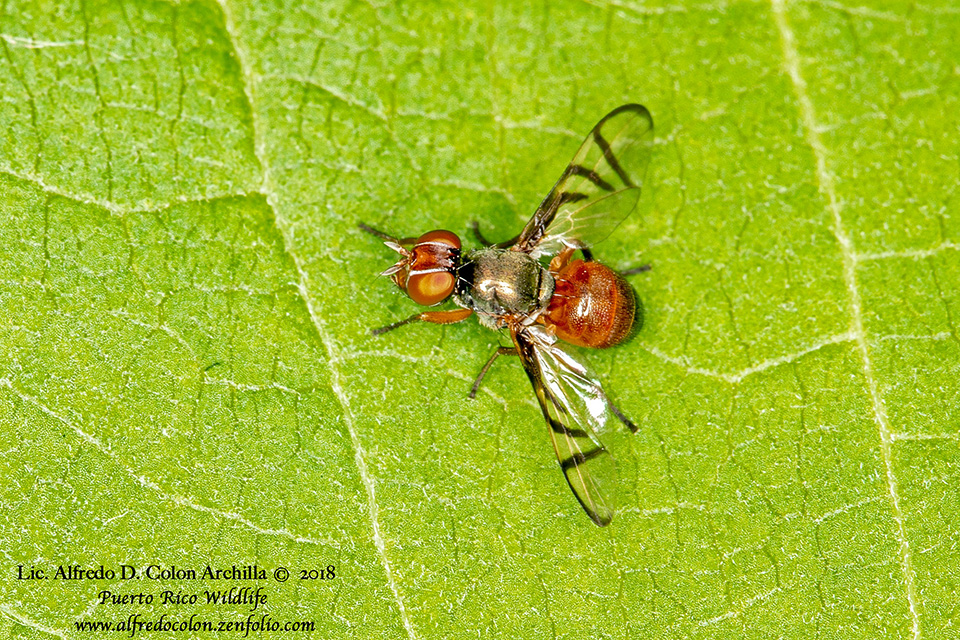
Rivellia quadrifasciata is a very small signal fly known by the common name soybean nodule fly. It was first described in as Herina quadrifasciata by Macquart ion 1835. It occurs in the United States east of the Great Plains. Rivellia colei was first described by Namba in 1956. It was previously included in R. quadrifasciata. It was separated on the base of differences in the male genitalia. It also occurs in the eastern United States. The source of the original description of R. colei was a specimen collected in Houston County, Minnesota. The author wrote “…these two species cannot be separated, as far as I can determine, without examination of the male genitalia…”, and that without such examination, “…previous citations of R. quadrifasciata other than the original may be referable to either R. quadrifasciata or R. colei.” According to BugGuide.net, that situation has not changed.
Female Rivellia colei cannot be distinguished from Rivellia quadrifasciata. The only difference in the male that is discernible in a live specimen is the direction of the hairs (setae) on the fourth abdominal segment. On R. colei they are pointed toward the rear. On R. quadrifasciata they are direct radially. In the lab, dissection of the male genitalia is the most reliable way to distinguish between the two species. The description below refers to both species.
Adults are ⅛″ to 3 ⁄16″ (4.0 to 4.9 mm) long.
There are two large compound eyes at the side of the head and three small simple eyes (ocelli) in a triangle at the top of the head. The compound eyes are brownish-yellow. They do not meet at the top of the head in either sex. The face is concave when viewed from the side. The upper face, corresponding to the forehead (frons) is mostly brownish-yellow, black around the ocelli. There is a thin, white, powdery (pruinose) strip bordering each compound eye on the frons. The back of the head is convex when viewed from the side. The antennae have three segments. The first two segments are yellow. The second segment does not have a longitudinal groove (suture). The third segment is long and mostly yellow but black at the tip and on the sides. It has a short, feather-like (plumose), forward-pointing bristle (arista) on the upper side. The fine branches or filaments of the arista are very short.
The thorax is large and has three segments. Each segment has four principal exoskeletal plates, one above, one below, and one on each side. The upper (dorsal) plates, from front to rear, are the prescutum, scutum, and scutellum. The prescutum and scutum are blackish-green and appear frosty (pruinose), mostly at the corners and especially at the sides. It is also covered with scattered pale hairs (setae). The scutellum is colored the same as the scutum and is pruinose except at the tip. It has two long and two short black, bristle-like setae at the rear margin, and a few short black setae submarginally.
The abdomen is brownish-yellow, shiny, and rough (rugose). The first segment is covered with pale setae. On males, the setae on the underside of fourth abdominal segment are directed either to the rear or radially.
The first and third segments of all legs (coxae and femora, respectively) are brownish-yellow. On the front and middle legs the fourth segment (tibia) is brownish-yellow. On the rear legs the tibia is black or brownish-yellow to dark brown. The last part of the leg, corresponding to the foot (tarsus) has five segments. On the front and back legs, the first segment is brownish-yellow, the remainder are slightly blackened. On the middle legs, the tarsi are entirely brownish-yellow.
The wings are clear with four narrow black bands. The first vein extends along the front (costal) wing margin then bends inward, ending half way between the inner and outer margins. The second band begins at the costal margin, slightly separated from the first band, follows the margin for a short distance, then bends inward, ending two-thirds the way between the inner and outer margins. The third vein extends straight from the costal margin almost but not quite to the inner margin. The fourth band begins at the costal margin, the base joining the third band, and wraps around the tip of the wing at the margin. The anal wing cell is rounded at the tip, with no pointed extension. The vein at the forward margin (costal vein) is complete, not broken. The first branch of the radial sector vein (R2+3) is long, ending beyond the middle of the wing.
Size
Total length: ⅛″ to 3 ⁄16″ (4.0 to 4.9 mm)
Similar Species
Habitat
Ecology
Season
Behavior
Life Cycle
Larva Food
Adult Food
Distribution
Sources
Rivellia quadrifasciata (Macquart, 1835) in Bánki, O., Roskov, Y., Döring, M., Ower, G., Hernández Robles, D. R., Plata Corredor, C. A., Stjernegaard Jeppesen, T., Örn, A., Pape, T., Hobern, D., Garnett, S., Little, H., DeWalt, R. E., Miller, J., Orrell, T., Aalbu, R., Abbott, J., Abreu, C., Acero P, A., et al. (2026). Catalogue of Life (2026-08-26 XR). Catalogue of Life Foundation, Amsterdam, Netherlands. https://doi.org/10.48580/dgyy9
A revision of the flies of the genus Rivellia (Otiidae, Diptera) of America north of Mexico Ryoji Namba. 1956. United States National Museum.
Occurrence
Common
Taxonomy
Order
Suborder
Brachycera
Infraorder
Cyclorrhapha
Zoosection
Schizophora
Zoosubsection
Acalyptratae (Acalyptrate Flies)
Superfamily
Tephritoidea (Fruit, Signal, and Picture-winged Flies)
Family
Platystomatidae (Signal Flies)
Subfamily
Platystomatinae
Genus
Rivellia
Complex
Rivellia quadrifasciata complex
Subordinate Taxa
Synonyms
Herina quadrifasciata
Common Names
soybean nodule fly
Visitor Photos
This button not working for you?
Simply email us at info@MinnesotaSeasons.com.
Attach one or more photos and, if you like, a caption.
Minnesota Seasons Photos
Slideshows
Visitor Videos
This button not working for you?
Simply email us at info@MinnesotaSeasons.com.
Attach a video, a YouTube link, or a cloud storage link.
Other Videos
Visitor Sightings
This button not working for you?
Simply email us at info@MinnesotaSeasons.com.
Be sure to include a location.
Mike Poeppe
7/9/2024
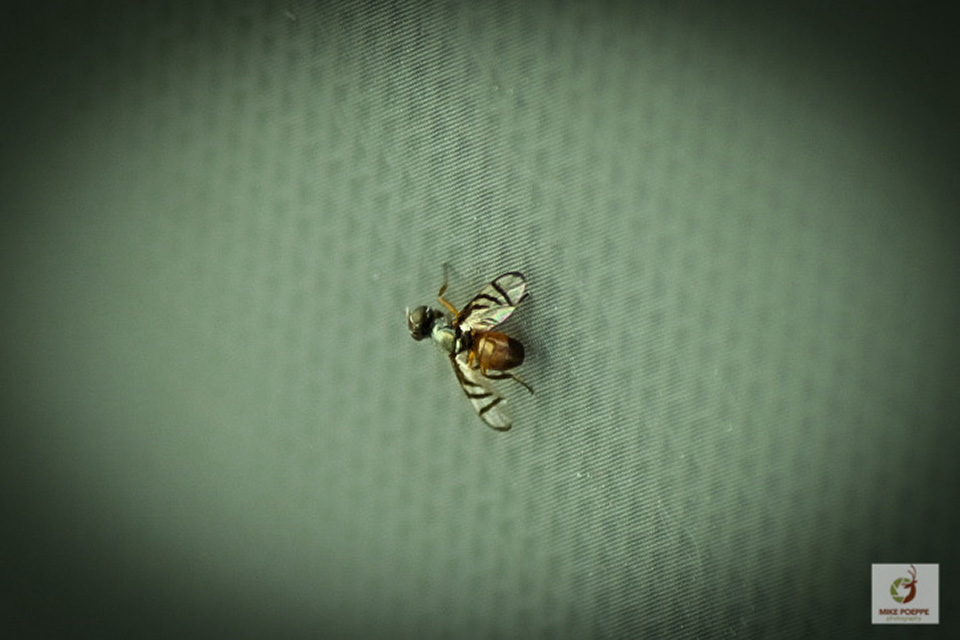
Location: Houston County, MN
Ann
6/30/2020
Location: Scandia, Minnesota
A Signal Fly was on the outside of one of our home's windows. We have never seen this type of fly before.
Alfredo Colon
August 2019
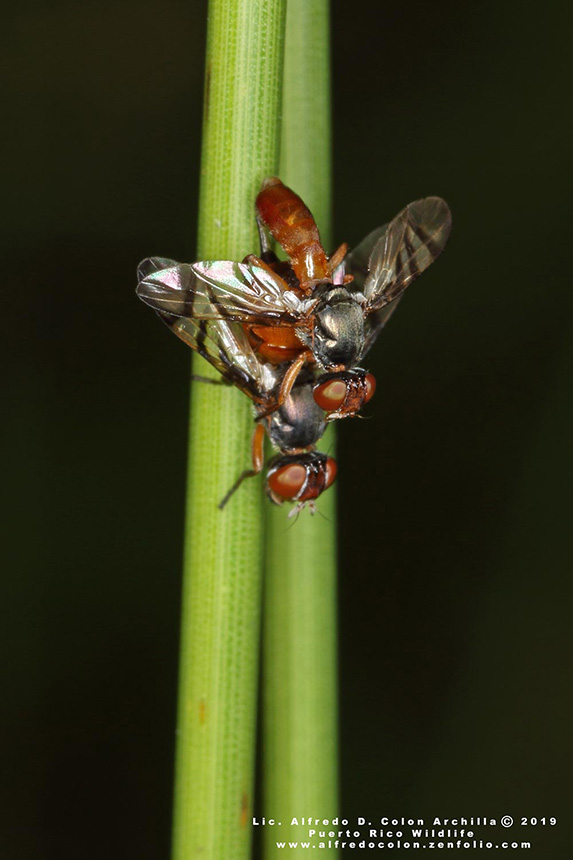
Location: Slinger, Wisconsin
Alfredo Colon
7/21/2018
Location: Woodbury, Minnesota
Minnesota Seasons Sightings