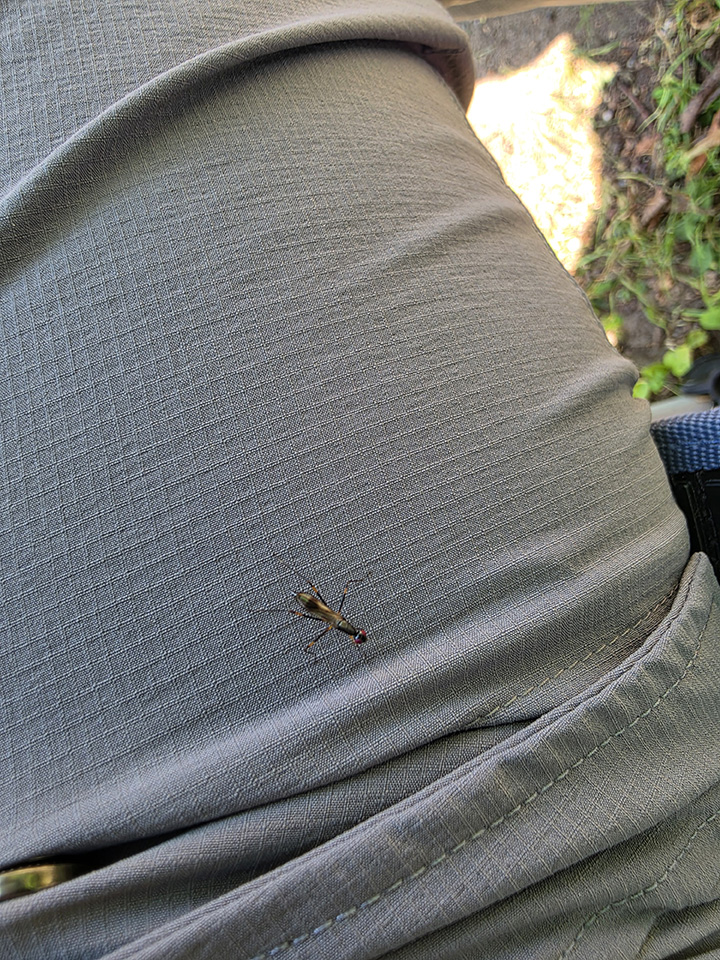
stilt-legged fly - Species Profile
Conservation • Description • Habitat • Ecology • Distribution • Taxonomy

Conservation Status
IUCN Red List
not listed
NatureServe
not listed
Minnesota
not listed
Description
Rainieria antennaepes is a relatively uncommon stilt-legged fly. It is a medium-sized fly but a large stilt fly. It is the only species in the genus Rainieria in North America. It occurs in the United States and southern Canada east of the Great Plains. Adults are found from early June to mid-August on foliage, on the bark of trees, or flying around in woodlands. Larvae are found in dung.
Adults are 5⁄16″ to ⅜″ (8 to 10 mm) in length. The body is long, slender, and entirely black except for the legs and antennae.
The head is round. The face is short. There are two large compound eyes and three small simple eyes (ocelli). The compound eyes are bright red and are not striped. They do not meet at the top of the head on either sex. The plate on the face (clypeus) is large, prominent, and broader than long. The antennae are short and yellow to brown. The second segment is almost as long as the third segment. It has long hairs (setae) on the lower margin. It does not have a longitudinal groove (suture) on the upper side. The third antennal segment is short and egg-shaped. It has a long, forward-pointing bristle (arista) on the upper side. The antennae bases are relatively close together. There are no stiff, whisker-like, sensory hairs (vibrissae) around the mouth.
The thorax is much longer than high.
The legs are long, stilt-like, and mostly pale. The front legs are shorter than the middle and hind legs. On the front legs there is a dark brown ring at the end of the third leg segment (femur). The last part of the leg (tarsus), corresponding to the foot, is usually entirely white, but sometimes the terminal segment is dark. On the femur of the middle and hind legs there is a broad dark brown ring beyond the middle and a narrow dark brown ring near the end. On the hind leg the base of the tarsus is sometimes white.
The wings are clear except for a large, triangular, faint but noticeable brown spot beyond the middle, and a small brown spot at the wingtip. The subcostal vein (Sc) is complete. The basal crossvein is present, making the discal and basal cells complete. The anal cell is short. The first posterior cell is open. The R5 cell is narrowed at the end.
Size
Total length: X¾″ to X¾″ (X to X mm)
Similar Species
Xxxxxxxxxxx
Habitat
Woodlands
Ecology
Season
Early June to mid-August (CCESR)
Behavior
Rainieria antennaepes is a mimic of a predatory ichneumonid wasp. It frequently holds it front legs up and forward, vibrating them, mimicking a wasp’s antennae.
Life Cycle
Larva Food/Hosts
Dung
Adult Food
Distribution

Sources
Biodiversity occurrence data published by: Minnesota Biodiversity Atlas (accessed through the Minnesota Biodiversity Atlas Portal, bellatlas.umn.edu. Accessed 7/17/2026).
Rainieria antennaepes (Say, 1823) in Bánki, O., Roskov, Y., Döring, M., Ower, G., Hernández Robles, D. R., Plata Corredor, C. A., Stjernegaard Jeppesen, T., Örn, A., Pape, T., Hobern, D., Garnett, S., Little, H., DeWalt, R. E., Miller, J., Orrell, T., Aalbu, R., Abbott, J., Abreu, C., Acero P, A., et al. (2026). Catalogue of Life (2026-06-19 XR). Catalogue of Life Foundation, Amsterdam, Netherlands. https://doi.org/10.48580/dgy8b
Cresson, E. T. (1938). The Neriidae and Micropezidae of America North of Mexico (Diptera). Transactions of the American Entomological Society (1890-), 64(4), 293–366. http://www.jstor.org/stable/25077421
Occurrence
Relatively uncommon
Taxonomy
Order
Suborder
Brachycera
Infraorder
Cyclorrhapha
Zoosection
Schizophora
Zoosubsection
Acalyptratae (Acalyptrate Flies)
Superfamily
Nerioidea
Family
Micropezidae (Stilt-legged Flies)
Subfamily
Taeniapterinae
Genus
Rainieria
Subordinate Taxa
Synonyms
Calobata antennaepes
Common Names
This species has no common name. The name of the family Micropezidae is stilt-legged flies, and it is applied here for convenience.