Striped deer fly
(Chrysops vittatus)
Conservation • Description • Habitat • Ecology • Distribution • Taxonomy

Conservation Status
IUCN Red List
not listed
NatureServe
NNR - Unranked
Minnesota
not listed
Description
Striped deer fly is a common, relatively small, deer fly. It occurs in the United States and southern Canada east of the Great Plains. It is especially common in the eastern U.S., where whitetail deer provide a plentiful food source. It is common, it is often abundant, and it is sometimes an annoying pest of humans in Minnesota. It can discourage visitors from visiting tourist areas. It has discouraged this visitor from entering the Boundary Waters Canoe Area Wilderness in early July, which is peak dear fly season.
Striped deer fly larvae are aquatic and predaceous, feeding on other insect larvae and on worms. Adults are active from June through August in Minnesota. They are found in open woodlands and wetlands, often near the margins of streams and ponds. Males feed on plant nectar. Females feed on the blood of mammals.
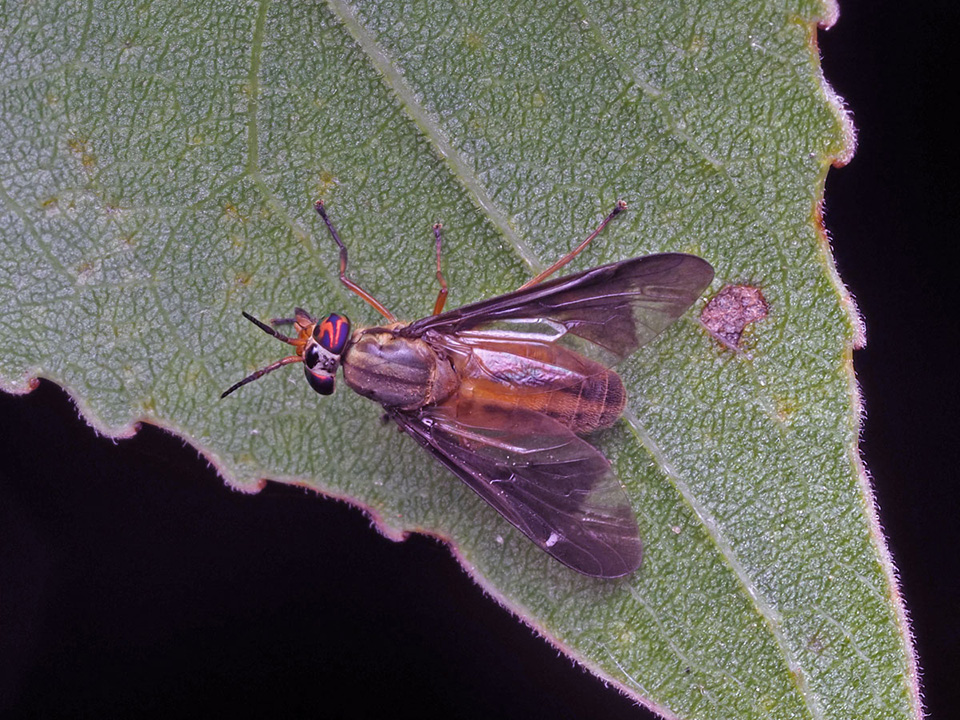
Males are relatively rare, and they are difficult to identify to the species level. Female adults are 5⁄16″ (7.5 to 8.3 mm) in length. The body is stout and reddish yellow with black markings. The wings have dark markings.
The head is broad, and it is covered with golden-yellow hairs. The compound eyes are bulging, iridescent, and brightly colored. On males they meet at the top of the head. On females they do not meet. There are three simple eyes (ocelli). The black area around the ocelli (ocellus spot) is broken up into three individual spots. Females have a large, bare, hardened area (frontal callus) on the front of the head between the compound eyes. The frontal callus is dull and reddish yellow with a dark upper margin. The antennae have three segments. The first segment (scape) is about 4 times longer than wide. The second segment (pedicel) is about two-thirds as long as the scape. Both segments are reddish yellow and are covered with short black hairs. The third segment (flagellum) is long, clearly ringed, and black, at least toward the tip. The large, bare, hardened area on the face (facial callus) and the small, bare, hardened area on each cheek (cheek callus) is reddish yellow. The mouthparts are modified for piercing flesh. The finger-like sensory mouthparts (palps) are reddish yellow.
The thorax is reddish yellow. On the upper side there ane three brown longitudinal stripes. On each side there is a brown stripe between the base of the wing ahd the shoulder (humeral) angle.
The abdomen is reddish yellow with 4 brown longitudinal stripes, 2 in the middle (middorsal stripes) and 1 on each side (lateral stripes). It has 7 segments (tergites). The first segment (T1) has two faint brown spots representing the middorsal stripes. On T2 the middorsal stripes are bold and the lateral stripes are faint or missing. On T3 through T5, all of the stripes are bold. T6 and T7 are black with a narrow yellow rear margin. The stripes on the thorax and abdomen are the features that give this species its common name.
The wings are clear with dark markings, including a dark leading edge (costa), a broad dark band in the middle (crossband) and a dark spot at the tip (apical band). The area between the crossband and the apical spot (hyaline triangle) is clear. Details of the extent and shape of these markings are important identifying features of species in the genus Chrysops. The dark markings are not broken by pale areas bordering the veins. The hyaline triangle is relatively large, extending beyond cell m1. The tip of the hyaline triangle reaches slightly beyond the fork of vein R4+5. The apical spot fills more than half of cell r4. It usually extends into cell r5 but does not completely fill the outer edge of it. Cell cu1a is mostly dark. More than three-quarters of cell br is dark.
Size
Total length: 5⁄16″ (7.5 to 8.3 mm)
Similar Species
Habitat
Open woodlands, wetlands, the margins of streams and ponds
Ecology
Season
June through August
Behavior
Life Cycle
Larvae are aquatic.
Larva Food/Hosts
Other insect larvae and worms
Adult Food
Males feed on plant nectar. Females feed on the blood on mammals.
Distribution

Sources
Biodiversity occurrence data published by: Minnesota Biodiversity Atlas (accessed through the Minnesota Biodiversity Atlas Portal, bellatlas.umn.edu. Accessed 10/18/2026).
Chrysops (Chrysops) vittatus Wiedemann, 1821 in Bánki, O., Roskov, Y., Döring, M., Ower, G., Hernández Robles, D. R., Plata Corredor, C. A., Stjernegaard Jeppesen, T., Örn, A., Pape, T., Hobern, D., Garnett, S., Little, H., DeWalt, R. E., Miller, J., Orrell, T., Aalbu, R., Abbott, J., Abreu, C., Acero P, A., et al. (2026). Catalogue of Life (2026-08-26 XR). Catalogue of Life Foundation, Amsterdam, Netherlands. https://doi.org/10.48580/dgyy9
Occurrence
Common and often abundant
Taxonomy
Order
Suborder
Brachycera
Infraorder
Orthorrhapha
Parvorder
Tabanomorpha (Snipe Flies and Allies)
Superfamily
Tabanoidea
Family
Tabanidae (Horse and Deer Flies)
Subfamily
Chrysopsinae (Deer Flies)
Tribe
Chrysopsini
Genus
Chrysops (Deer Flies)
Subordinate Taxa
Synonyms
Chrysops areolatus
Chrysops lineatus
Chrysops ornatus
Common Names
striped deer fly
Visitor Photos
This button not working for you?
Simply email us at info@MinnesotaSeasons.com.
Attach one or more photos and, if you like, a caption.
Minnesota Seasons Photos
Slideshows
Visitor Videos
This button not working for you?
Simply email us at info@MinnesotaSeasons.com.
Attach a video, a YouTube link, or a cloud storage link.
Other Videos
Striped Deer Fly
Cayman Mickler
Visitor Sightings
This button not working for you?
Simply email us at info@MinnesotaSeasons.com.
Be sure to include a location.
Alfredo Colon
6/30/2026

Location: Albany, NY
Alfredo Colon
6/18/2024
Location: Albany, NY
Minnesota Seasons Sightings