western conifer seed bug - Species Profile
Conservation • Description • Habitat • Ecology • Distribution • Taxonomy

Conservation Status
IUCN Red List
not listed
NatureServe
not listed
Minnesota
not listed
Description
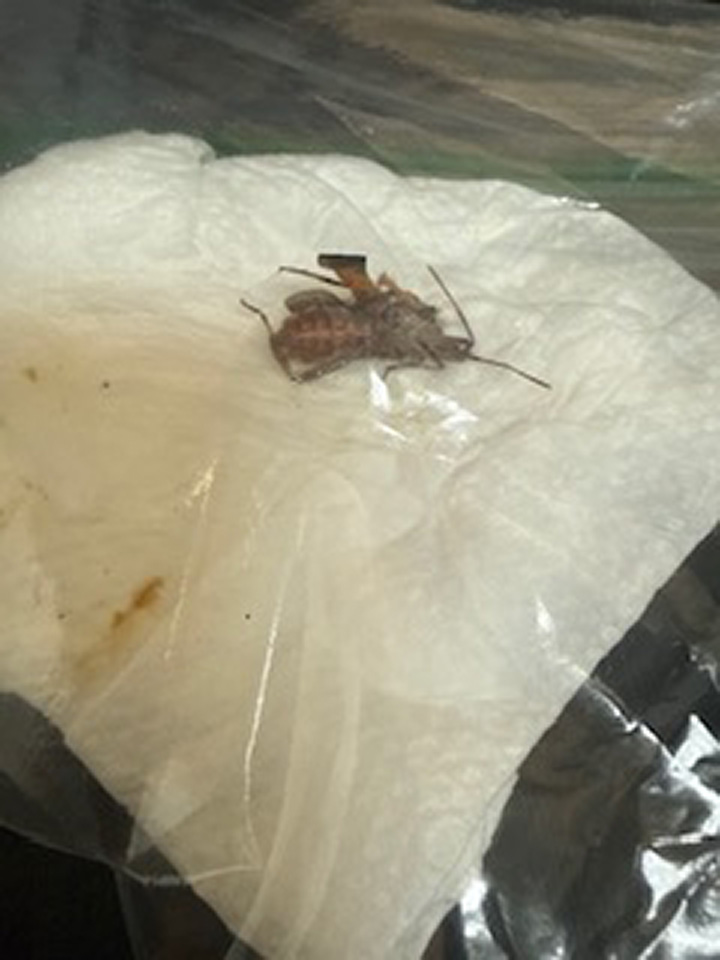
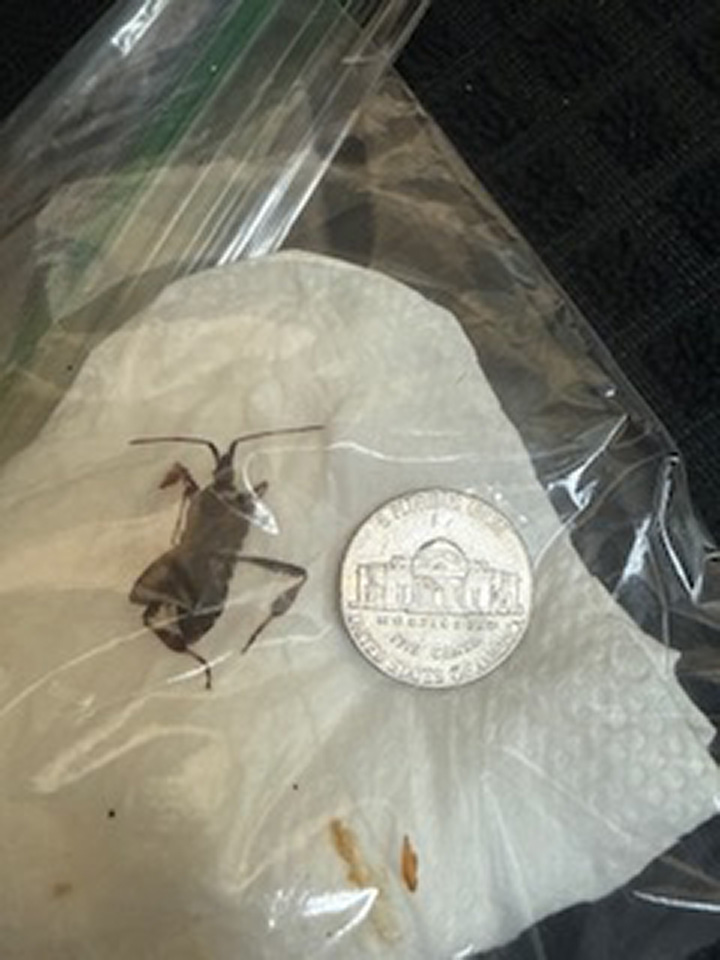
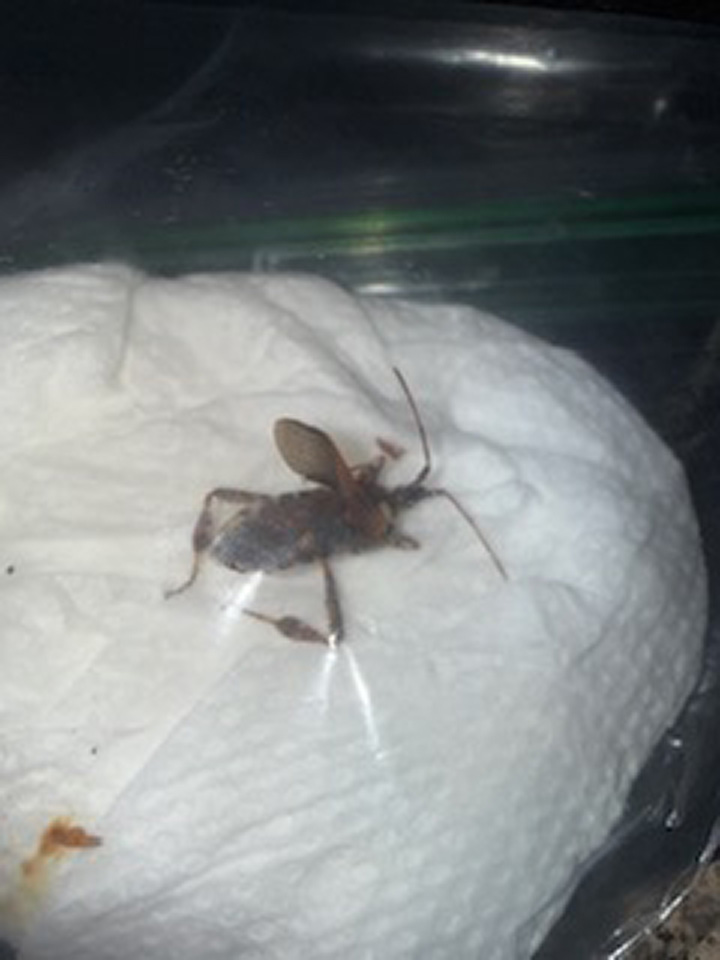
Western conifer seed bug is a common and widespread, terrestrial, leaf-footed bug. It is most often encountered in the fall, when it seeks shelter for the winter.
Adults are ⅝″ to ¾″ in length.
The front (anterior) thoracic shield (pronotum) is covered with long, erect hairs.
The upper (dorsal) side of the abdomen is mostly hidden by the wings and is rarely visible except in flight. It is orangish-yellow with black markings, including two narrow, elongated, lance-shaped longitudinal marks in the center; and five broad, horizontal patches on each side.
There are two pairs of wings, and they are held flat over the body when at rest. Between and at the wing bases there is a triangular plate (scutellum). The forewings (hemelytra) on the mature adult are longer than the abdomen but do not completely cover the sides of the abdomen. The sides of the abdomen are exposed and appear conspicuously striped when the wings are closed. The hemelytra have a thickened section at the base and a thin membranous section at the tip with a clear dividing line between the two. The thickened basal part is comprised of a narrow area (clavus) behind the scutellum when the wings are closed, and the remaining broad marginal area (corium). There is a yellowish-white, horizontal, zig-zagged line on the corium that is narrow and confined to the veins. At the end of the corium there is a small but distinct triangular area (cuneus). The hindwings are thin, membranous, and concealed under the forewings.
The head is small, much narrower and somewhat shorter than the pronotum. At the front of the head there is a rounded lobe that projects forward. There is a pair of large compound eyes and a pair of small simple eyes (occelli). The mouth parts are optimized for piercing and sucking. They take the form of a long, 4-segmented beak that extends along the underside of the body between the legs. It consists of 4 hair-like blades (stylets) with sharp tips enclosed in a 4-segmented sheath. There are two channels in the beak, one spitting out saliva to keep the food flowing, and one for sucking in liquid food. The two lower jaw-like structures (maxillae) and two lower lips do not have feeler-like structures (palpi) attached. The antennae are exposed, conspicuous, and long, much longer than the head. They have four segments. The first segment is chestnut orange with a black longitudinal stripe.
The third segment (femur) of the hind leg is is stout and spurred below. The fourth segment (tibia) is greatly dilated. The dilations are nearly equal in length and are less than 70% of the length of the tibia. They are lance-shaped and are not scalloped. The outer dilation is slightly wider than the inner. The feet (tarsi) have only 3 segments.
Size
Total length: ⅝″ to ¾″
Similar Species
Habitat
Ecology
Season
One generation per year: Late May to the onset of cold weather in the fall
Behavior
When in flight the wings create a loud buzz. Unlike similar-looking assassin bugs, they do not bite. When handled they squirt a foul-smelling chemical from glands on the sides of their bodies that is an effective deterrent. As the weather turns cold in the fall they often bask in the sun on the south side of human dwellings.
Life Cycle
Adults emerge in late May or early June. The female lays rows of 1 ⁄16″ long eggs on needles of host species. The eggs hatch in about 10 days. The young (nymphs) pass through 5 instar stages before becoming an adult. Adults overwinter.
Nymph Food
Developing seeds and early flowers of host species
Adult Food
Sap from green cones and twigs of pine, hemlock, spruce, and fir.
Distribution

Sources
Leptoglossus occidentalis Heidemann, 1910 in Bánki, O., Roskov, Y., Döring, M., Ower, G., Hernández Robles, D. R., Plata Corredor, C. A., Stjernegaard Jeppesen, T., Örn, A., Pape, T., Hobern, D., Garnett, S., Little, H., DeWalt, R. E., Miller, J., Orrell, T., Aalbu, R., Abbott, J., Abreu, C., Acero P, A., et al. (2026). Catalogue of Life (2026-07-17 XR). Catalogue of Life Foundation, Amsterdam, Netherlands. https://doi.org/10.48580/dgykv
Occurrence
Common and widespread
Taxonomy
Order
Hemiptera (True Bugs, Hoppers, Aphids, and Allies)
Suborder
Heteroptera (True Bugs)
Infraorder
Pentatomomorpha
Superfamily
Coreoidea (Leaf-footed Bugs and Allies)
Family
Coreidae (Leaf-footed Bugs)
Subfamily
Coreinae
Tribe
Anisoscelini
Genus
Leptoglossus
Subordinate Taxa
Synonyms
Narnia anaticula
Theognis occidentalis
Common Names
pine seed bug
western conifer seed bug
western conifer-seed bug
WCSB