white-marked tussock moth - Species Profile
Conservation • Description • Habitat • Ecology • Distribution • Taxonomy

Hodges #
8316
Conservation Status
IUCN Red List
not listed
NatureServe
N5 - Secure
Minnesota
not listed
Description
White-marked tussock moth is a small, short-lived, late-season moth. It is common in the United States east of the Great Plains and in adjacent Canadian provinces. Sightings in the west and in Mexico are few and scattered. Adults emerge in late August to early October. They are ⅝″ to ⅞″ (15 to 22 mm) long with a wingspan of 1″ to 1⅜″ (25 to 35 mm). They have vestigial mouthparts and do not feed. They live just a few weeks and are gone by mid-October.
The female is grayish-white to light brown and ½″ to 9 ⁄16″ long (12 to 14 mm). It does not have wings.
The forewing of the male is dark grayish-brown with a thin, sharply defined, dark line that separates the basal and median areas (antemedial or AM line) and another that separates the median and post-medial areas (postmedial or PM line). These lines are often edged with wide brown bands. There is a bold white crescent on the subterminal line near the inner margin. The hindwing is dark brown. The antennae are plumose and conspicuous.
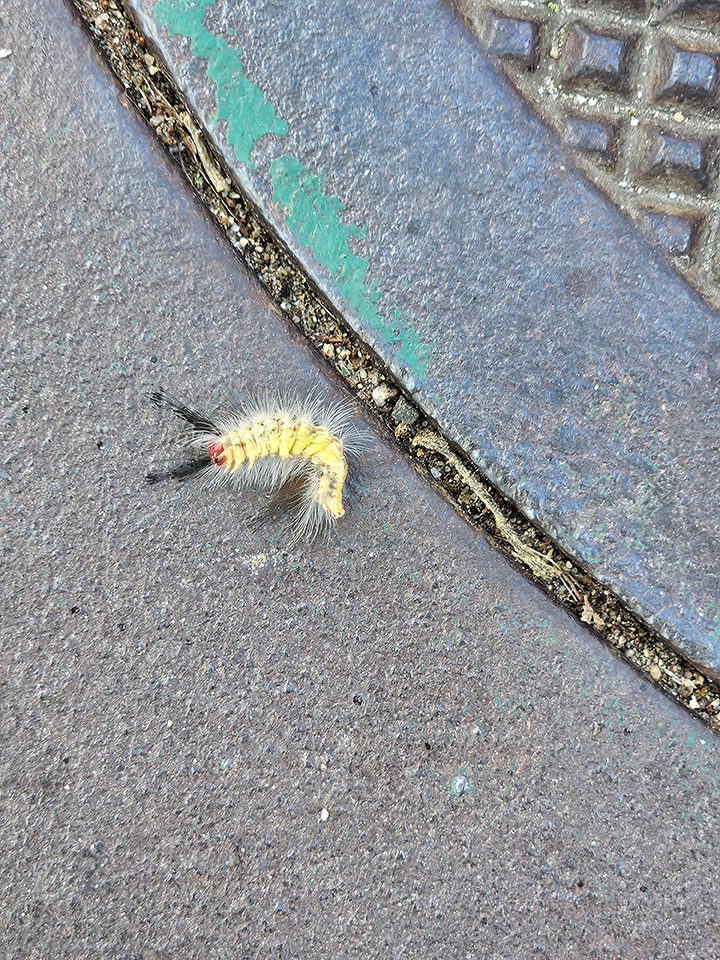
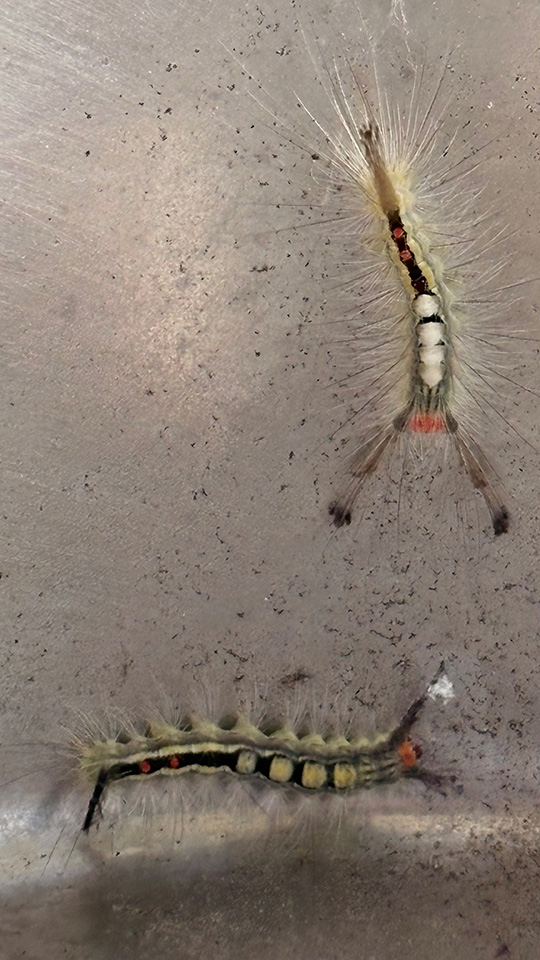
The caterpillar is distinctively marked and easy to recognize. The head is bright red. The abdomen has a broad black stripe in the middle (middorsal) flanked a broad bright yellow stripe on each side (subdorsal). There is a tuft of erect, white, gray, or yellowish hairs on each of the first through fourth abdominal segments (A1–A4). Segments A6 and A7 each have a small, bright red gland on top. Mature caterpillars are about 1⅜″ (35 mm) long.
Size
Total length: ⅝″ to ⅞″ (15 to 22 mm)
Wingspan (male): 1″ to 1⅜″ (25 to 35 mm)
Similar Species
Fields, woodlands, and forests
Habitat
Fields, woodlands, and forests
Ecology
Season
One generation in the north: Late August to early October
Behavior
Caterpillars disperse by ballooning. The spin a long thread of silk and let go of the plant they are on, letting the wind or breeze carry them to a new location. Most do not survive the process, succumbing to predators or to starvation when they land on a site that is inhospitable. Early stage (instar) larvae eat soft leaf tissue. Later stage caterpillars eat everything on the leaf but the main veins.
Caterpillars have two bright red glands on the abdomen and have been observed drawing their long hairs (setae) over the glands. The glands may produce a poison to deter predators. Whether that is true or not, it is known that contact with the setae to sensitive skin, as on a person’s back, stomach, or inner arm, can cause an allergic reaction.
Life Cycle
Mating occurs on the top of the empty cocoon from which the female emerged. She lays a mass of up to 300 eggs right there, usually on the cocoon, covers them with froth, and soon dies. The eggs overwinter and hatch in the spring.
Larva Food/Hosts
Leaves of deciduous and coniferous trees and shrubs
Adult Food
Adults do not feed
Distribution

Sources
7, 21, 24, 27, 30, 75, 82, 83.
Biodiversity occurrence data published by: Minnesota Biodiversity Atlas (accessed through the Minnesota Biodiversity Atlas Portal, bellatlas.umn.edu. Accessed 8/1/2022).
Orgyia leucostigma J.E.Smith, 1797 in GBIF Secretariat (2023). GBIF Backbone Taxonomy. Checklist dataset https://doi.org/10.15468/39omei accessed via GBIF.org. Accessed 8/1/2022.
Quinn, Edward. M., and Ron Danielson. April 27, 2009. A Survey of Lepidoptera in Three Priority Areas of the Minnesota State Parks System. https://files.dnr.state.mn.us/eco/nongame/projects/consgrant_reports/2009
/2009_quinn_danielson.pdf.
Occurrence
Very common
Taxonomy
Order
Lepidoptera (Butterflies and Moths)
Superfamily
Noctuoidea (Owlet Moths and Allies)
Family
Erebidae (Underwing, Tiger, Tussock, and Allied Moths)
Subfamily
Lymantriinae (Tussock Moths)
Tribe
Orgyiini
Genus
Orgyia
Subordinate Taxa
white-marked tussock moth (Orgyia leucostigma intermedia) 
white-marked tussock moth (Orgyia leucostigma leucostigma)
white-marked tussock moth (Orgyia leucostigma oslari)
white-marked tussock moth (Orgyia leucostigma plagiata)
white-marked tussock moth (Orgyia leucostigma sablensis)
Synonyms
Hemerocampa leucostigma
Orgyia obliviosa
Common Names
white-marked tussock moth